Global drill library
Warmup
5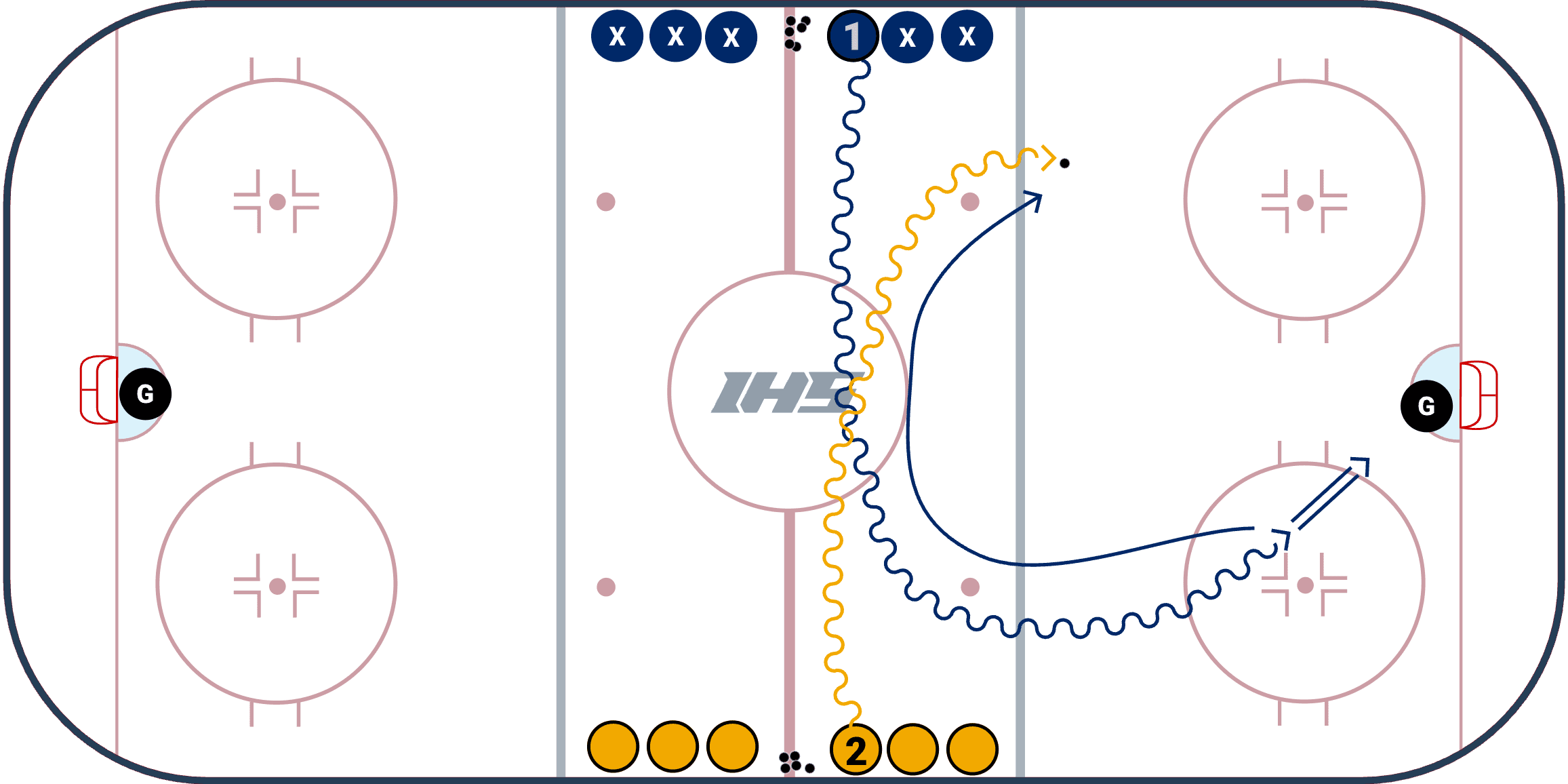
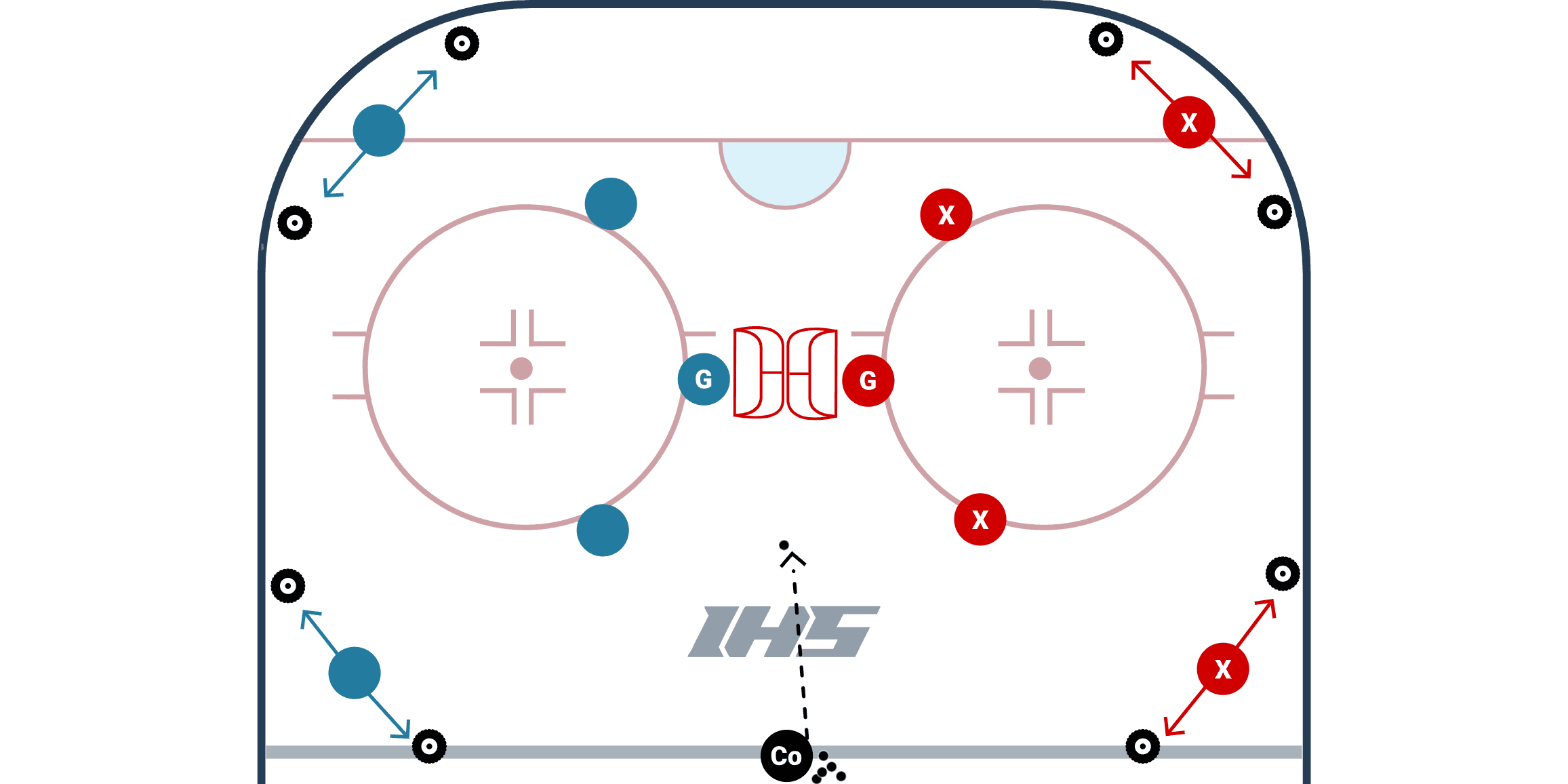
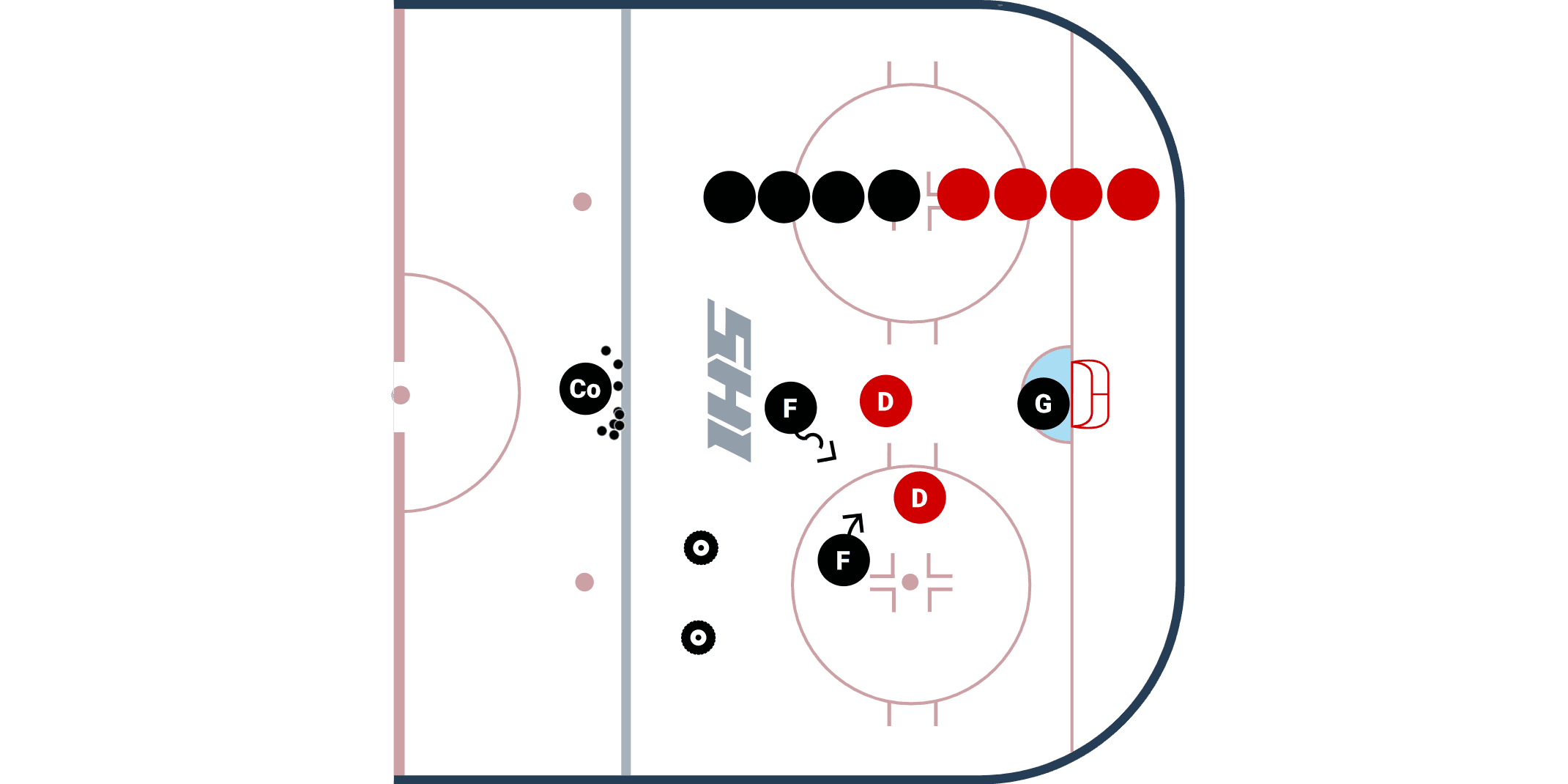
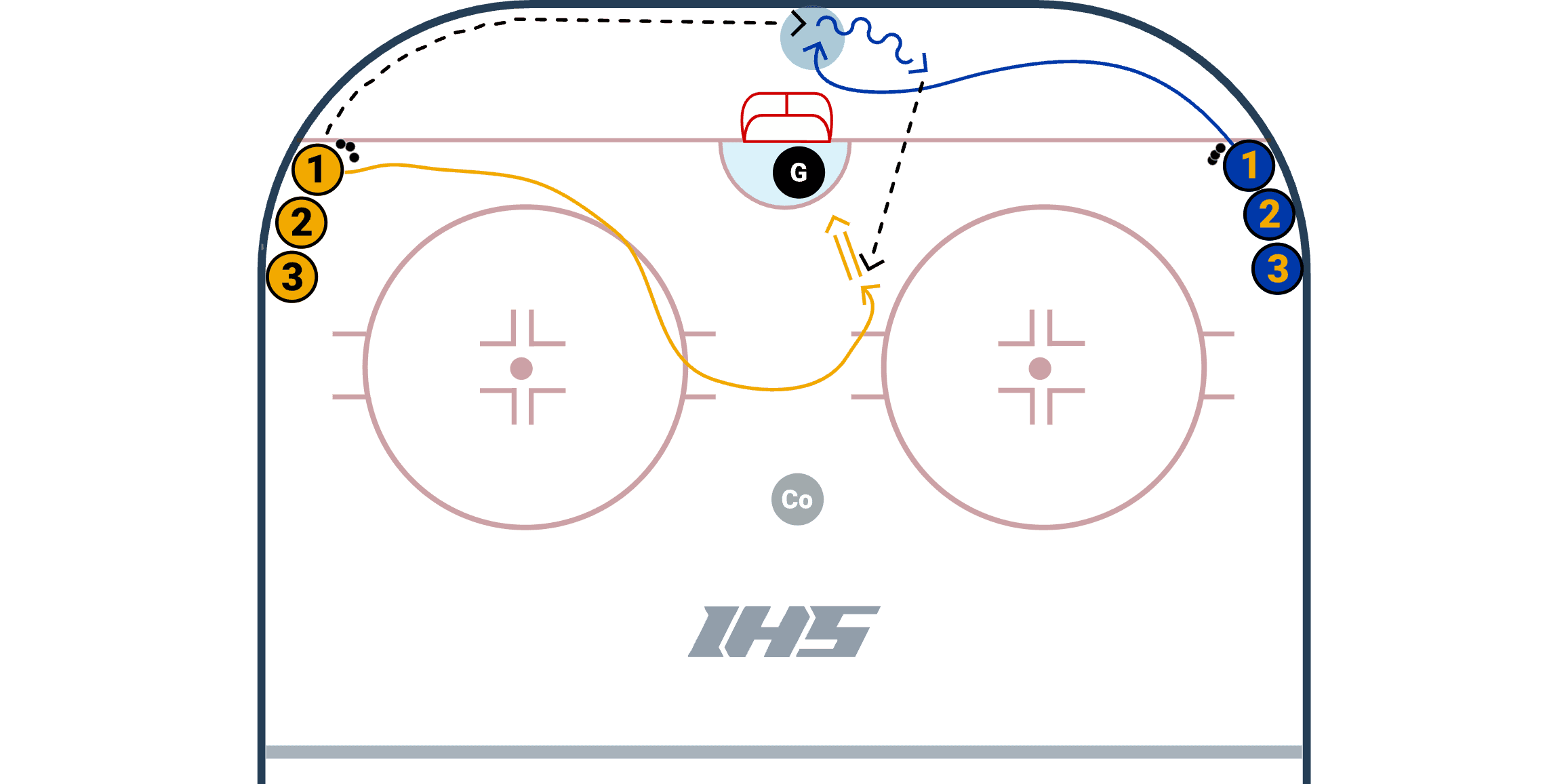
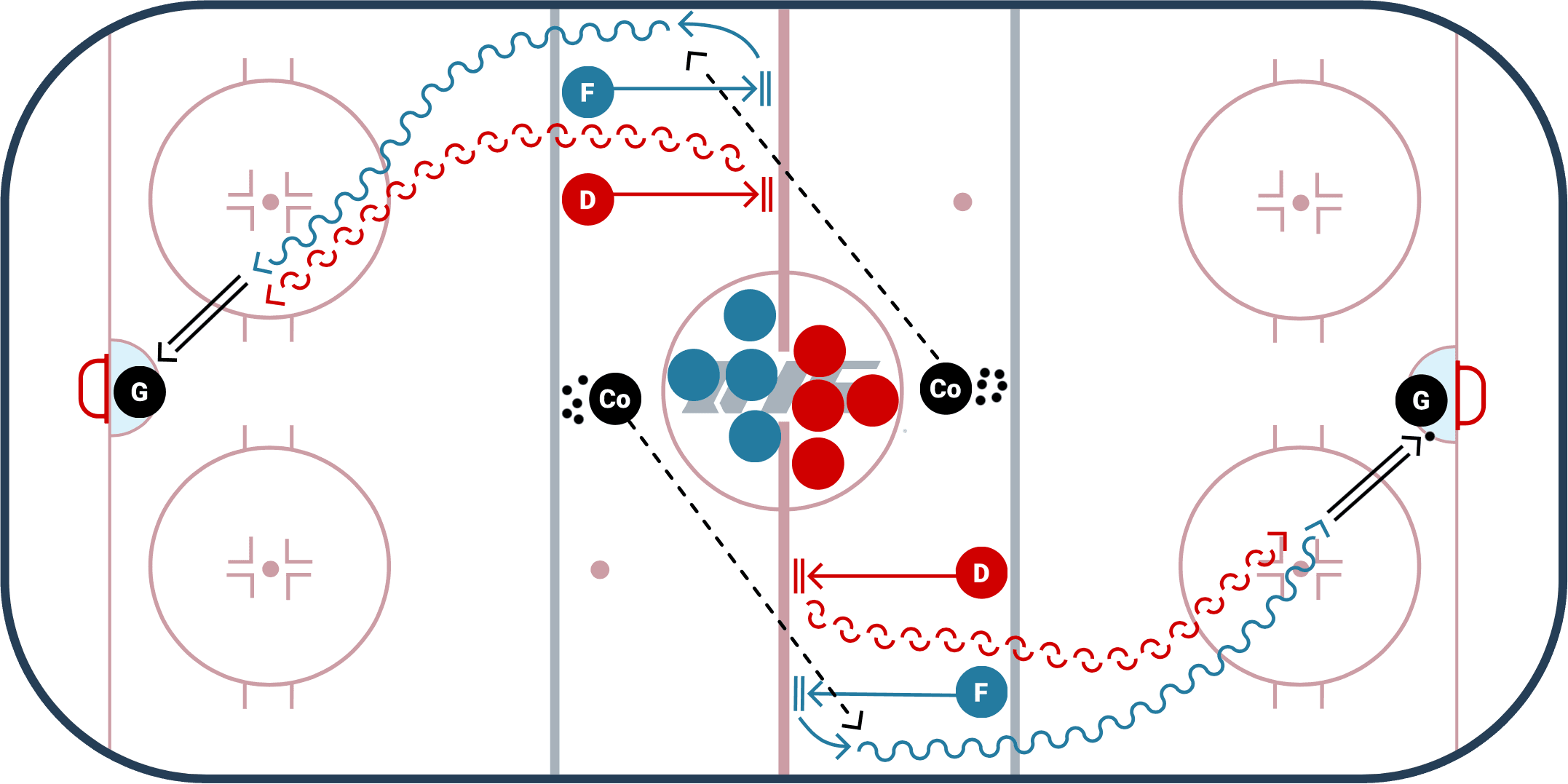
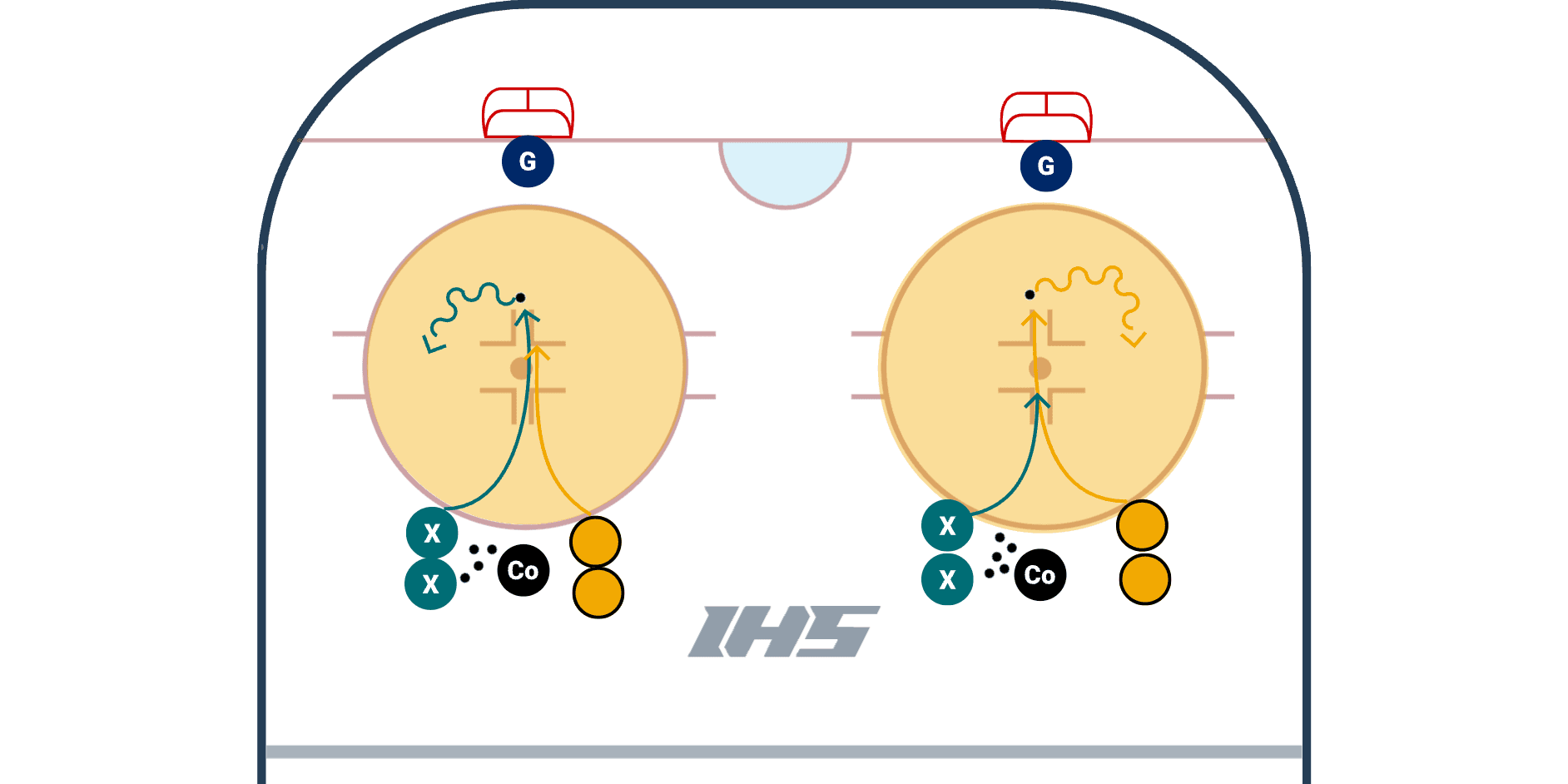
The Angle Shooter drill from Jim Midgley focuses on developing angling habits and defensive pressure immediately after a player takes a shot. Players attack across the ice to take a shot on net, then quickly transition into a defensive role where they angle the next puck carrier to the outside. This drill reinforces strong skating habits, smart stick positioning, and controlling the opponent’s lane to reduce quality scoring chances. Setup - Divide players into two groups (two colors) on each side of the ice. - Run the drill simultaneously on both sides of the rink. - Use the offside dots as a skating guideline when players attack across the ice. - The drill is whistle-controlled by the coach. How It Works - On the whistle, the first player (#1 ) carries the puck across the ice using the offside dots as a guide and takes a shot on net. - After the shot, the coach blows the whistle again. - The shooter immediately stops, turns, and becomes the angler. - At the same time, a player from the opposite line (# 2) carries a puck across the ice toward the net to take a shot. - The original shooter angles the puck carrier, forcing them to the outside and disrupting the shot. Key Concepts - Angling fundamentals - Offense to defense transition - Stick positioning and puck pressure - Forcing attackers to low-percentage areas - Defensive skating habits
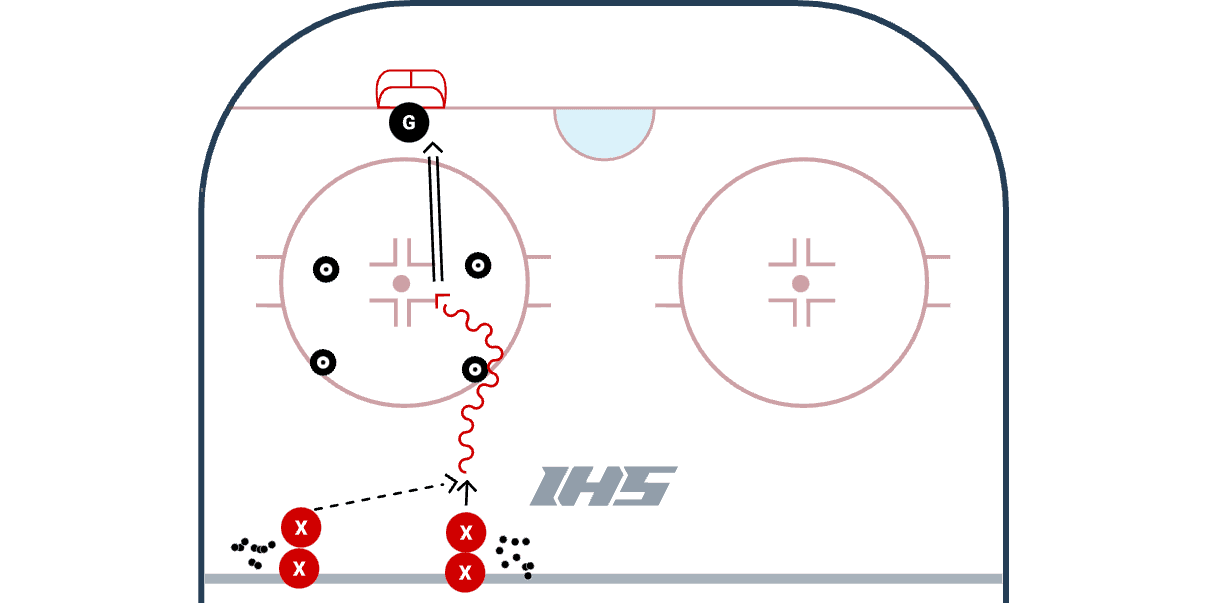
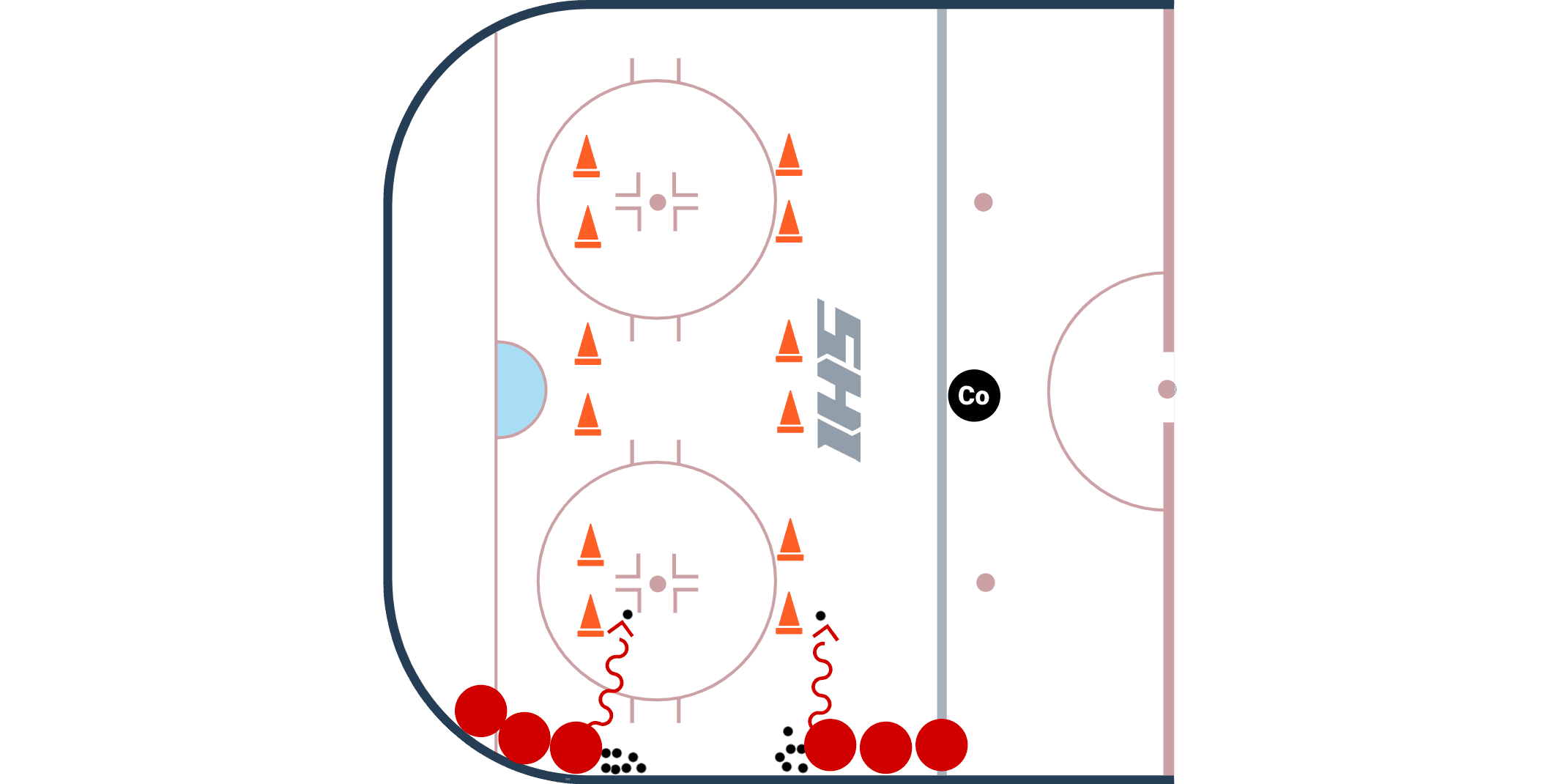
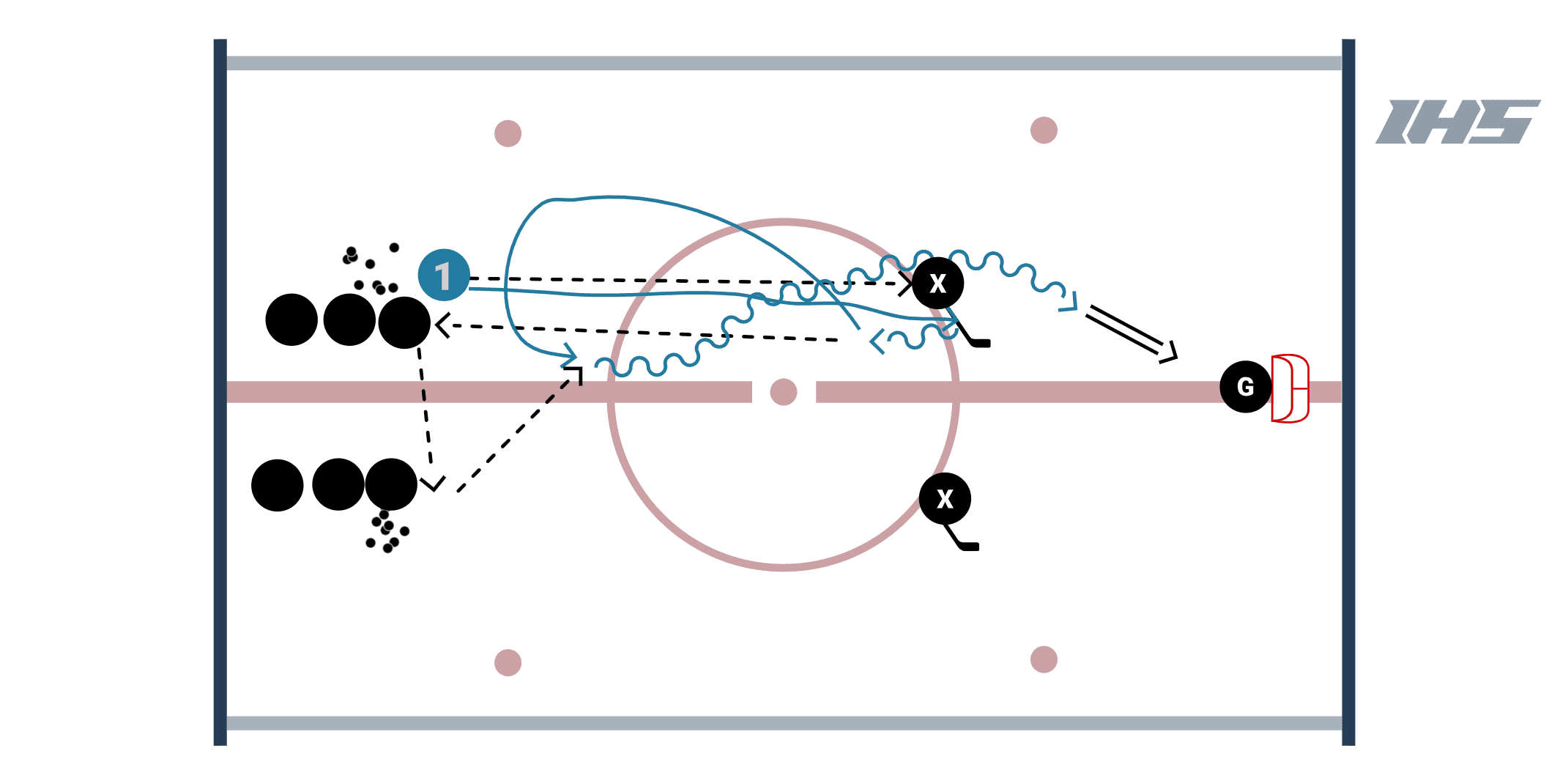
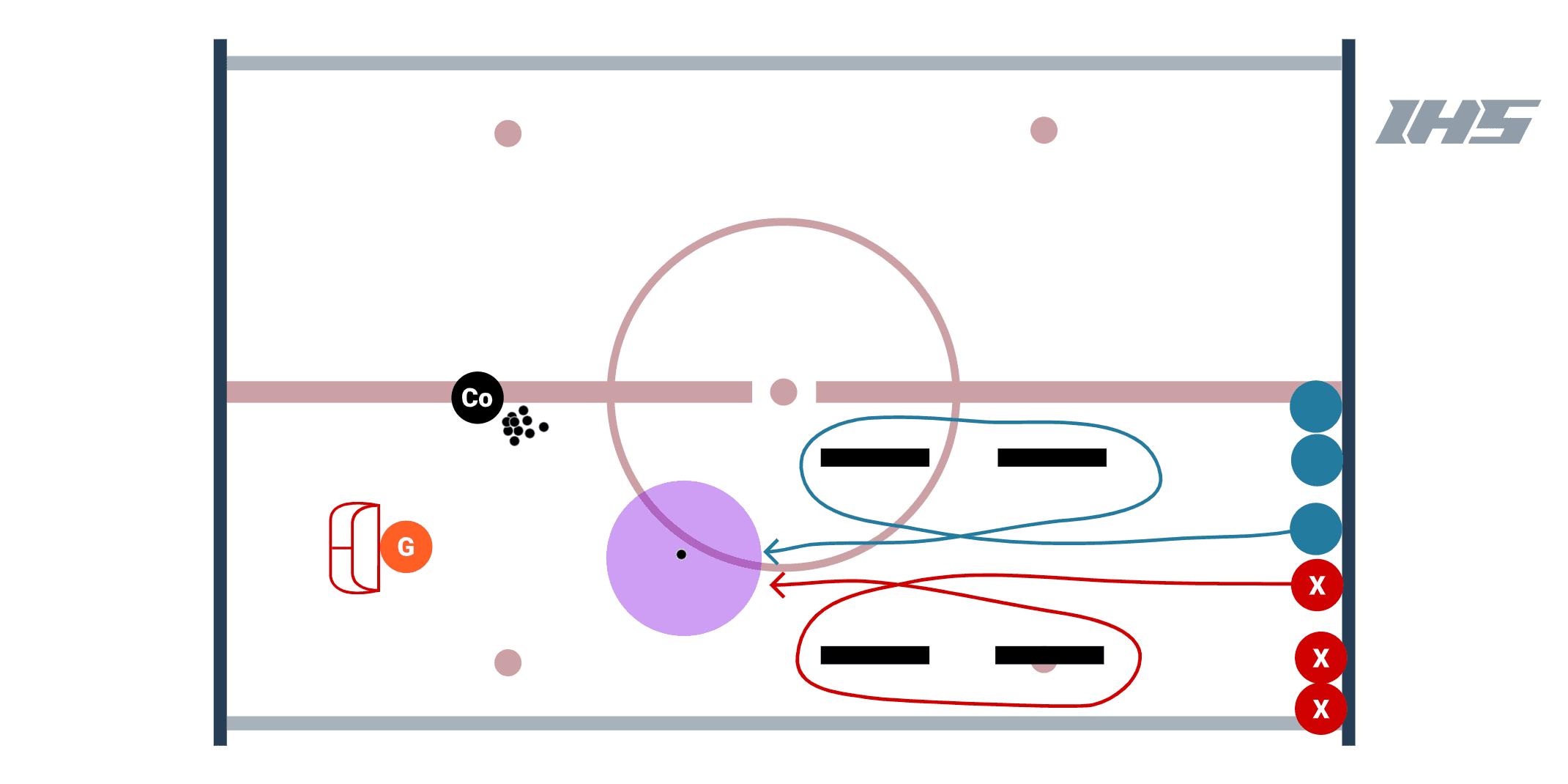
This is a simple but effective drill that works on quick releases in stride. Setup - 2 Lines of players - 4 Tires set pp in a rectangle in line with the players - Player accepts a pass from the other line - Player with puck attacks the first cone - Player pulls the puck inside the next cone and shoots in stride
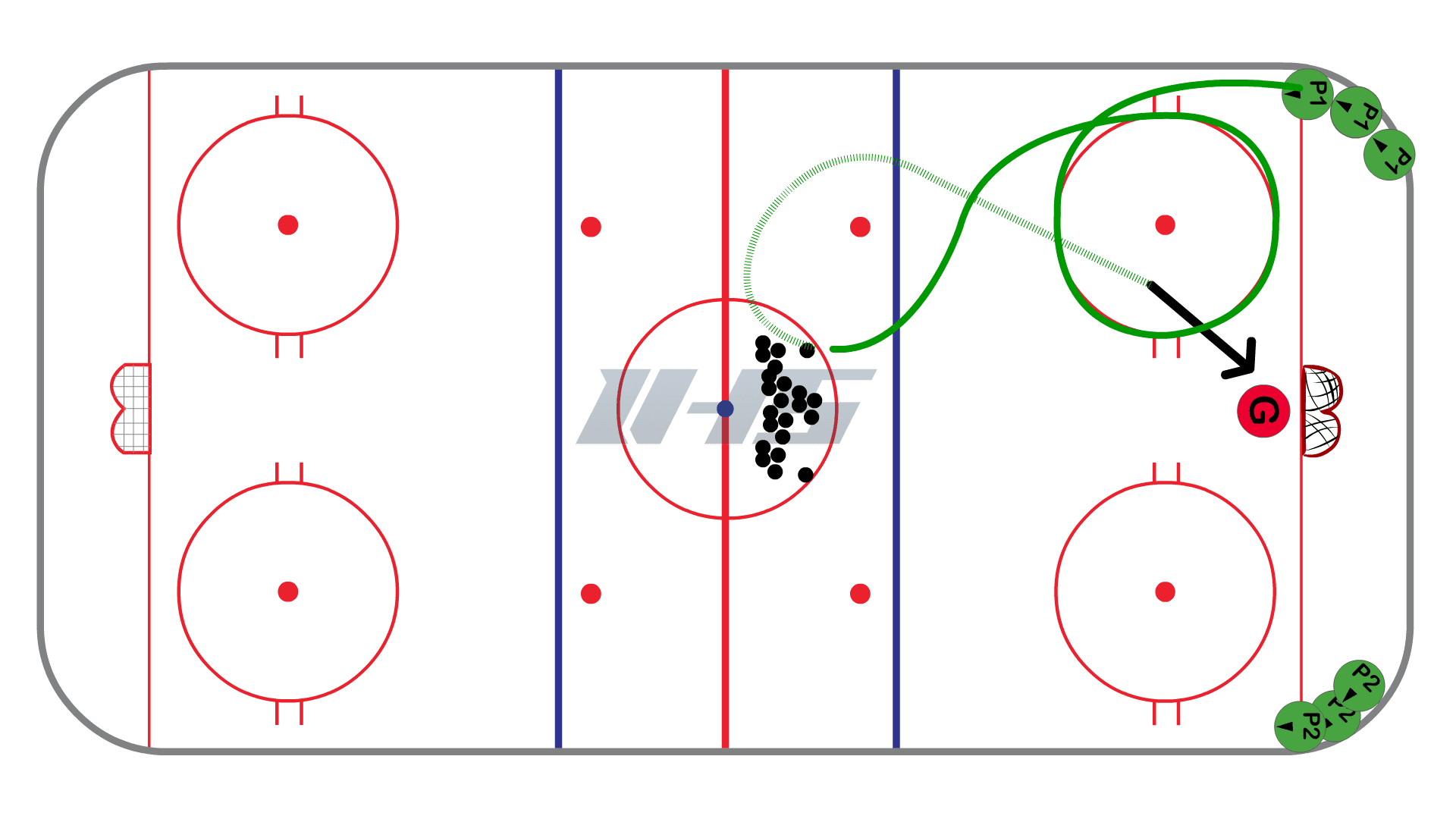
In this half ice drill the players will work on cross-overs in both directions, retrieving a puck,and taking a shot on net. The only set up required is to place all the pucks at center ice and scatter the around so they can be retreived.
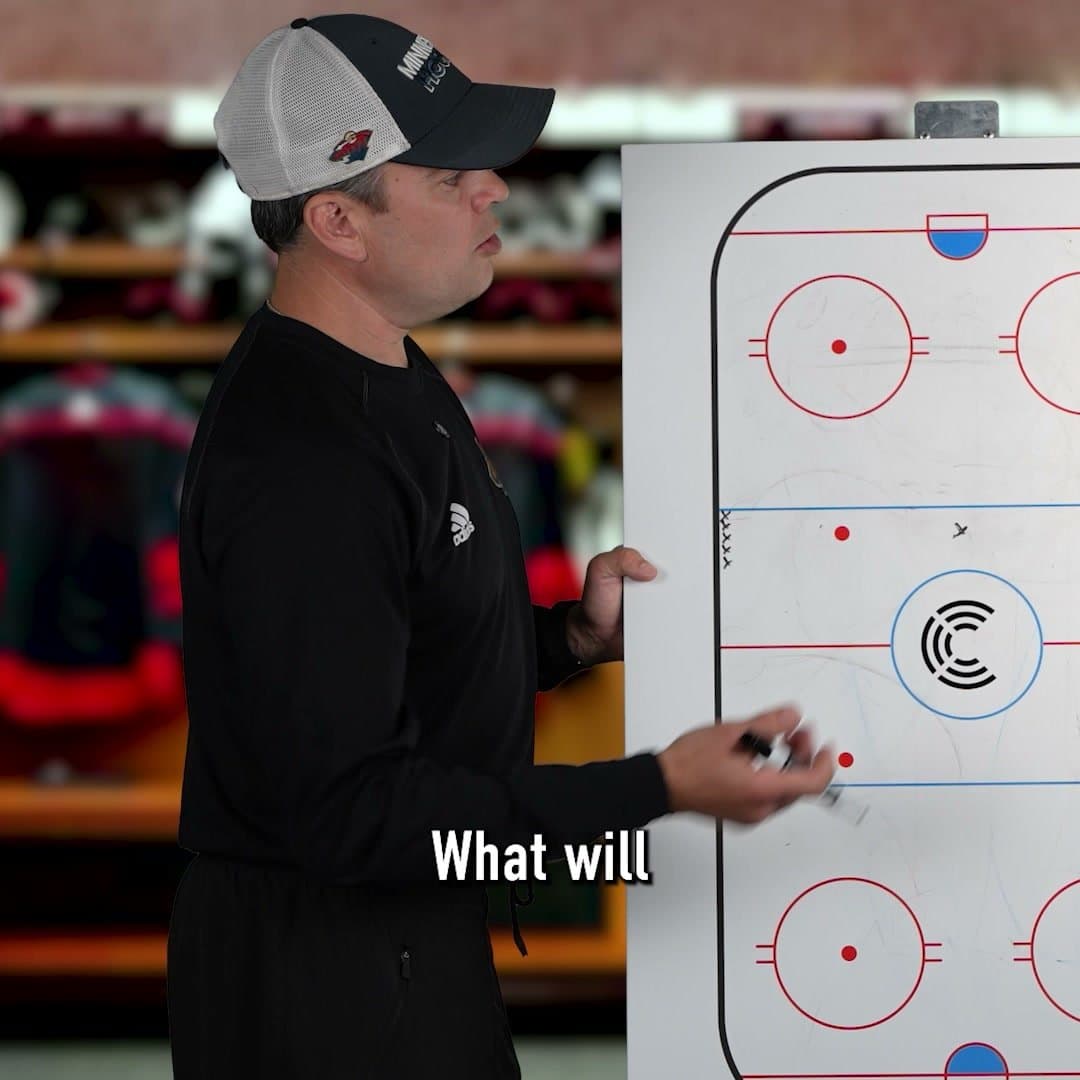
Warm-up drill focused on wall work, from Minnesota Wild skating and skills coach Andy Ness. A skill that gets too little attention at the younger age groups.
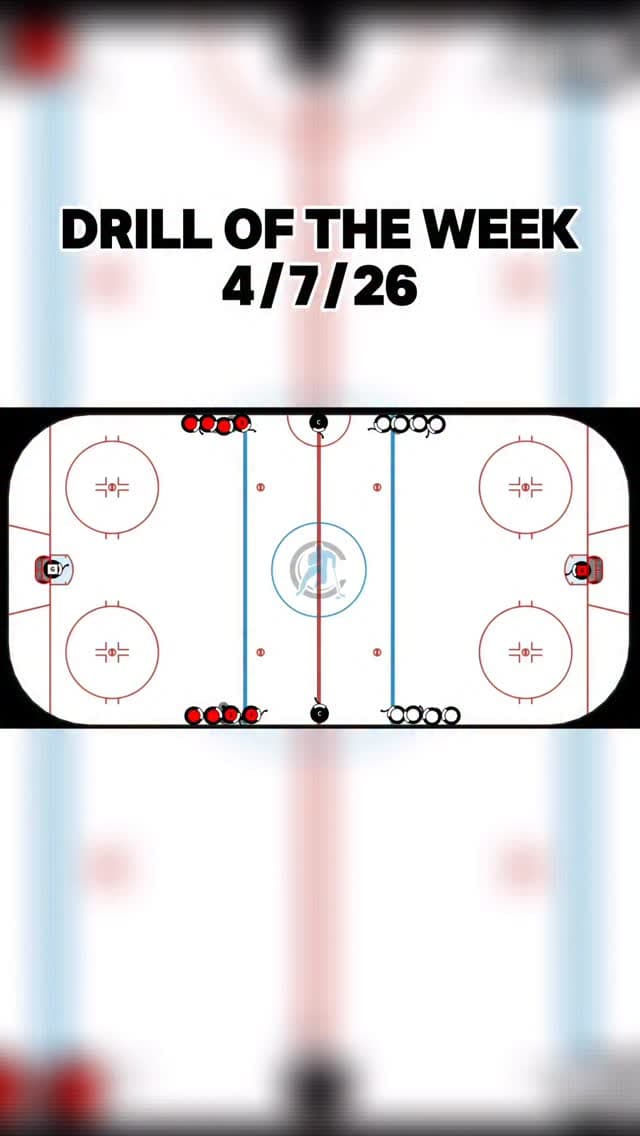
Warm-up drill designed to get plenty of puck touches early in practice.
Defensive Zone
2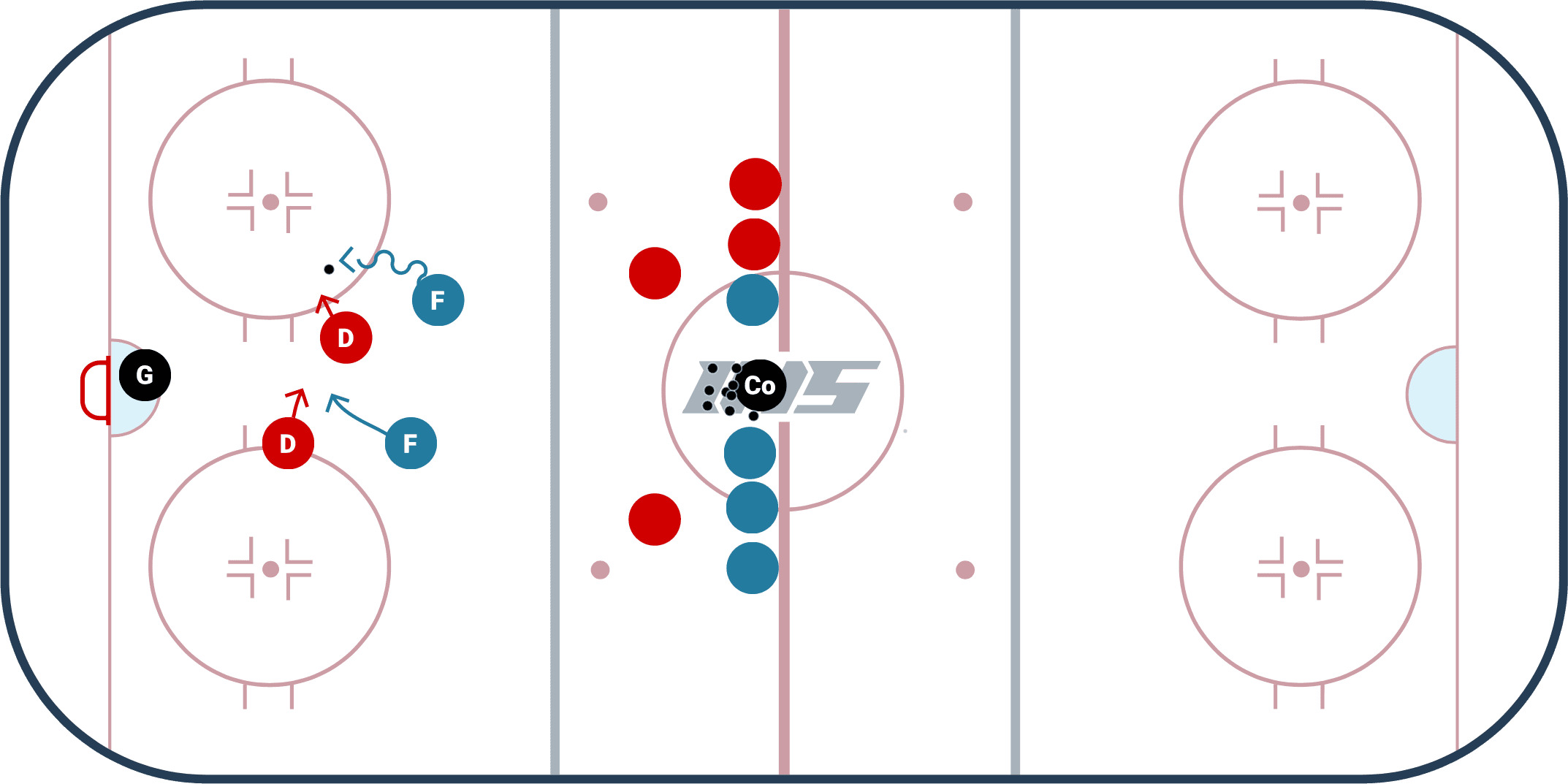
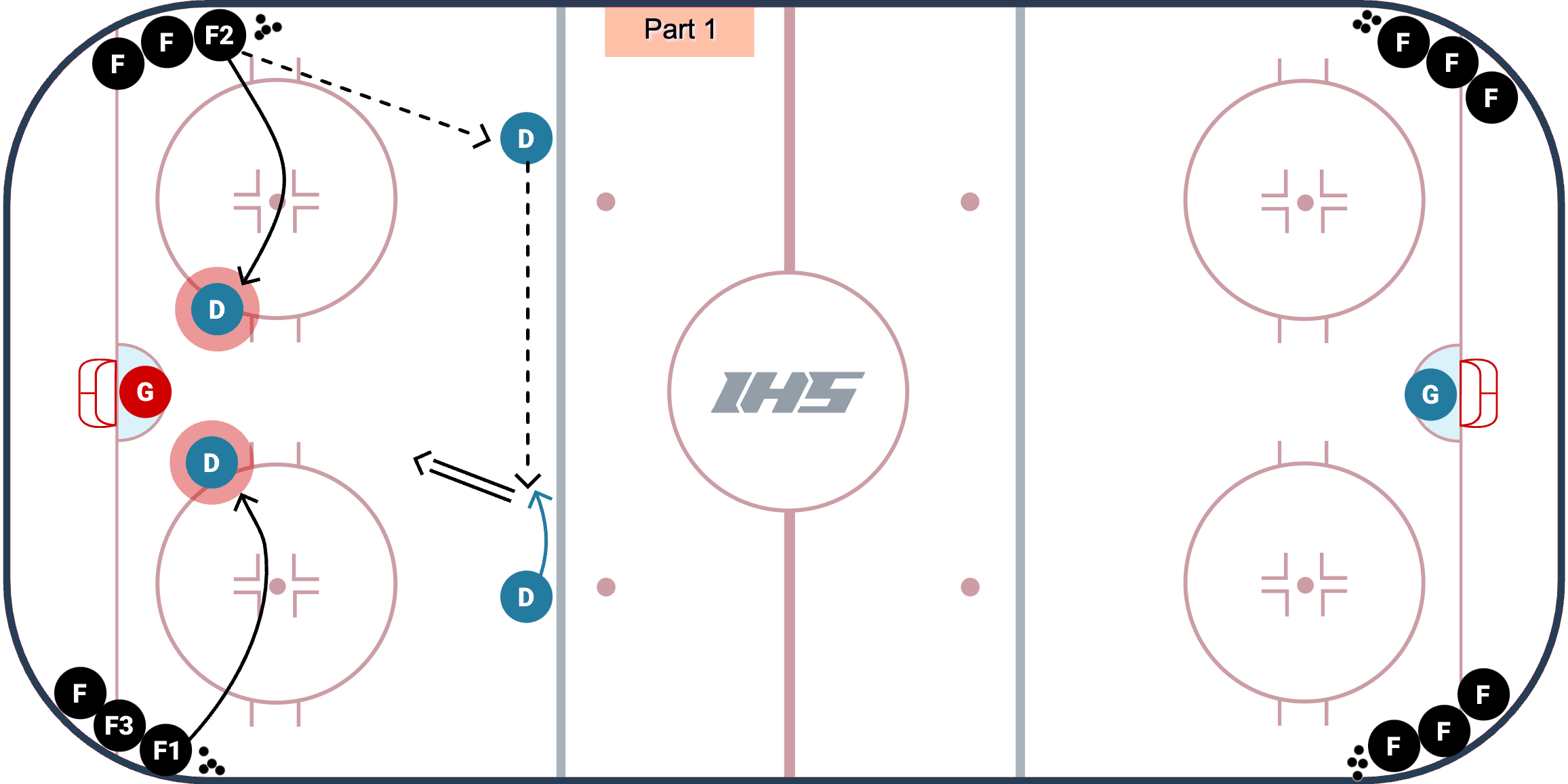
A continuous 2 vs. 2 small area hockey game that puts the defenders at a disadvantage since they will be double shifting. The defense will be tired so it is extra important that they communicate with each other, focus on good positioning and habits. Setup: - 2 defenders start at the blue line and 2 forwards start in the center ice circle. - Game starts with the coach passing the puck to one of the 2 forwards (this begins the 2 vs. 2). - Forwards try to keep possession of the puck and score. - The defenders try to defend and can end the game by skating the puck out of the zone or passing the puck to the forwards that are next in line. - If a goal is scored, or the goalie freezes the puck, or the puck goes out of play, the coach has the option to chip another puck in the zone, or pass to the next forwards in line. - When the shift ends (either with a goal, the defense getting the puck out of the zone, or a coach's whistle), the forwards switch to defense and the new forwards start the 2 vs. 2. - Keep Score: 3 points for a goal, 2 points for the defense skating the puck out of the zone, 1 point for the defense passing the puck out of the zone, and 0 points if the coach blows the whistle and changes lines. Variations: - Can be set up on 1/4 ice (view animation here). - Can be 1v1 (view example), 2v2, 3v3 (view example), or 4v4. - Can add "gates" (like Picket Fences 2v2) at the point that the defenders must skate through.
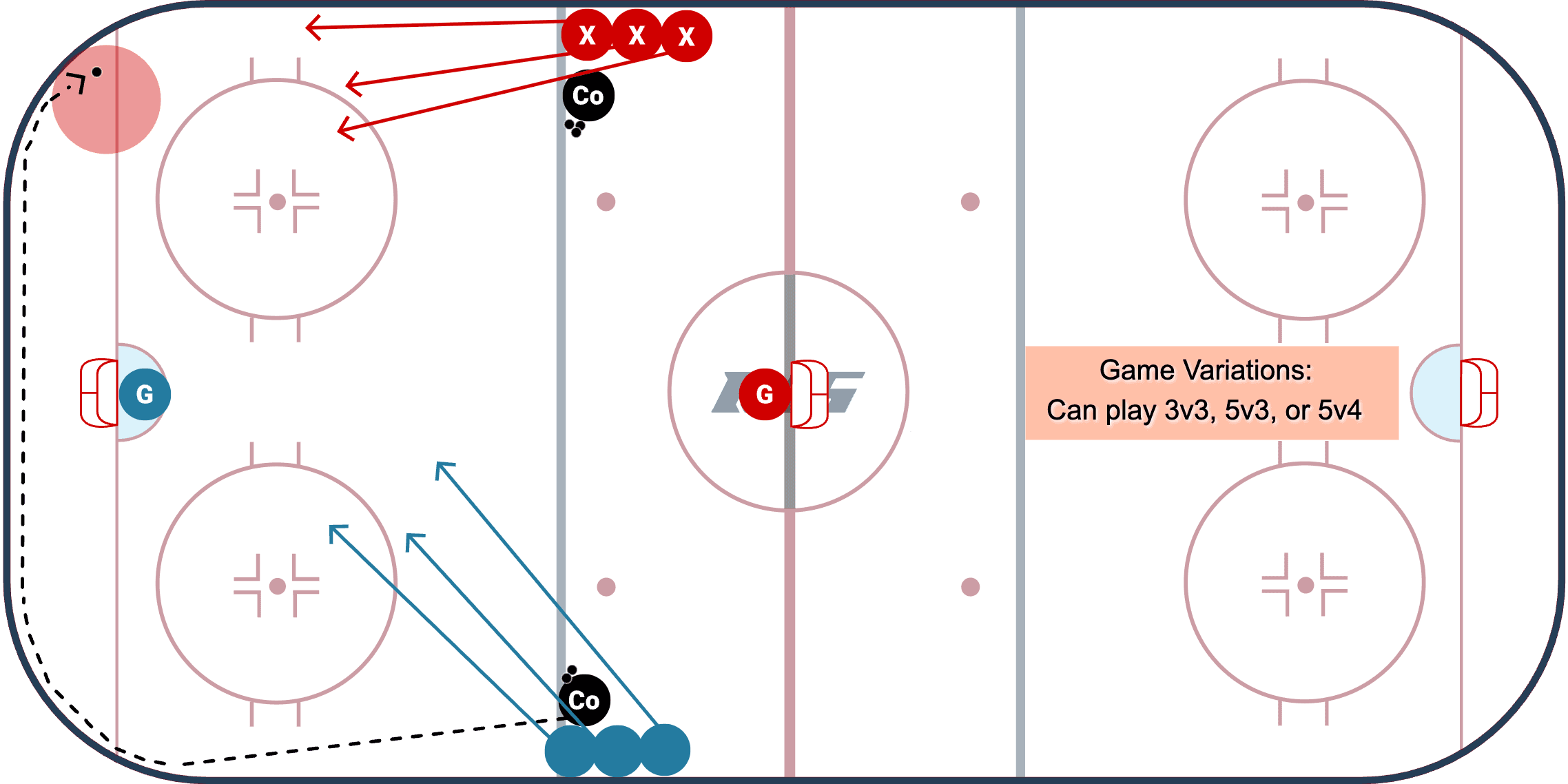
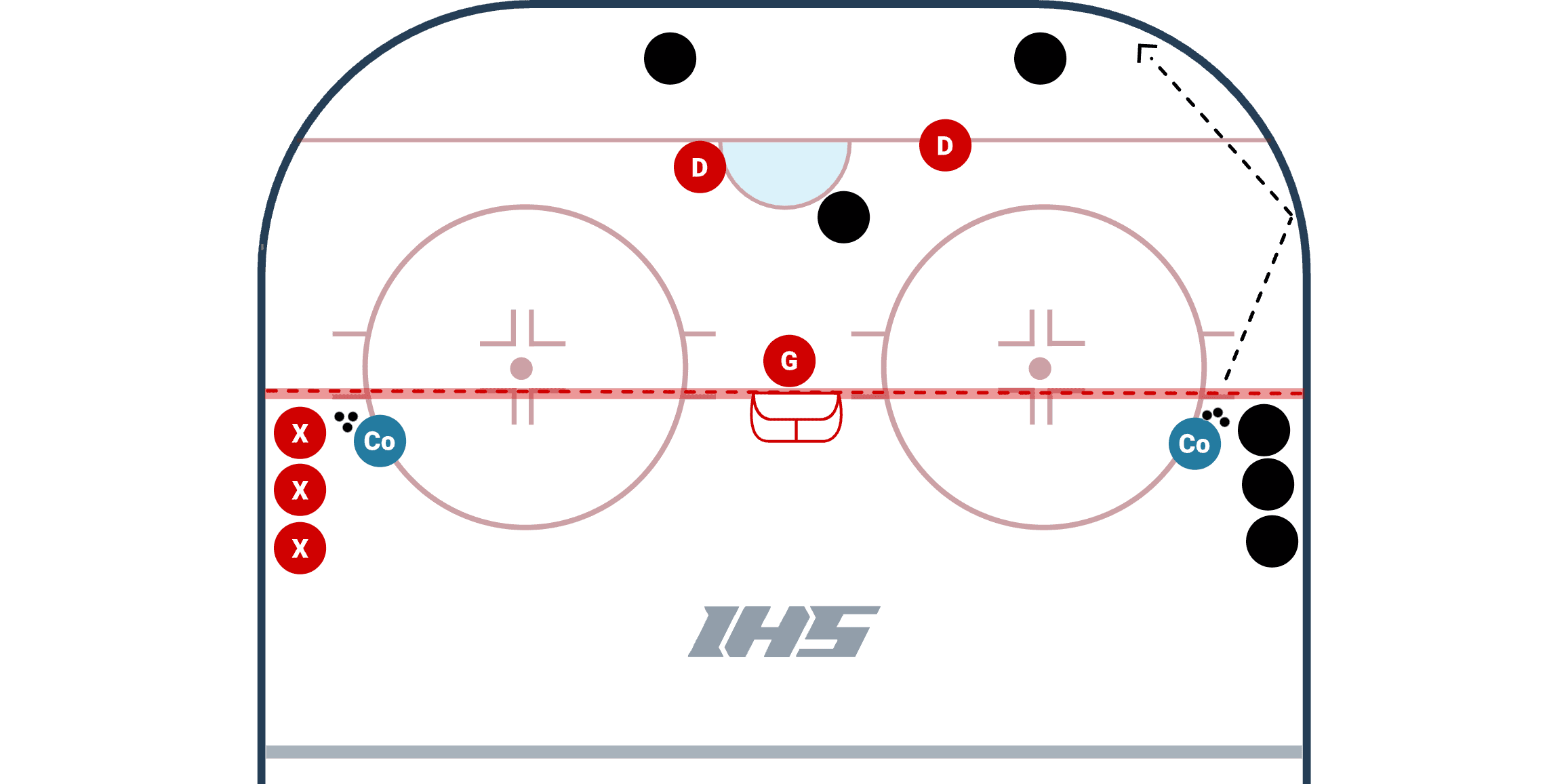
The Corner Houda from Dave Smith focuses on puck retrievals, wall play, quick transitions, and structured zone play. It offers flexibility for various d-zone and special teams scenarios by changing it up from 3v3 to 5v3 to 5v4. Setup - Two coaches positioned on opposite sides of the blue line to initiate a rimmed puck. - Players are split into offensive and defensive groups—typically starting 3v3 (but can expand to 5v3 and 5v4). - Puck is rimmed around the boards to initiate a battle. Execution - First three players from one side retrieve the puck and start on offense; three from the other side defend. - Offensive group gains possession and attempts to create a scoring opportunity. - Drill is repeatable with different number combinations: 3v3, 5v3, 5v4 (PP/PK), etc. - Defensive group must pass or skate the puck over the red line to transition out. - Can include a net and goalie at the red line for breakout scoring opportunities after defensive transition. Progression - Start with 3v3 for basic wall play and transition work. - Advance to 3v5 to work on defensive zone returns and structure (slot, net front, strong side wall). - Incorporate special teams scenarios: Power play (PP) starts with puck possession. Penalty kill (PK) may retrieve puck and clear or attempt to shut down the PP setup. - Power play (PP) starts with puck possession. - Penalty kill (PK) may retrieve puck and clear or attempt to shut down the PP setup. Variations - Use variations (3v3, 5v3, 5v4) to target different systems and teaching points. - Can have the defensive group must pass or skate the puck over the red line to transition out or you can include a net and goalie at the red line to give the defense a chance to shoot on net.
Small Area Games
13Description This small area game from Kendall Coyne Schofield requires a lot of decisions, thinking and working no matter which side of the puck you are on. It is great for working hard to get to open space and utilizing your support players to create opportunities on offense. The game reinforces all of the key themes that Kendall looks to get out of small area games including; moving, thinking, working, creativity, decision making and fun. Setup - 2 Nets should be set up on the goal line in an offensive zone in line with the face-off circles - Each team is designated a net for them to score on and another to defend - Teams consist of 2 active players and 2 stationary players - Players not participating can line up on the blue line and keep the puck in - The 2 active players per team can go anywhere in the zone - The 2 stationary players per team are lined up at the point and along the boards just above the hash mark - Coaches set up just outside of the blue line with pucks Game Objective: Play a game up to a certain number team "X" vs team "O" - Coach dumps 1 puck in and the players play 2 v 2 in the zone to try to score on the opponents net - The active players can use their stationary support players who can either pass or shoot to score - The coach allows players to compete as long as he or she sees fit (usually 30-40 seconds) - Each goal counts towards the team total - When the whistle blows or a goal is scored, the active players leave the zone to rest, the stationary players become the active players and 2 new stationary players come in - Coach can throw in a new puck when: - The goalie covers the puck - The puck goes out of play - A goal is scored Coaching Points - Working hard to get open and find lanes - Identifying and using outlets for support to relieve pressure - Communication: practicing both verbal and non-verbal communication with your teammates
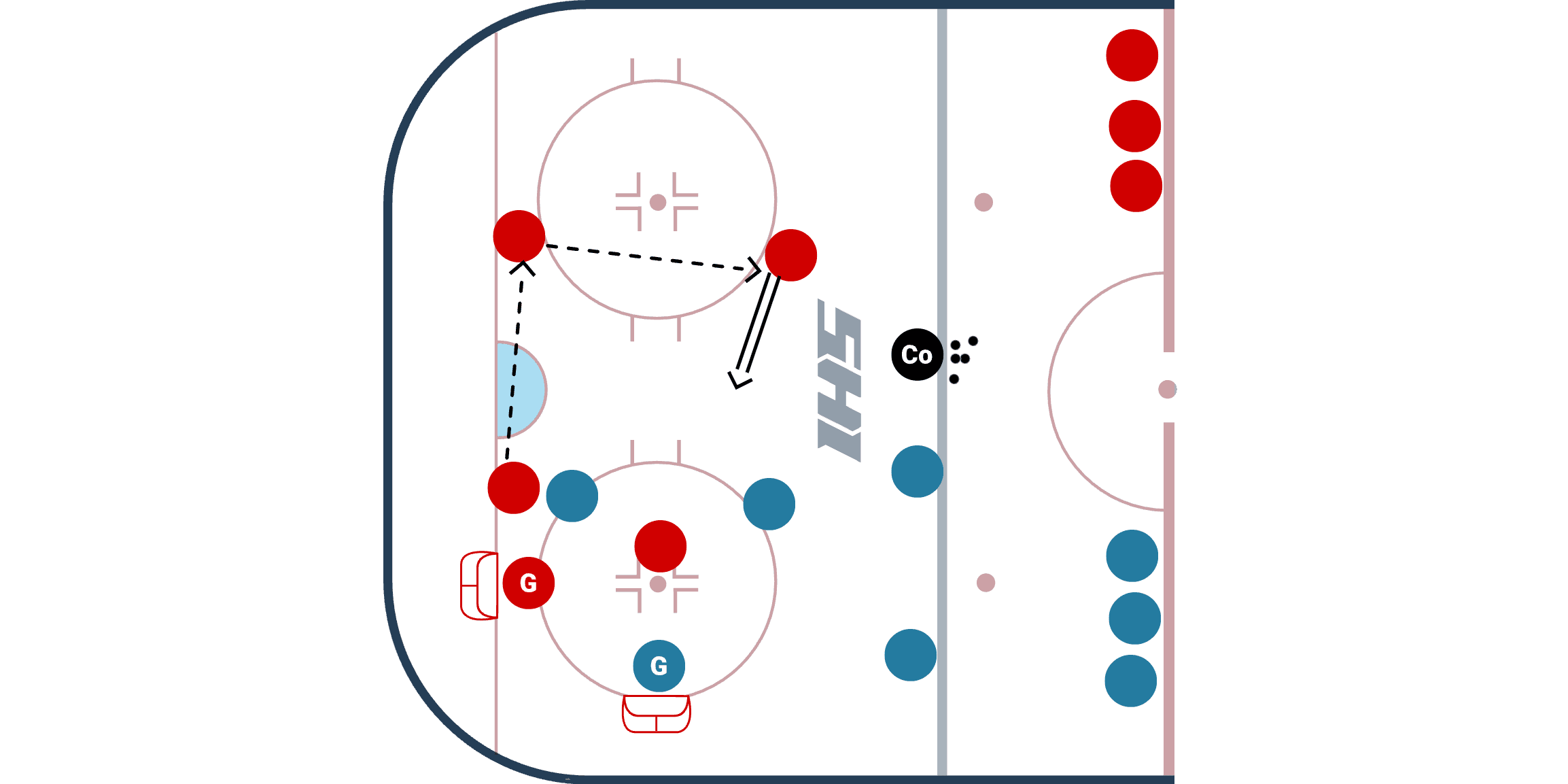
2 v 2 Net Front Corner Battles with Support is a competitive 2 v 2 small area game from the 2025 Buffalo Sabres Development Camp that practices corner and net front battles. The design of this drill encourages players to win the puck battle and pass it to the point for support and a shot, tip or redirect on net. Setup - Nets are in the corner as shown in the diagram. - Each team has 2 players at the point, 2 players in zone, and 1 goalie. - The drill begins with a coach flipping the puck into the zone. - Each team is working to retrieve the puck and score on the opposing teams net, while the defending team is working to get the puck back so they can score on the other net. - Coaches can require the defense to have to pass the puck to the point before they can transition to offense, or they can allow the defense to immediately attack the other teams goal. Variations - Coaches can require the defense to have to pass the puck to the point before they can transition to offense, or they can allow the defense to immediately attack the other teams goal. - Coaches can require the defense to only look for passes and redirects and no shots. - Coaches can require the defense to one touch or two touch everything so the puck is not sitting at the point. - Coaches can only allow the defense to go d to d once or twice (if they allow them to go back and fourth unlimited times it can slow the game down) - This drill is a variation of Defend Net Front Progression With 2 Point Players, which sets up the two goals on the goal line and gives the players more space but works on similar concepts and would be better for younger age levels.
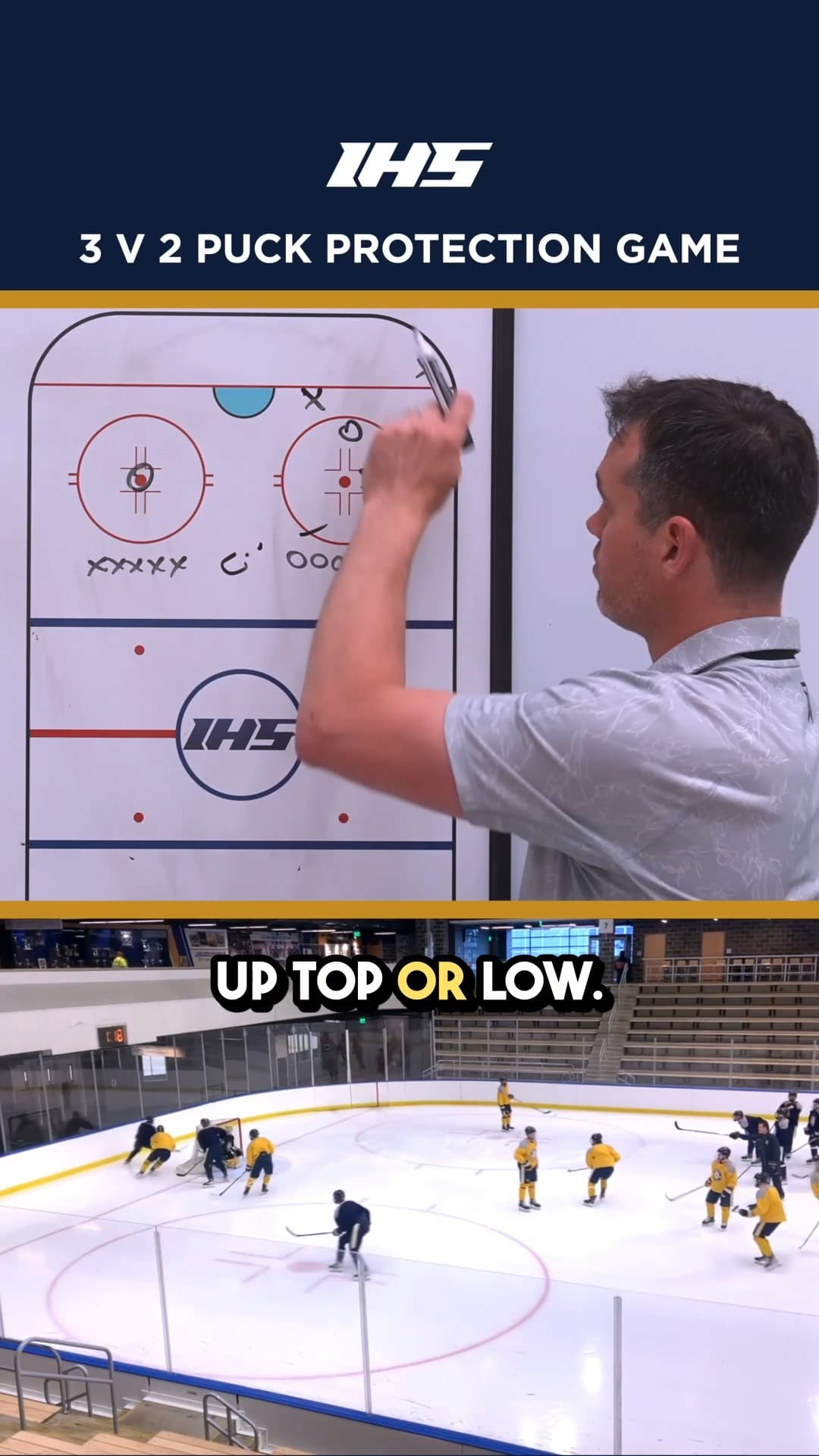
Small area 3 v 2 game built around holding onto pucks under pressure with a numerical advantage.
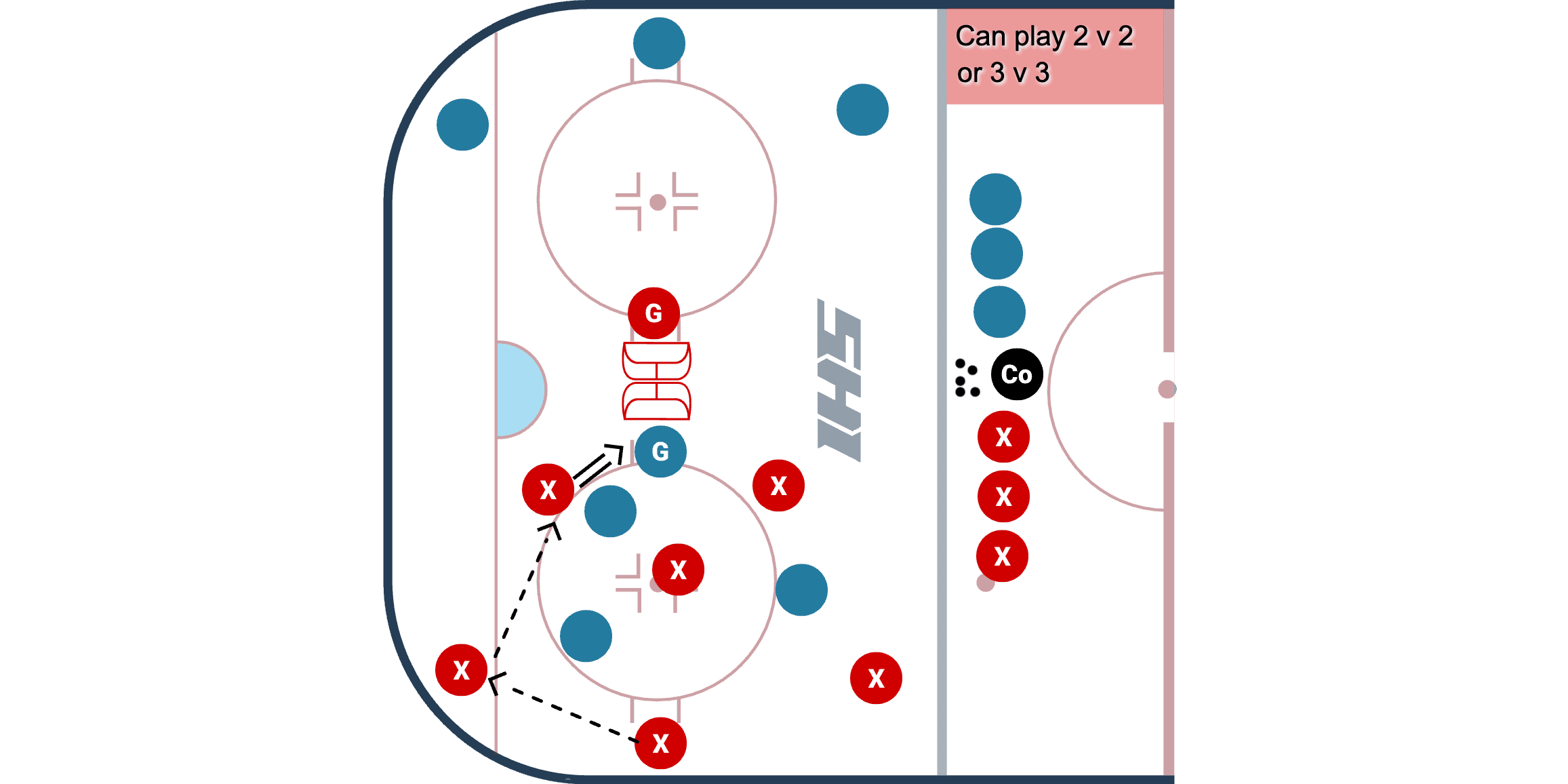
The 4 Corner Possession Game (with Offensive Advantage) is a fun small area game that encourages players to use their teammates in the corners for support. The setup of this game allows for a lot of creativity. - Offensive players should focus on give & goes, using their point players, and net front presence to create tips, deflections, and react to rebounds. The defending team should focus on boxing out in front, keeping their sticks on the ice to block passing lanes, and react quickly to clear rebounds. Setup - Two nets back to back in the center of the zone (as shown in the diagram) - 2 v 2 and each team has 2 extra support players in their offensive end - The support players must stay in their boundary (can be cones or tires) - Coach dumps puck in to start - Change players every 30 - 45 seconds - the 2 v 2 players can rotate to become support players, then rotate out - The defensive point players can only go d to d once then they must shoot or pass to a forward (they can not keep passing d to do over and over) - The defensive point players can only hold onto the puck for 3 seconds (or less). - Keep score! Variations - Can set up to be 2 v 2 (as shown above) or 3 v 3 - Can set up Defensive Advantage - see video here - (place the support players on the defensive side of their zone) - Can set up Cross-Ice Advantage (place one support player on the defensive side and one support player on the offensive side, but have them on the same side of the ice so they can make cross-ice passes) - Can set up Cross-Ice Advantage Mixed (place one support player on the defensive side and one support player on the offensive side, but place them on opposite corners of the ice so they can NOT make cross-ice passes)
A continuous 2 vs. 2 small area hockey game that puts the defenders at a disadvantage since they will be double shifting. The defense will be tired so it is extra important that they communicate with each other, focus on good positioning and habits. Setup: - 2 defenders start at the blue line and 2 forwards start in the center ice circle. - Game starts with the coach passing the puck to one of the 2 forwards (this begins the 2 vs. 2). - Forwards try to keep possession of the puck and score. - The defenders try to defend and can end the game by skating the puck out of the zone or passing the puck to the forwards that are next in line. - If a goal is scored, or the goalie freezes the puck, or the puck goes out of play, the coach has the option to chip another puck in the zone, or pass to the next forwards in line. - When the shift ends (either with a goal, the defense getting the puck out of the zone, or a coach's whistle), the forwards switch to defense and the new forwards start the 2 vs. 2. - Keep Score: 3 points for a goal, 2 points for the defense skating the puck out of the zone, 1 point for the defense passing the puck out of the zone, and 0 points if the coach blows the whistle and changes lines. Variations: - Can be set up on 1/4 ice (view animation here). - Can be 1v1 (view example), 2v2, 3v3 (view example), or 4v4. - Can add "gates" (like Picket Fences 2v2) at the point that the defenders must skate through.
The Designated Shooters Umbrella Power Play Game engages a lot of players at once, and encourages puck movement, and battles in front of the net. The game can be played 2 v 2 or 3 v 3, and you can modify the game to have 2 or 3 point players. Setup - Place nets back to back inside the zone. - Set up 3 "Umbrella" point players at the point on each sides of the ice. - Set up a 2 v 2 or 3 v 3 game inside the zone. - On the whistle, coach chips the puck into the zone and the players battle out 2 v 2 or 3 v 3. - Players are encouraged to use their point players for give and gos, one timers, and tips in front of the net. Variations - Can set the game up to only have 2 point players instead of 3. - Can play 2 v 2 or 3 v 3 inside the zone. - Can award 2 points for a goal off of a one timer.
The Fran Gow 3 on 2 and 3 on 3 small area game focuses on controlling pucks off the wall, creating time and space, and attacking the net with purpose. Players learn to manage pressure, roll off defenders, protect the puck, and make quick decisions in tight areas while defenders work on stick on puck and box outs. Drill Setup - Place a net just above the hashmarks or along the ringette line if available. Establish a goal line across the ice with the net facing the end boards. - Start with three offensive players and two defensive players. You can add a third defender to make it three on three for additional compete. - Each offensive group receives three pucks. The first and third pucks are rimmed in by the coach on their side. The second puck is rimmed by the coach on the opposite side. - On each whistle a coach rims a puck around the boards. Offense must retrieve it, control it off the wall, and attack the net. Any time a puck crosses the line, enters the net, or is covered by the goalie, the next whistle starts the next puck. Coaching Points - Offense: Coaching Points - Defense: Coaching Points - General Concepts: Variations - Can place net on goal line, on the hashmarks (as shown in diagram) or on top of circles - Can play 3 v 2 or 3 v 3
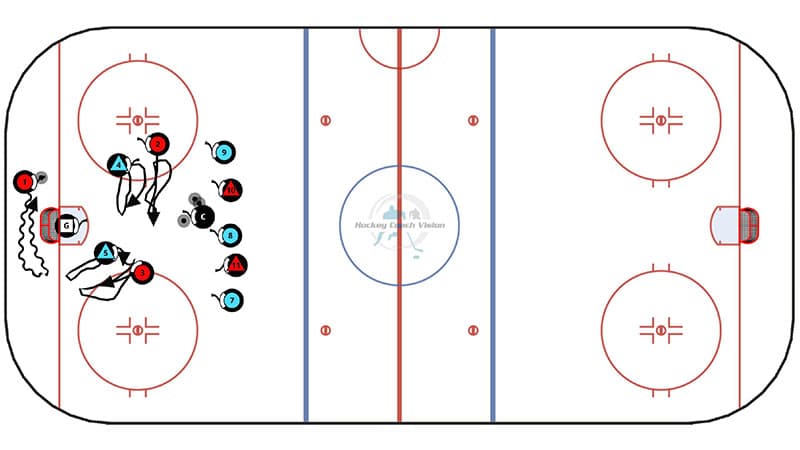
This small area game is played from the top of the circles and below. The coach has the pucks in the middle of the ice and the players are split into two teams and lines up at the top of the circles to define the boudary. How the game is played - The coach will dump a puck in and designate one team to have 3 players join the game while the other team will have two. The team that has three players must always have one player below the goal line. They can rotate players behind the net but they must always have 1 behind the net.
Picket Fences is a great small area hockey game that can be setup as a 2 vs. 2 or 3 vs. 3 game. The offensive team gets 2 points for scoring a goal and the defensive team gets 1 point by skating the puck between the tires. Game: Objective: Play a Game up to a certain Number (1 point for the Defensive Team skating the puck between the tires & 2 points for the Offensive Team when they score) - When the whistle blows, three players in White (Offensive) get a puck from coach while three players in Red (Defensive) being to defend - The team in White attempts to score while the Team in Red attempts to steal the puck & skate it between the tires - The coach allows the players to compete for 20-30 seconds - There is NO change of possession (White is offense the entire shift) - When the next whistle blows, three new players enter from the White and Red team - Now, Red is on Offense and White is on Defense - Coach can give a new puck to the Offensive Team if: - If the goalie covers the puck - If the puck goes out of play - A goal is scored - The defensive team skates the puck between the tires Principles: The brilliance of this game is both teams are attempting to ‘score’ while one attacks the goalie & one aims for possession to skate the puck between the tires. The game incorporates: - Defending 3v3 (in a condensed space) - Once the Defenders gain possession of the puck, they must thinking ‘offensively’ to skate/get open to score a Goal (skate puck between tires) - Communication with other teammates is essential so each defender can operate in a ‘man on man’ scenario - Attacking 3v3 (in a condensed space) - The offensive players are can either challenge a defender 1v1 with the puck or try to isolate and create a 2v1 on a defender - Player without the puck must work to get open, drive net or create space for teammates - Must find a way to create space & opportunities to get off a quality shot with pressure - ‘Play after the Play’ – anticipate loose puck/rebounds and regain possession for more offensive zone time with the puck - Players must constantly talk & perceive the ever changing environment to solve problems as they happen (both offensively & defensively) Related Game / Variation The picket fences 3 vs 3 uses the full zone and incorporates 2 gates. This way the defenders can use deception or are forced to use another option in order to carry the puck through the gates.
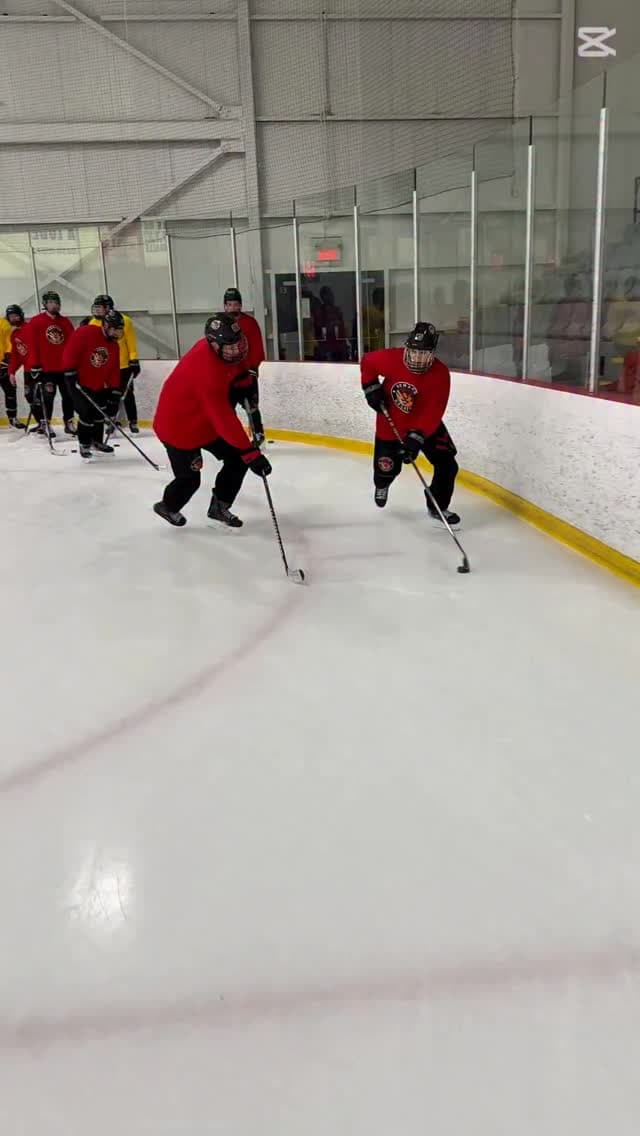
Puck protection with interchanges: heads up, brains on, leading with the puck and creating space.
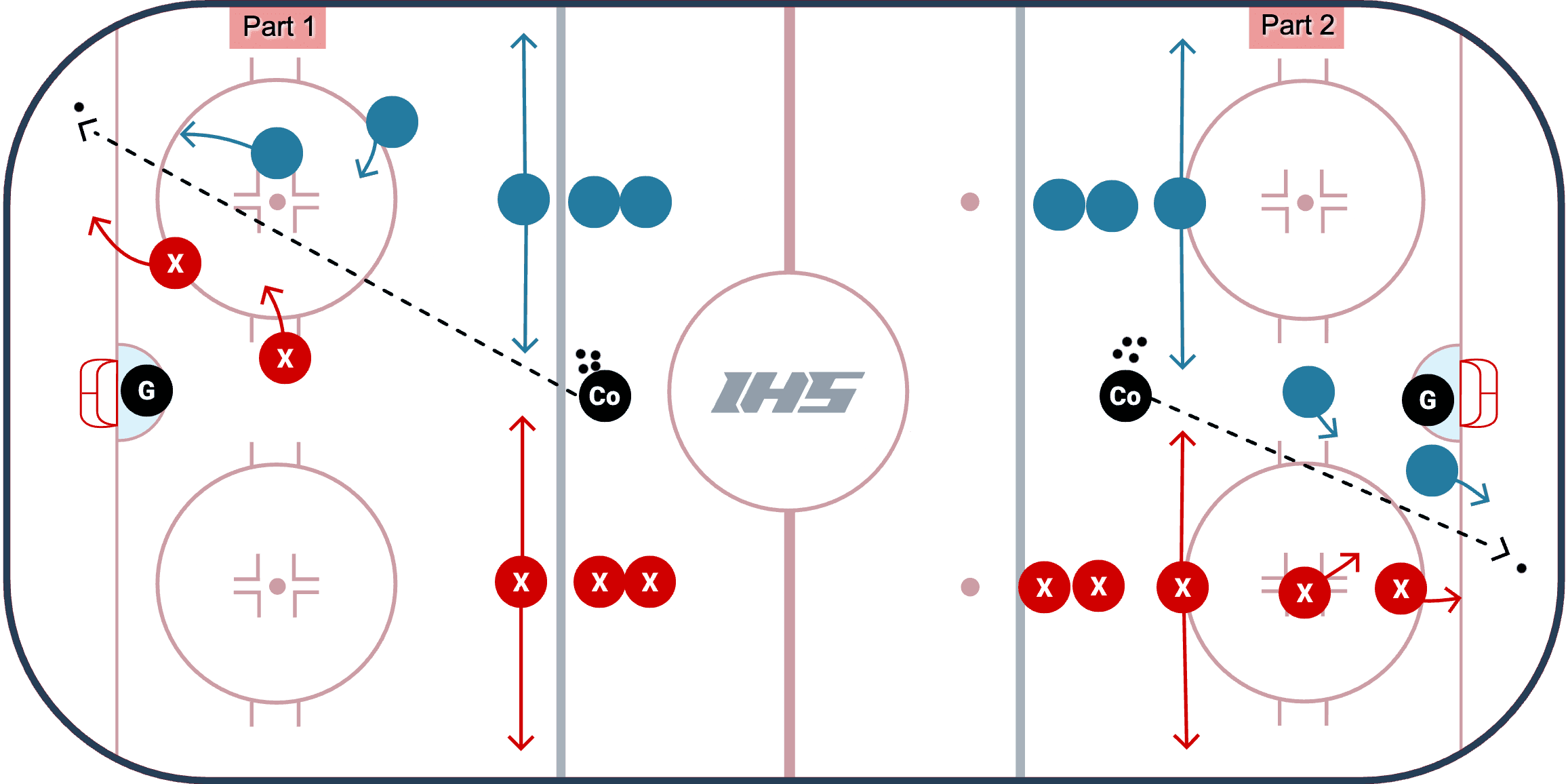
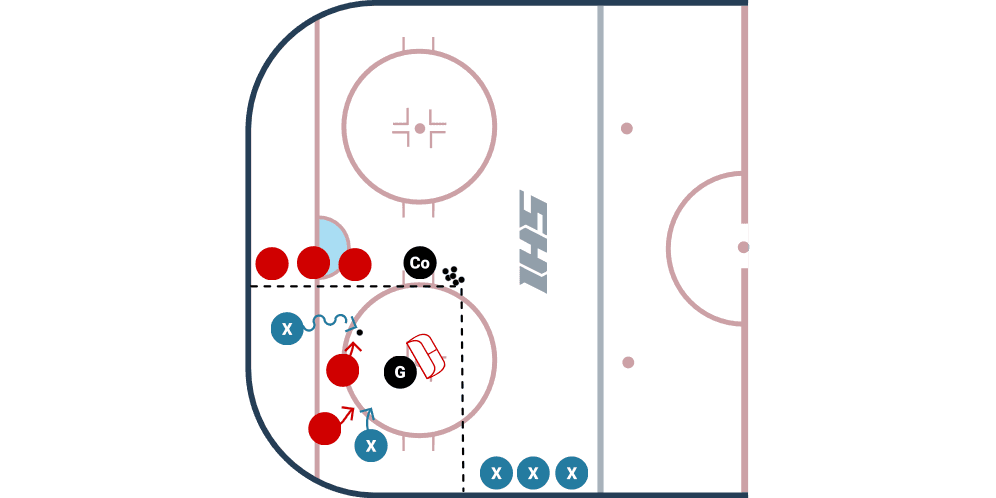
The Box Game from Brad Flynn is a small area game that works on quick decision making, transitions, give & goes and net front play. Setup - Teams line up at the blue line. - Coach dumps a puck in the corner, which starts an in zone 2 on 2. - The 3rd person in each line jumps into the zone at the point and they are the "slide player" at the blue line. They are allowed to go to the boards, to the coach. The slide player can pass or shoot. - Anytime there is a change of possession, the team that got the puck must pass to their slide player and work to get open, or get to the front of the net. - Part 2 progression option: Coaches can move the slide players up to the tops of the circle, so there is a smaller amount of space, which will require quicker decision making and give the slide players more opportunities for quick shots to the net. Variations - Can reduce the playing area as shown in the video - Can make this a 2 v 2 or 3 v 3 game.
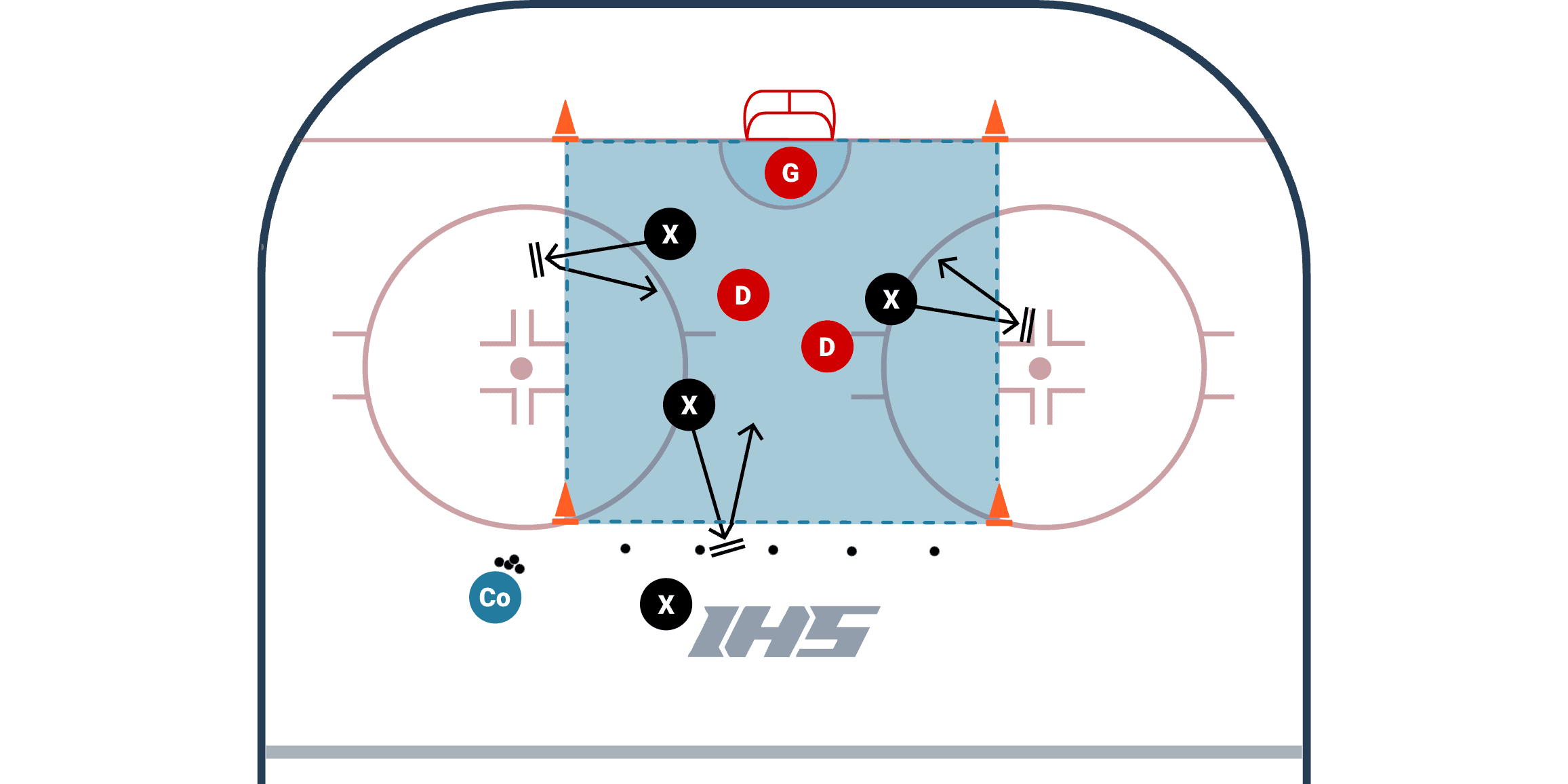
The Tomas Holmstrom Small Area Game from Spiros Anastas is a competitive net front battle drill designed to teach offensive players how to get inside for screens, tips, and rebounds while defenders work on box outs, containment, and blocking shots. A shooter fires from the top of the circles as players fight for positioning inside a defined box. Drill Setup - Draw a box from just inside the dots and hashmarks up to the top of the circles and back down to the goal line. Drill Setup - Players: Drill Setup - 3 offensive players inside the game - 2 defensive players with the option to add a third to increase difficulty or emphasize shot blocking - 1 shooter positioned outside the box at the top of the circles Drill Setup - Place 5 pucks outside the box for five consecutive reps. Drill Setup - On each whistle all offensive players must tag up outside any boundary of the box which can include the goal line, the sides, or the high line. Defenders do not tag up but must track where attackers enter. The shooter can only shoot after the whistle but may delay to wait for a screen or tip. Shots only with no direct passes. After five reps switch offense and defense and keep score. Coaching Points - Offense: Coaching Points - Defense: Coaching Points - Shooter: Coaching Points - Goalie: Variations - Can make it 3 v 2 or 3 v 3 - Can require the defenseman to shoot further away - Can allow the defenseman to pass for redirects or one timers Variations - View more drills and content from Spiros Anastas
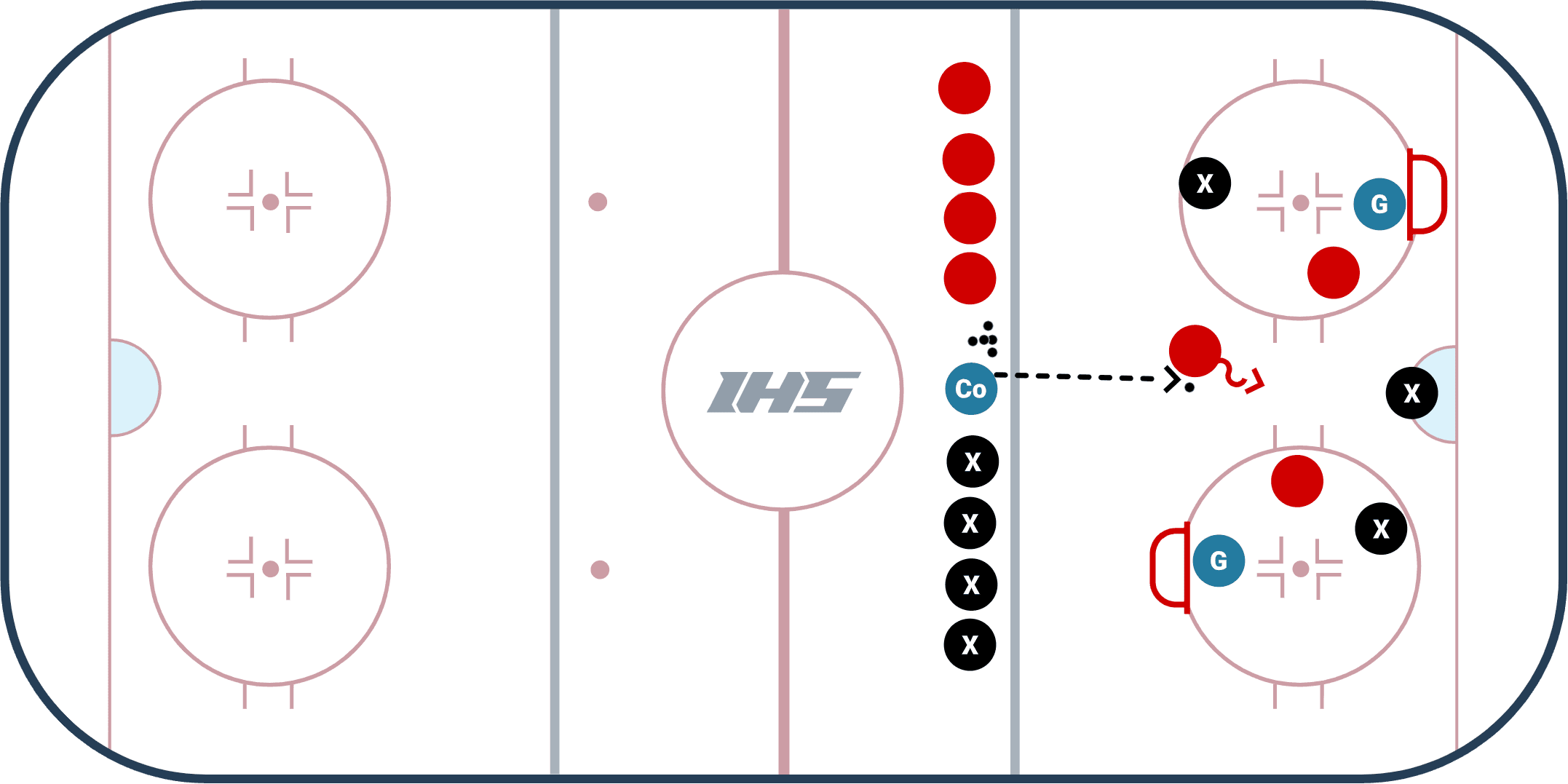
The Union Scoring Small Area Game from Topher Scott is a fun small area game where teams can score on either net. The unique setup of the nets promotes creativity, thinking outside of the box to create time & space and score goals. Setup - Coach chips the puck into the zone or passes to one of the players to begin the 3 vs. 3 game. - Players can score on either net. - Game can be stopped when a goal is scored, the goalie freezes the puck, or the coach blows the whistle. Keep score!
Skills & Skating
15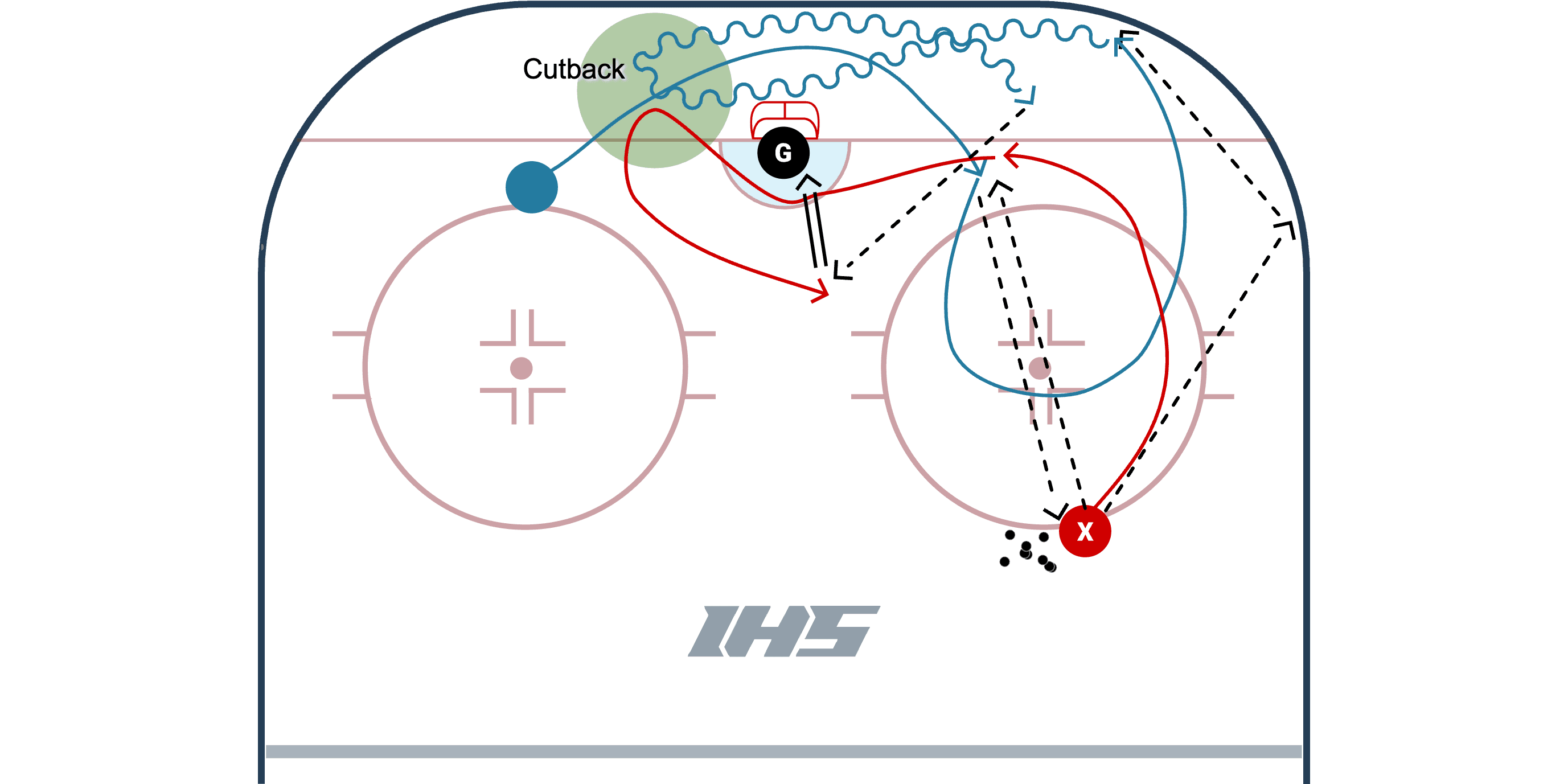
This is a great drill for working on cutbacks behind the net, it is useful for both forwards and defensemen because this is a great skill to use whether in the offensive or defensive zone. - SETUP: Setup - To set up this drill, there should be a line at the top of one of the circles with a pile of pucks. The player starting the drill can start on the top of the other circle but after that it is continuous. - There should be a goalie in net in its respective position. - HOW THE DRILL WORKS: Setup - To start the drill, player 1 will skate around the net and show their forehand to player 2 who is first in line. Player 2 will pass the puck to player 1, get it back, and then as player one turns towards the wall showing either their forehand (lefty) or backhand (righty), they will give the puck back to 1. - Player 1 will then skate back around the net while player 2 is mirroring them. Player 2 will then provide pressure just off of the left post and player 1 will perform a cut-back to escape the pressure and turn back the other way. - After Player 1 makes it back around the post, they will find player 2 in the slot for a quick pass and shot. - Because this is continuous, after Player 2 shoots, they will skate around the net and get ready for a give and go with the next player in line. - COACHING POINTS: Setup - The most important thing about this drill is performing the cut back and utilizing the space behind the net to create separation between you and the defender.
This is a simple but effective drill that works on quick releases in stride. Setup - 2 Lines of players - 4 Tires set pp in a rectangle in line with the players - Player accepts a pass from the other line - Player with puck attacks the first cone - Player pulls the puck inside the next cone and shoots in stride
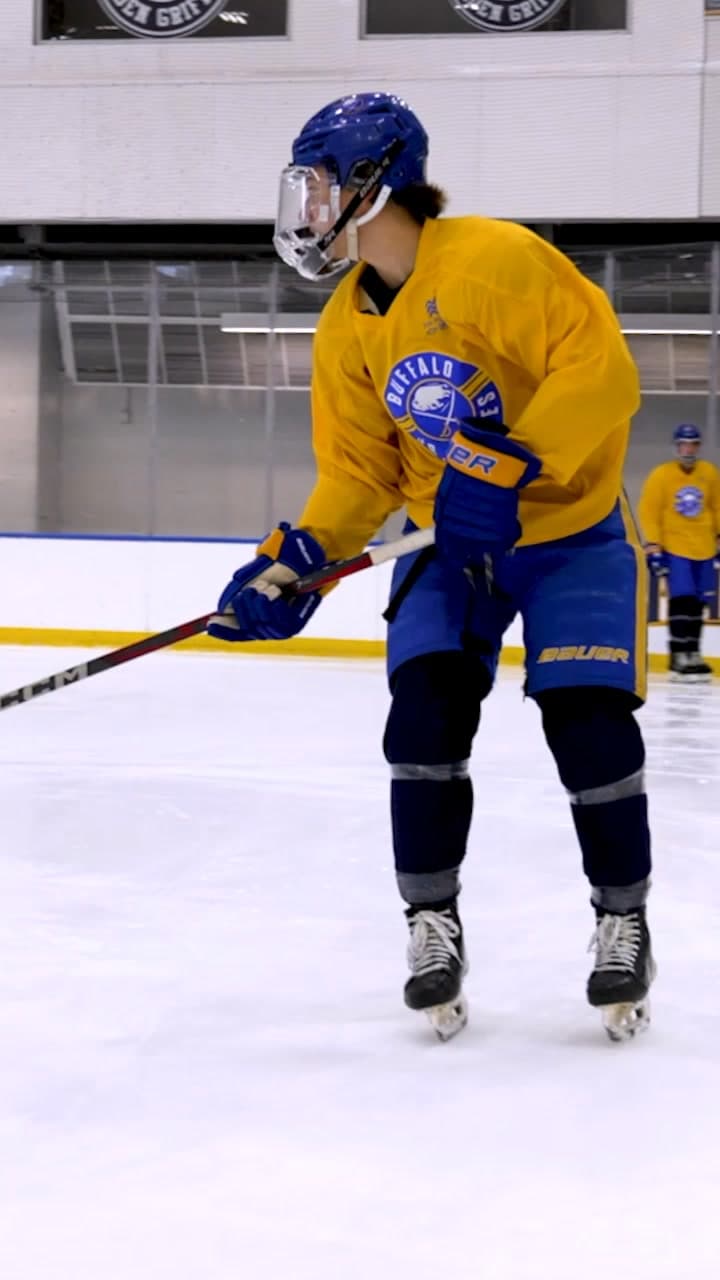
Academy of Hockey soft catch progression. Practice the soft catch to keep your speed and instantly load up for a shot, pass or deke without missing a stride.
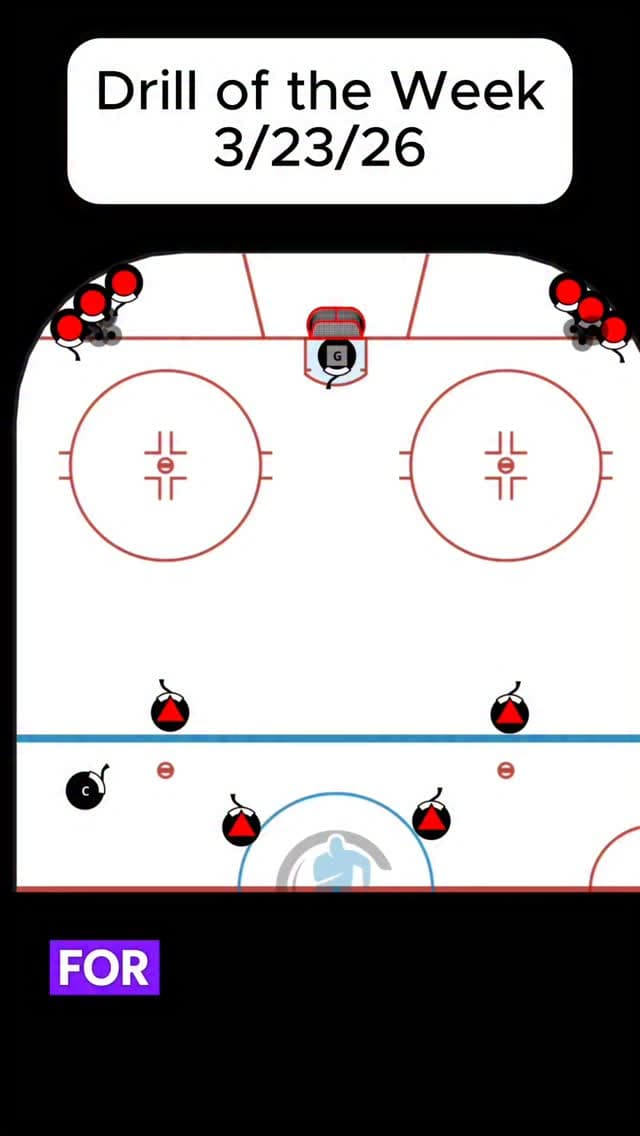
Adam Schankula's drill of the week (posted 3/23/26), an NHL-style practice drill walkthrough.
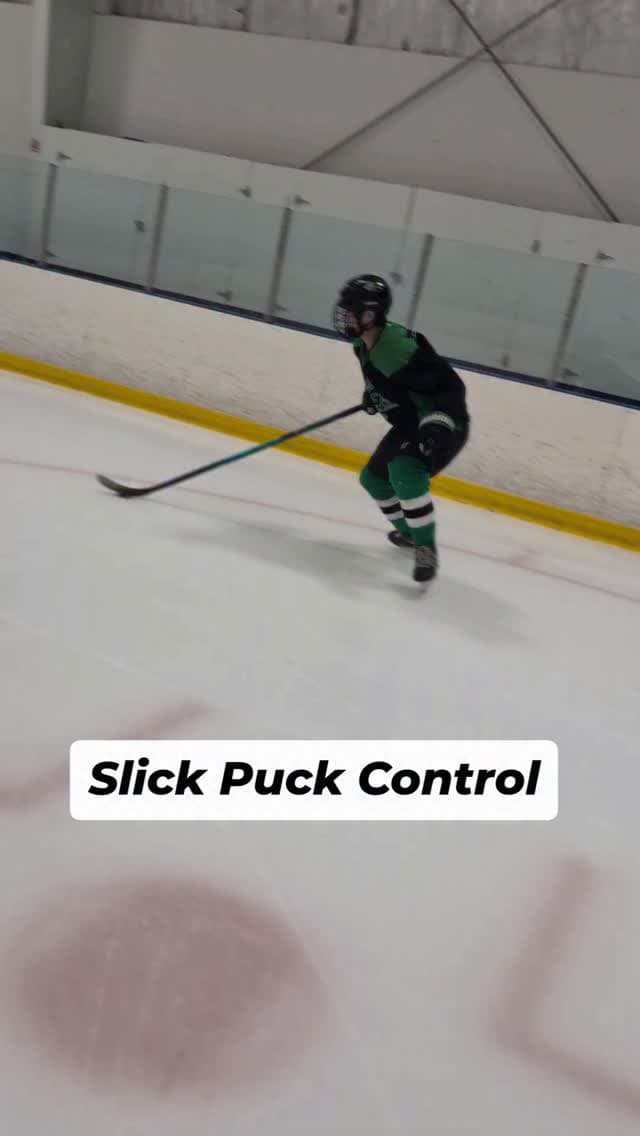
Combined edge work and puck control reel, moving the feet and the puck at the same time.
Ice Hockey skills progressions are extremely important for the development of young ice hockey players. They need to work on fundamental skills on a consistent basis to help improve their game. - Repetitive practice of these skills can help with muscle memory so they can be applied in practices and games. Coaches can make the series as simple or as complex as they would like. In this video, Ben Eaves demonstrates additional skills for the Finnish Skills Series. - To view the first part of this skills series (skills 1 - 26), please click the Finnish Skills Series: Part 1. To view the third part of this skill series (skills 37 - 46), please click the Finnish Skills Series: Part 3. Finnish Skills Series Part #2 contains the following skills: - Top hand only stickhandling - Top hand only long reach around the cone - Backwards top hand only long reach around the cone - Backwards inside edges around the cones - Backwards outside edges (short stride) - Backwards outside edges (long stride) - Hip slalom - Backwards hip slalom - Close Open Close - Attack position fake and push puck Related Links - Finnish Skill Series Part # 1 - Finnish Skill Series Part # 3 - Finnish 5 Puck Passing Progression - Setups for the Finnish Skills Series
Fortis Academy skills clip. The original post carried no description beyond its hashtags; watch the video for the full pattern.
Fortis Academy training clip. The original post carried no description beyond its hashtags; watch the video for the full pattern.
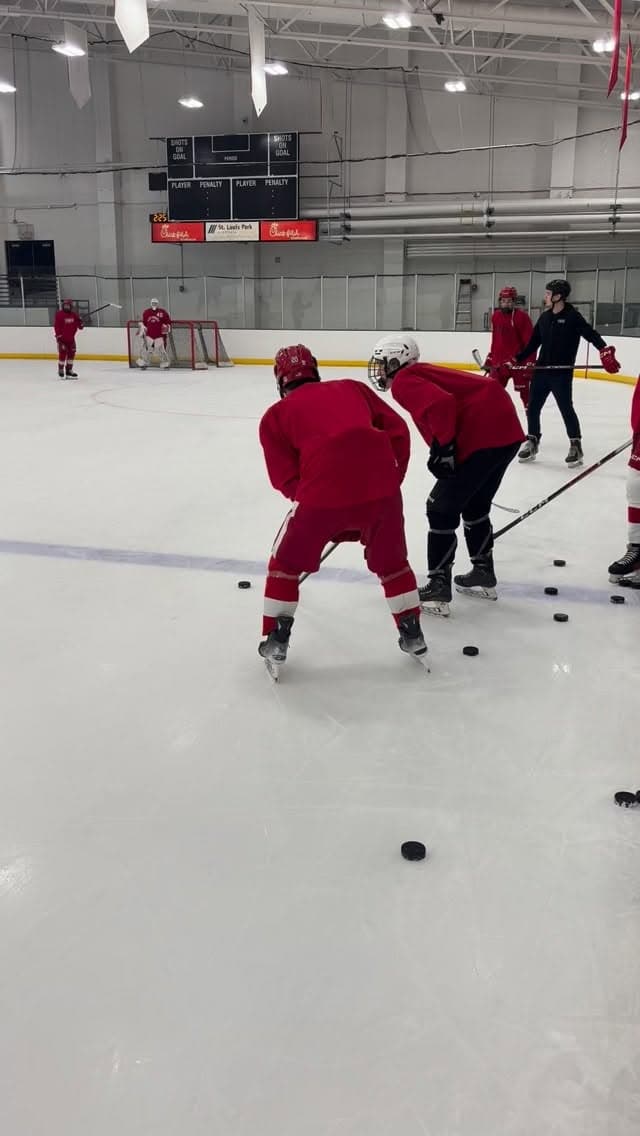
Fortis Academy skills clip. The original post carried no description beyond its hashtags; watch the video for the full pattern.
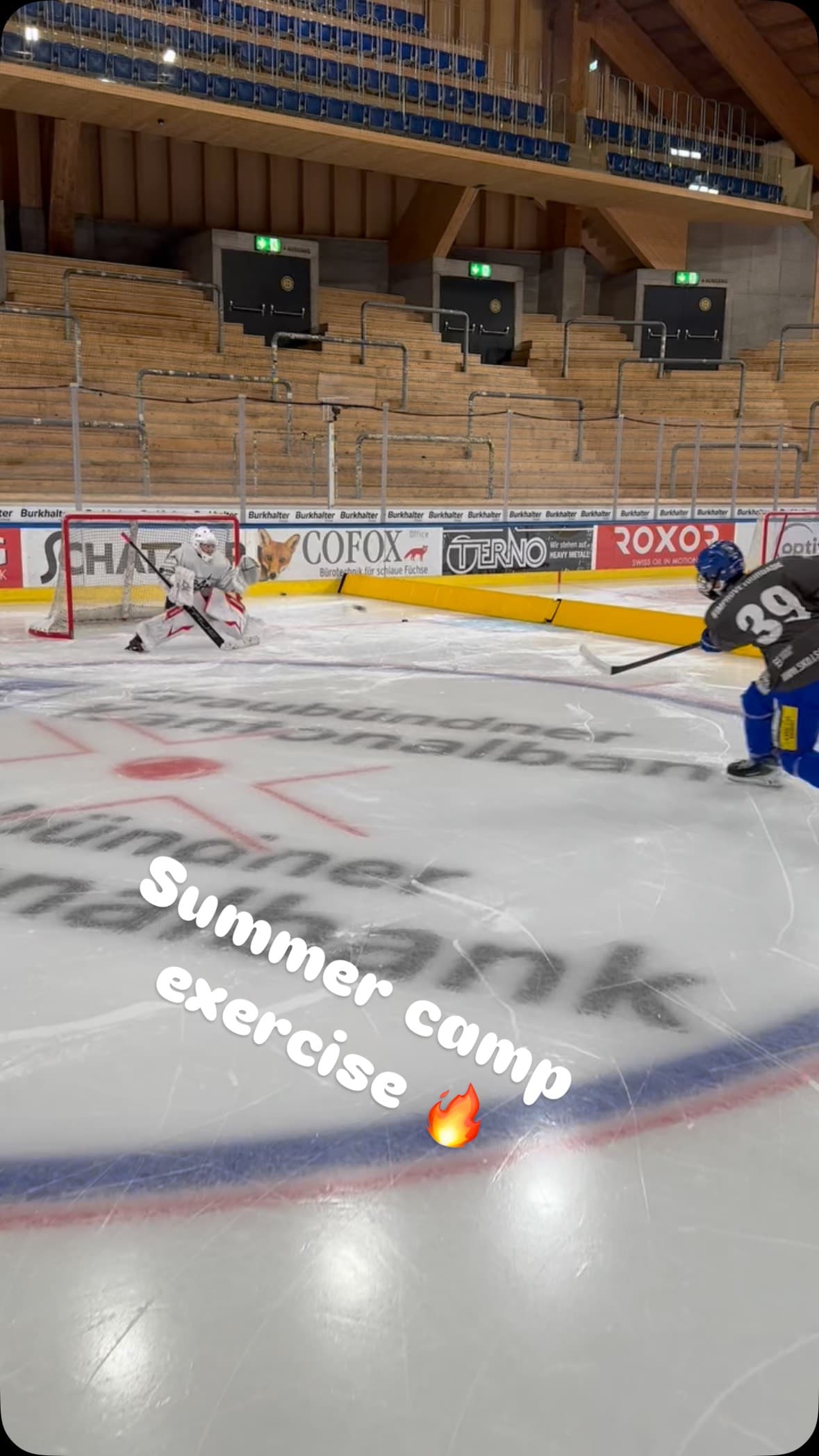
Summer camp exercise built on a simple sequence: pass, support the puck, finish at the net.
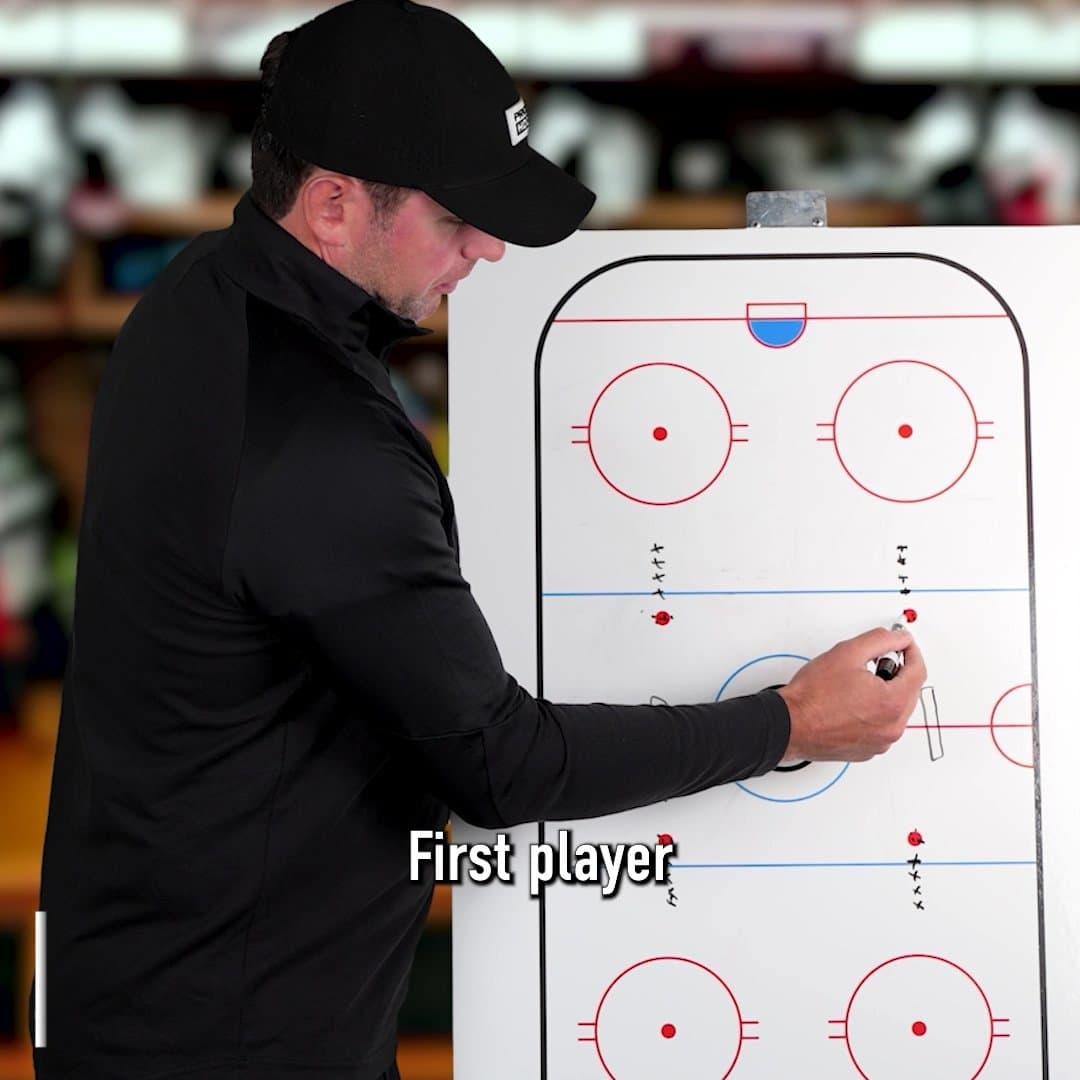
Danny Heath, founder and head coach of Project Hockey, shares habits for passing into space, following his on-ice presentation at TCS Live Minnesota.
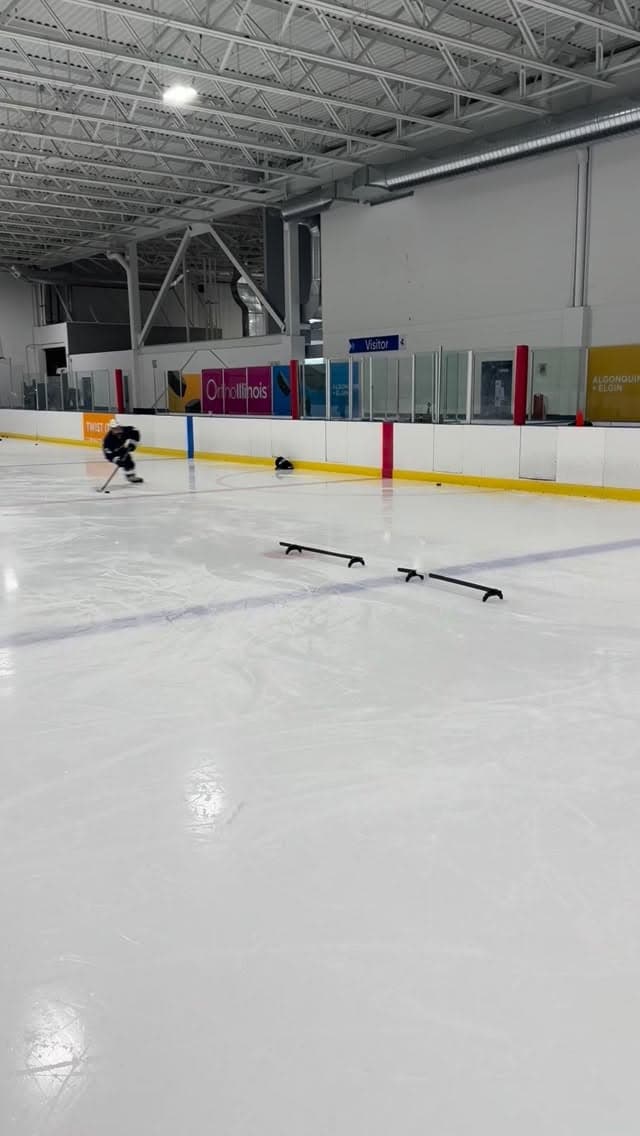
College and AAA forwards working on playing with the puck away from their bodies, controlling it while shifting weight rather than keeping the hands in tight. The stickhandling is deliberately stripped out so the focus is weight transfer.
The Soft Catch Behind the Net to Attack from the Academy of Hockey is a drill from the Soft Catch Skills Practice to help practice wall play, passing, routes and timing. Coaches can add light pressure to the drill so players need to keep their head up and pass around the coach. The drill highlights the "soft catch skill" where players catch the puck across their body in stride. - The primary benefit of a soft catch across your body is that it allows you to maintain your skating momentum and instantly load your weight to seamlessly transition into a shot, pass, or deke without missing a stride. The soft catch also allows you to protect the puck while along the boards. Setup - One net - Two lines along each side of the boards. - On the whistle, one side rims the puck (yellow player 1) along the boards while the player from the other side soft catches the puck (blue player 1), curls and finds the player who rimmed the puck in the slot for a quick shot. - The drill is continuous and after a rep is completed, the next player in the other line rims the puck (blue player 2). Variations - Coaches can add light pressure to the drill so the players must keep their head up and pass around. - Can add a live defender so the drill becomes a live 2 v 1. - Can set this up in different areas of the ice so the rim and puck collection happen at a different spot other than behind the net.
This drill is a quick offensive drill for forwards to work on their stick lifts, timing, and attack. - SETUP: Setup - This is a neutral zone drill, there should be one net on the red line with its back towards the wall. One player on each side of the bottom of the circle ready to receive a pass. - Two lines of players in line with the posts with a pile of pucks nearby. There is only one player ready with a puck per rep. - HOW THE DRILL WORKS: Setup - To start the drill that player going first will make a pass vertically to the player across from them. They will then attack, stick lift, and take the puck and make a pass back to their own line. - After passing back to their own line, the player who received the pass will pass it laterally to the first player in the other line. While this is happening the player doing the drill swings and turns towards the middle to catch the puck from the player who has the puck. - After receiving the puck, the player then attacks the player vertically across from the line they started in and pulls the puck to the outside, making sure they are protecting it with their back and hips and then once they get around the player, they take the puck in and shoot. - COACHING POINTS: Setup - In this drill it is important that the players focus on showing good targets for all of their passes including some communication. They should also make sure that they are being strong and quick in their stick lifts.
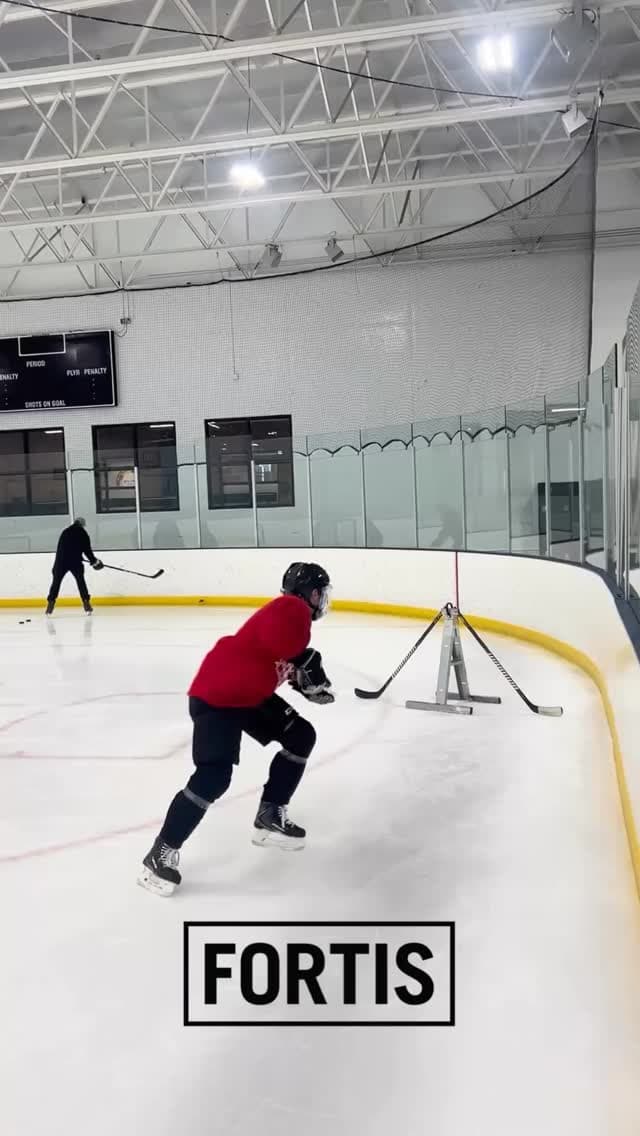
Small-detail skills reel: stick lifts, give-and-gos and changes of direction, the little things that sharpen a player's skills on the ice.
Shooting
10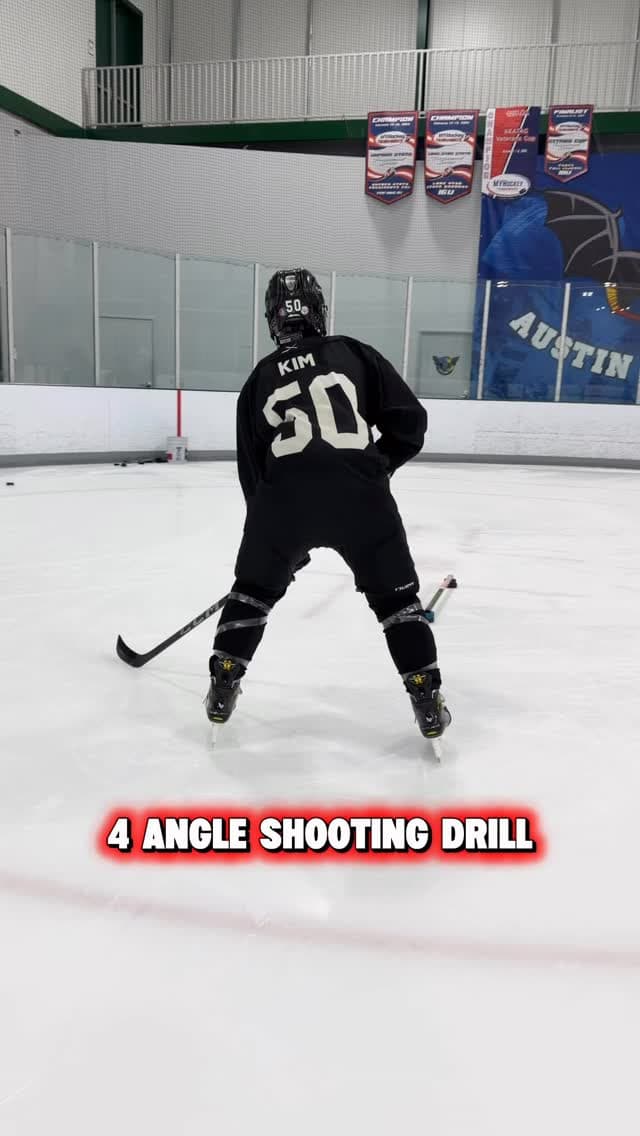
Four-station shooting drill working quick shots and timing with different shot types.
The Angle Shooter drill from Jim Midgley focuses on developing angling habits and defensive pressure immediately after a player takes a shot. Players attack across the ice to take a shot on net, then quickly transition into a defensive role where they angle the next puck carrier to the outside. This drill reinforces strong skating habits, smart stick positioning, and controlling the opponent’s lane to reduce quality scoring chances. Setup - Divide players into two groups (two colors) on each side of the ice. - Run the drill simultaneously on both sides of the rink. - Use the offside dots as a skating guideline when players attack across the ice. - The drill is whistle-controlled by the coach. How It Works - On the whistle, the first player (#1 ) carries the puck across the ice using the offside dots as a guide and takes a shot on net. - After the shot, the coach blows the whistle again. - The shooter immediately stops, turns, and becomes the angler. - At the same time, a player from the opposite line (# 2) carries a puck across the ice toward the net to take a shot. - The original shooter angles the puck carrier, forcing them to the outside and disrupting the shot. Key Concepts - Angling fundamentals - Offense to defense transition - Stick positioning and puck pressure - Forcing attackers to low-percentage areas - Defensive skating habits
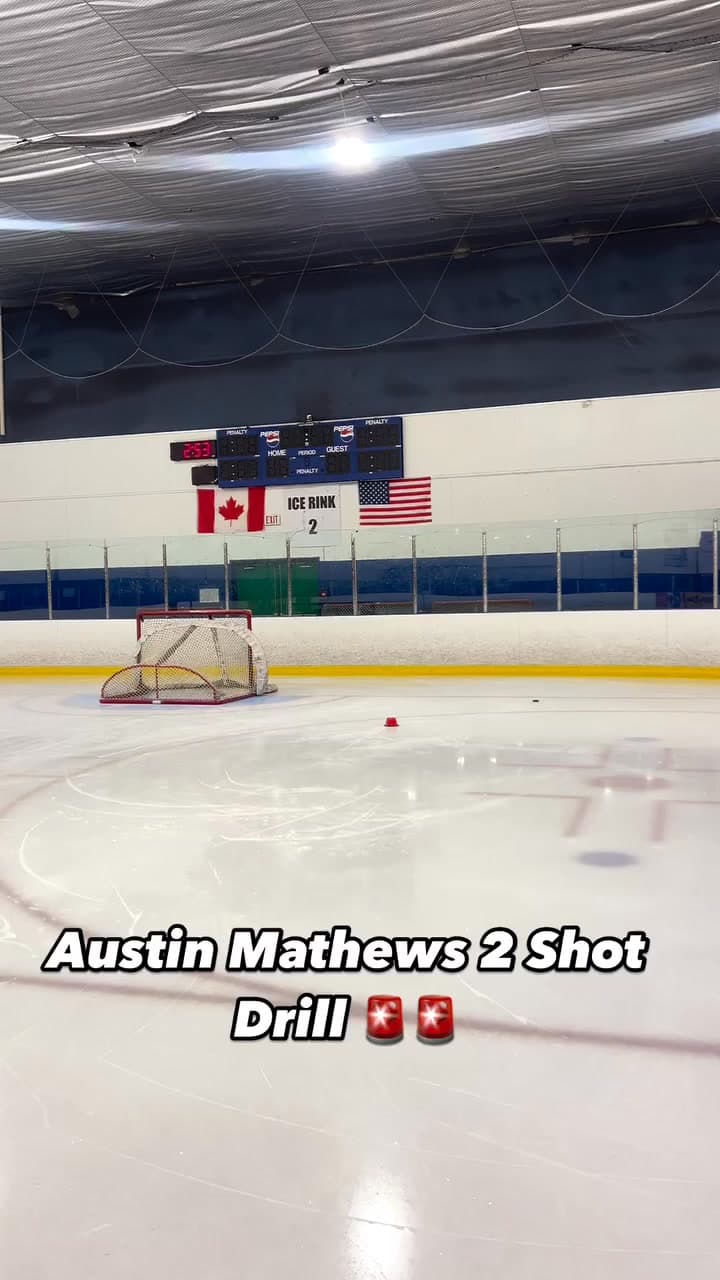
Two-shot shooting drill in the Auston Matthews style, combining a deke and a quick second release.
This is a simple but effective drill that works on quick releases in stride. Setup - 2 Lines of players - 4 Tires set pp in a rectangle in line with the players - Player accepts a pass from the other line - Player with puck attacks the first cone - Player pulls the puck inside the next cone and shoots in stride
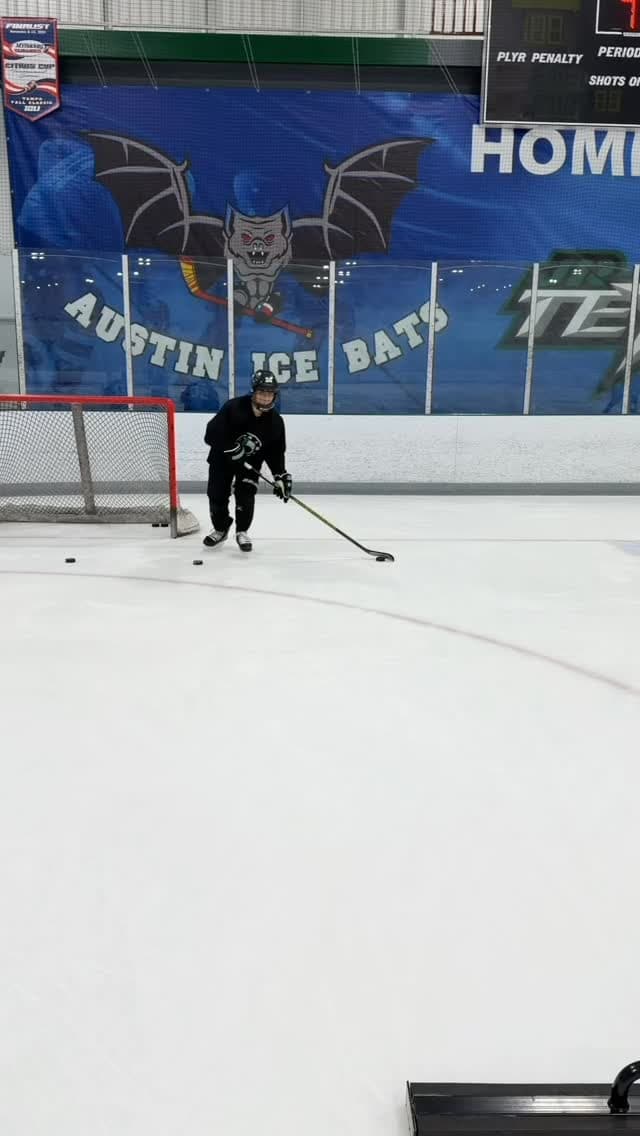
Generating scoring chances by popping off the goal line and receiving a pass as the shoulders and hips rotate, for a quick release shot, or drawing the puck across the body to change angles if the defender steps up.
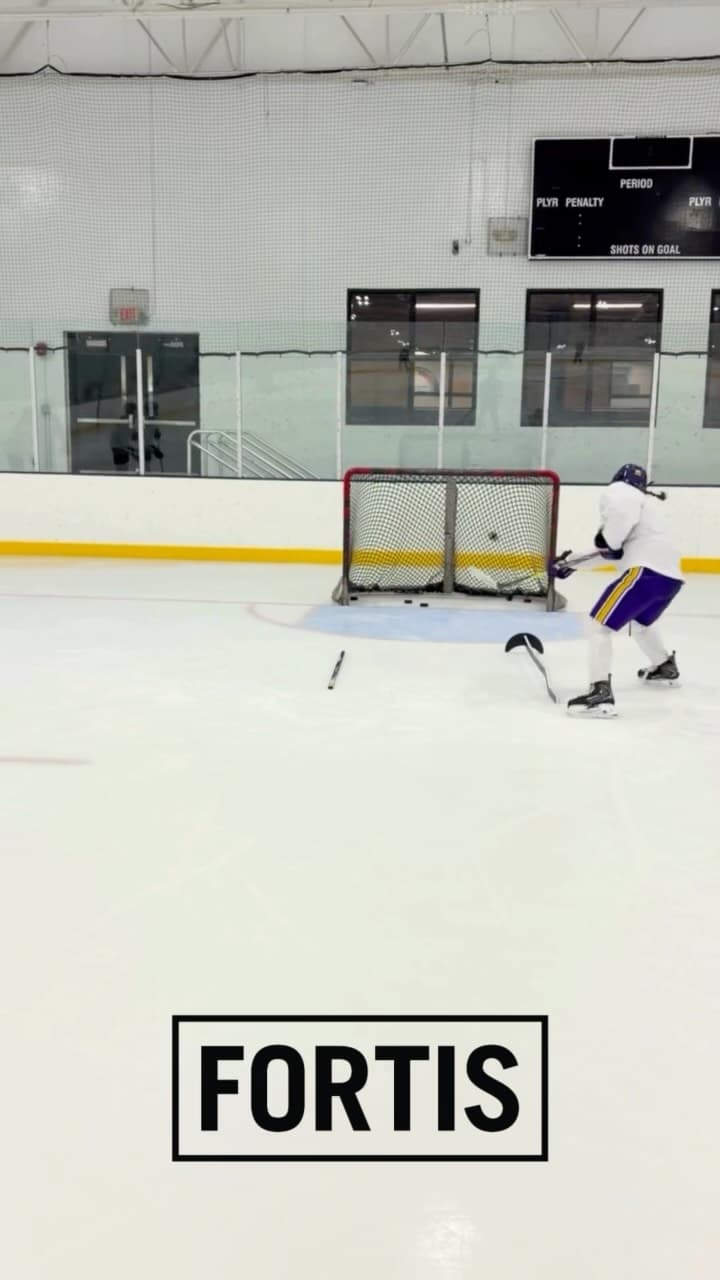
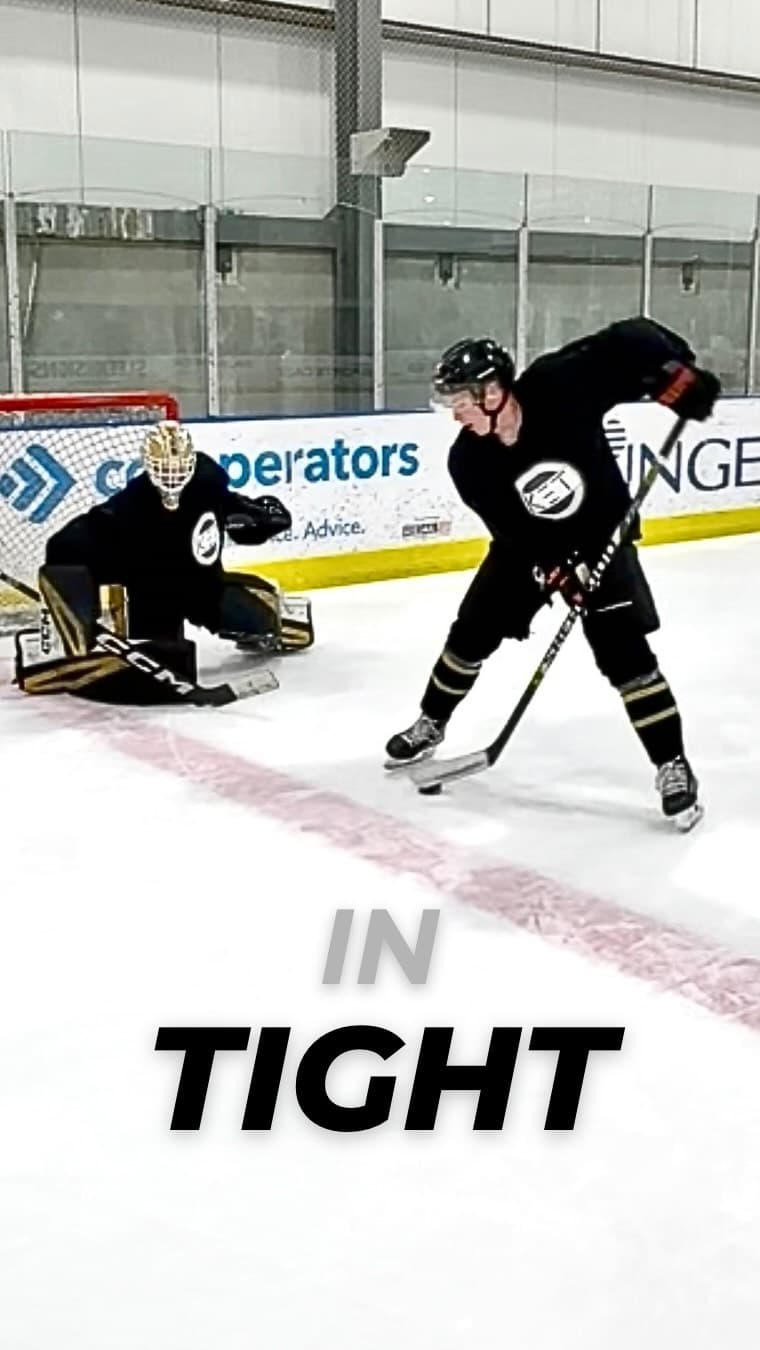
In-tight shooting work around the net, focused on getting control of loose pucks and finishing before the goalie can reset.
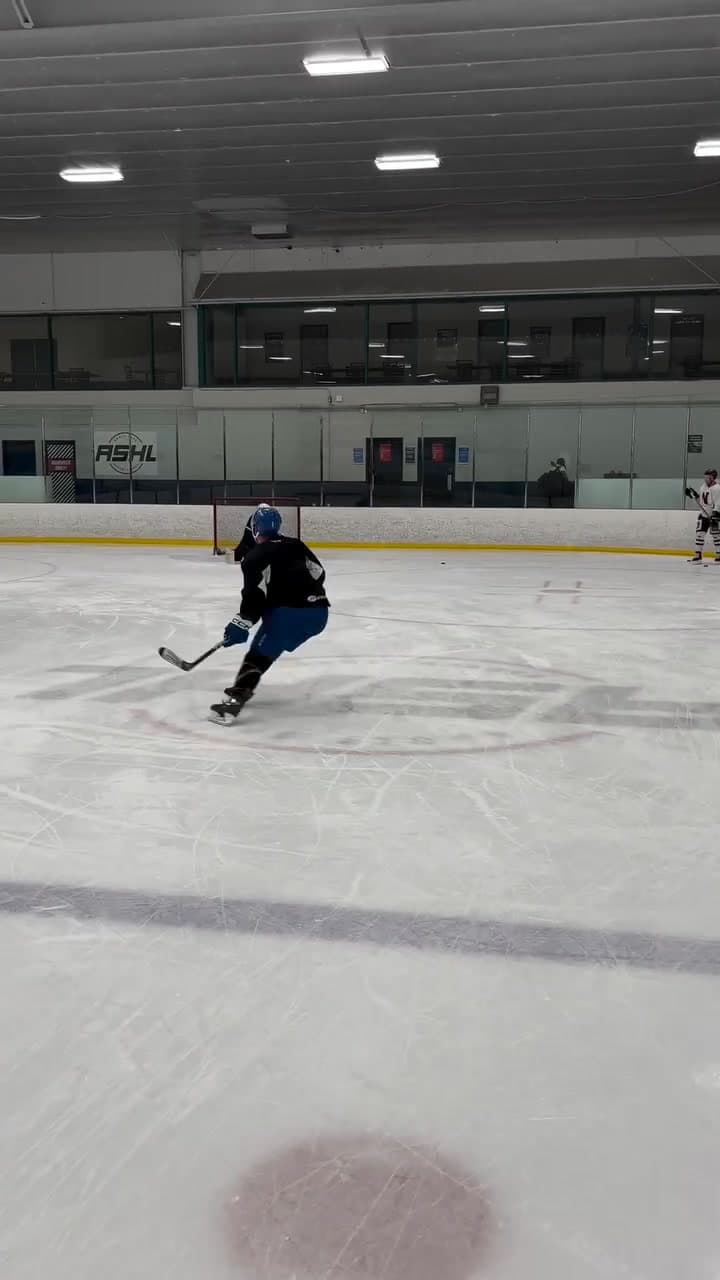
Defenseman Brad Hunt working the low-high look: skate from near the boards up to the middle of the offensive zone after receiving the puck, and get the shot away before the lane closes. Forwards drive the net front to screen and hunt the rebound.
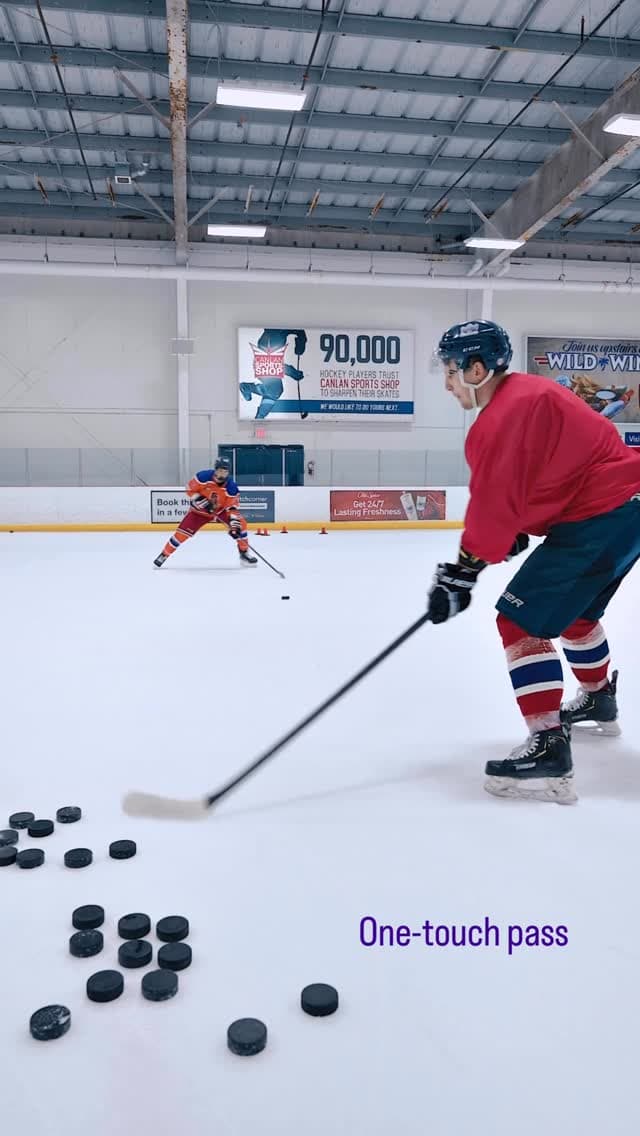
Quick release drill. Waiting for the perfect moment gives the goalie time to read the play and get set; the faster the release, whether the pass was perfect or not, the harder it is to react to. If it feels uncomfortable for the shooter, it is uncomfortable for the goalie too. Trains reaction, timing and the ability to capitalize before the goalie is ready.
Summer camp exercise built on a simple sequence: pass, support the puck, finish at the net.
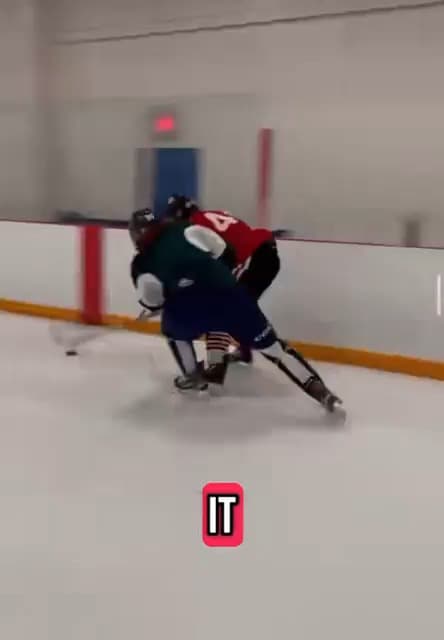
Shoot, strip the next puck, shoot again. Keep the feet moving the whole way through.
1-on-1s
5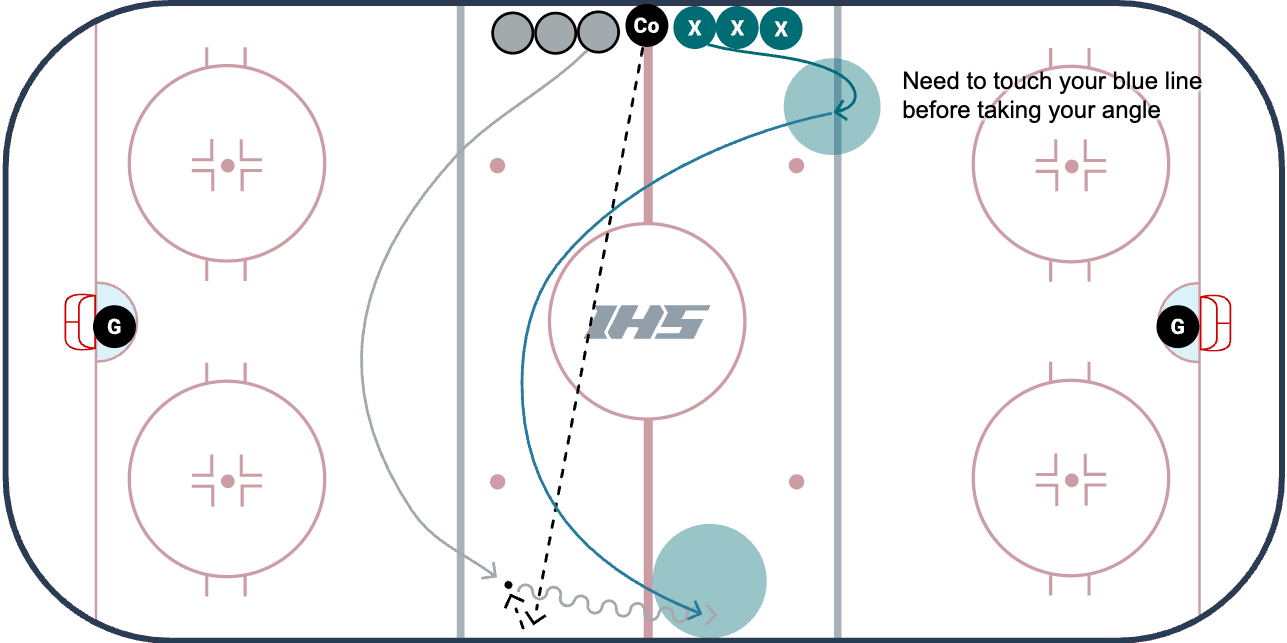
Develop proper gap control by teaching defensemen to defend while skating forward, using good angles and an active stick to eliminate time and space. Description - This 1 on 1 drill teaches defensemen how to maintain a tight gap while defending with their feet moving forward. The defender starts by touching the blue line before closing space on the attacking forward, using proper angles, stick position, and body control to dictate the play. Setup & Execution - Coach spots a puck off the wall for the forward to retrieve. - The defender begins by touching the blue line before closing the gap. - The forward attacks the net while the defender skates forward to maintain a tight gap. - The defender uses proper angling and an active stick to take away time and space. - Transition and recover only when the attacker gains an advantage. - Play continues until the scoring chance is complete.
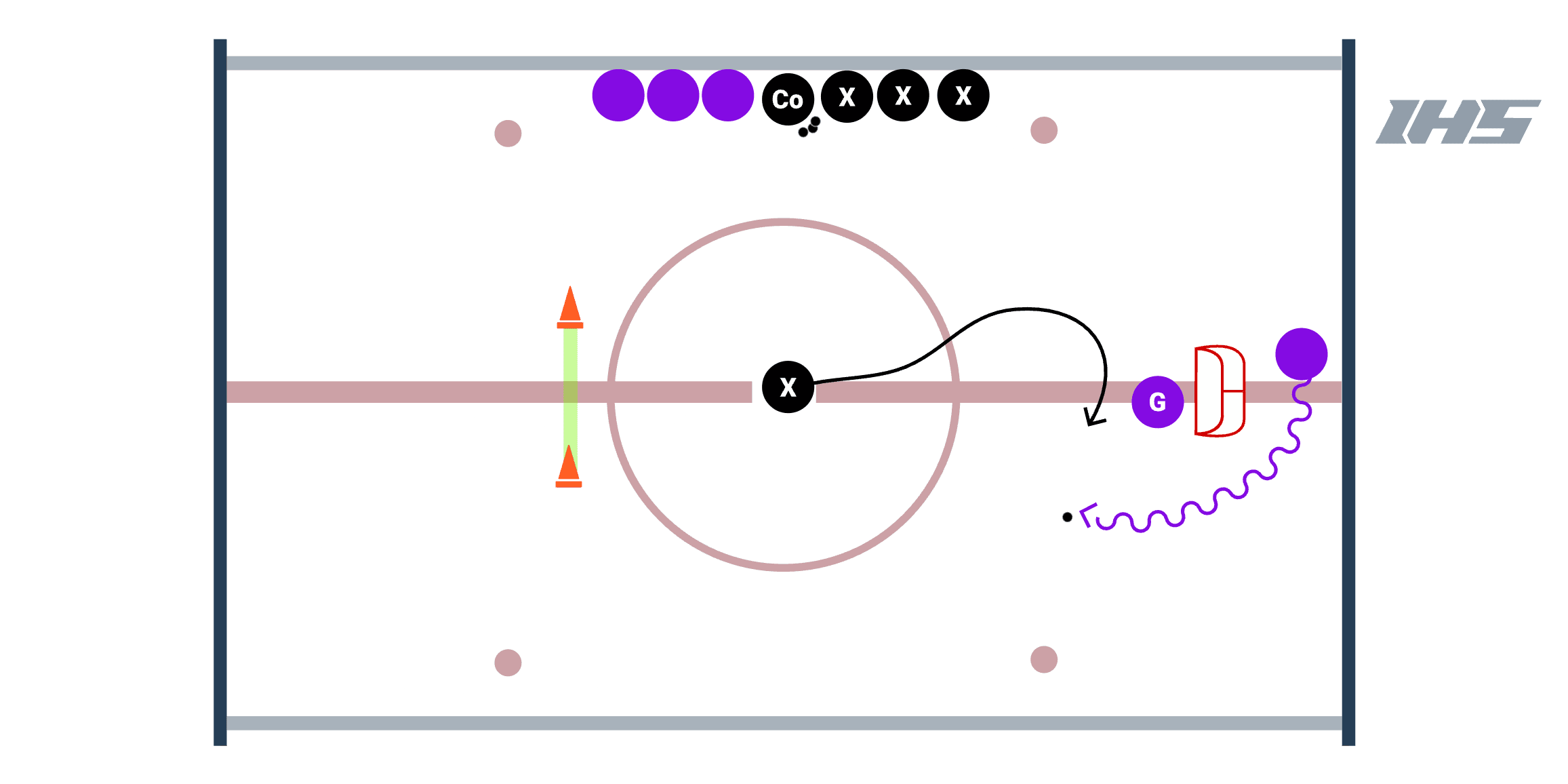
1 v 1 Use the Net from Jason Lammers is a great drill for all age levels that encourages offensive awareness and puck protection while the defenders work on angling and proper stick detail. The offensive team is trying to skate the puck through the gate while the defender is looking to strip the puck and score on net. Setup - Setup a net and a gate as the goals. These can be placed in center ice like the video displays, or in other areas of the ice. - A defensemen starts with the puck behind the net. - A forechecking forward starts in the middle of the playing area and tries to angle the defender to one area of the ice. - The defender keeps their head up, uses the net to protect the puck and tries to skate through the gates. - If the forward strips the puck, they try to score a goal on net. - After the rep the forward rotates to defense, the defender rotates out, and a player from the line sets up behind the net. - Keep score! 1 point for a goal through the gates and 2 points for a goal. Variations - Can set this up in different areas of the ice. - Can use tires, cones or gloves to create the gate. - Can make the gate larger (makes the game easier for the breakout team) or smaller (makes the game harder) - Can progress this to 2 v 2, so that the defensive team has to work together to break the puck out and the forechecking team can work together to stop the breakout. - Can progress this to the in zone net and these two options: 1 v 1 Puck Retrieval to 2 v 1 from Jason Lammers 2 v 1 Use the Net drill from Topher Scott - 1 v 1 Puck Retrieval to 2 v 1 from Jason Lammers - 2 v 1 Use the Net drill from Topher Scott
This one on one drill focuses on an area of the ice where a lot of turnovers occur. Being able to transition quickly will help generate scoring chances. This drill sets players up in a situation where the sole purpose is to have them keep moving their feet as they enter the zone, fighting through the check if they have to. Setup - This can be set up as a full ice (as shown in the video), or half ice on both sides, or as a station drill. - The drill is set up with the pucks and coaches in the middle of the ice at about the edge of the center face-off circle with pucks. The extra players are inside the center circle out of the way. The forward starts on the blue line along the wall and the defense start on the blue line just inside the dots. - On the whistle, both players skate up to the red line and stop. The forward calls to receive a pass from the coach (or another player) and the defense transitions backwards... then the danger zone starts! - Variation: If the defense is getting beat too often, you can have them stop or pivot backwards in between the blue line & center line, which will give them a bit of a head start on the forwards. Forward Options - Outside Option: The first is to use their speed and gain the zone to the outside. If the defense is able to play them at the blue line then they can give themselves a soft chip inside the zone and keep their feet moving through the check. - Middle of Ice Option: If the defense does not do a good job at the blue line and allows the forward to enter the zone with space then the forward can cut to the middle of the ice. It is important that the forwards get the puck down deep into the zone in this situation. - Get Creative! Anything goes! Change up your skating speed and tempo, use deceptive moves with your body and puck control to get the defenceman off balance, etc. Have fun and work to survive the danger zone! Defense Coaching Points - This 1 on 1 drill is for a very specific part of the ice. More 1 on 1 situational drills can be viewed on our 1 on 1 hockey drills page.
A fun race that works on edges, tight turns and body positioning. Rewards the winner with a shot. Variations - Left Turn - Right Turn - Forward to Backwards - Backwards to Forwards - Side Jumps
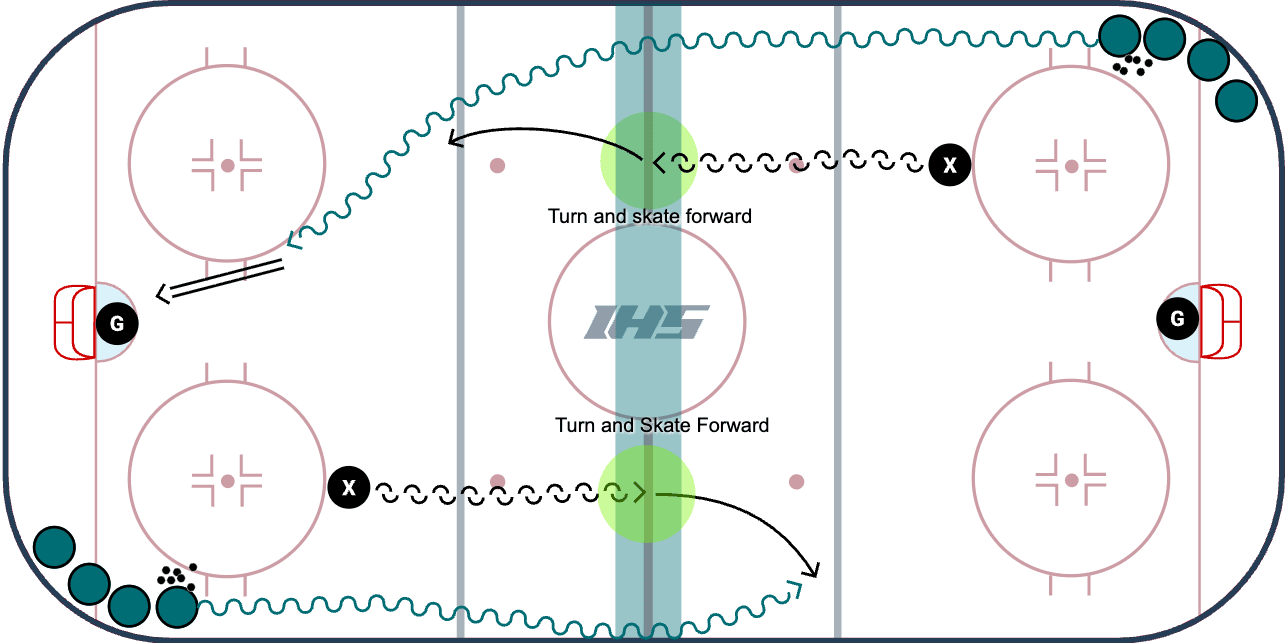
Develop a defenseman's skating, gap control, and confidence by reinforcing efficient footwork and maintaining a tight gap in open-ice situations. Description - This 1 on 1 drill provides defensemen with opportunities to develop confidence in their skating and gap control. Defensemen work on quickly transitioning from a backward skate to forward skating, maintaining a tight gap, and using efficient footwork to eliminate time and space as the attacker advances. Setup & Execution - The forward begins with the puck and attacks straight down the ice. - The defenseman starts by backpedaling to the red line. - Once the defenseman reaches the red line, they pivot, match the attacker's speed, and close the gap. - The play continues as a live 1 on 1 to the net. - As a progression, the defenseman can quickly recover into a second rush to reinforce repeated gap control and skating habits. Coach's Note - Doug emphasizes that this drill is designed to build confidence in a defenseman's skating. The more comfortable a defenseman is with their footwork, the more confident they'll be maintaining tight gaps and holding the blue line in game situations.
Defending & Gap Control
5Develop proper gap control by teaching defensemen to defend while skating forward, using good angles and an active stick to eliminate time and space. Description - This 1 on 1 drill teaches defensemen how to maintain a tight gap while defending with their feet moving forward. The defender starts by touching the blue line before closing space on the attacking forward, using proper angles, stick position, and body control to dictate the play. Setup & Execution - Coach spots a puck off the wall for the forward to retrieve. - The defender begins by touching the blue line before closing the gap. - The forward attacks the net while the defender skates forward to maintain a tight gap. - The defender uses proper angling and an active stick to take away time and space. - Transition and recover only when the attacker gains an advantage. - Play continues until the scoring chance is complete.
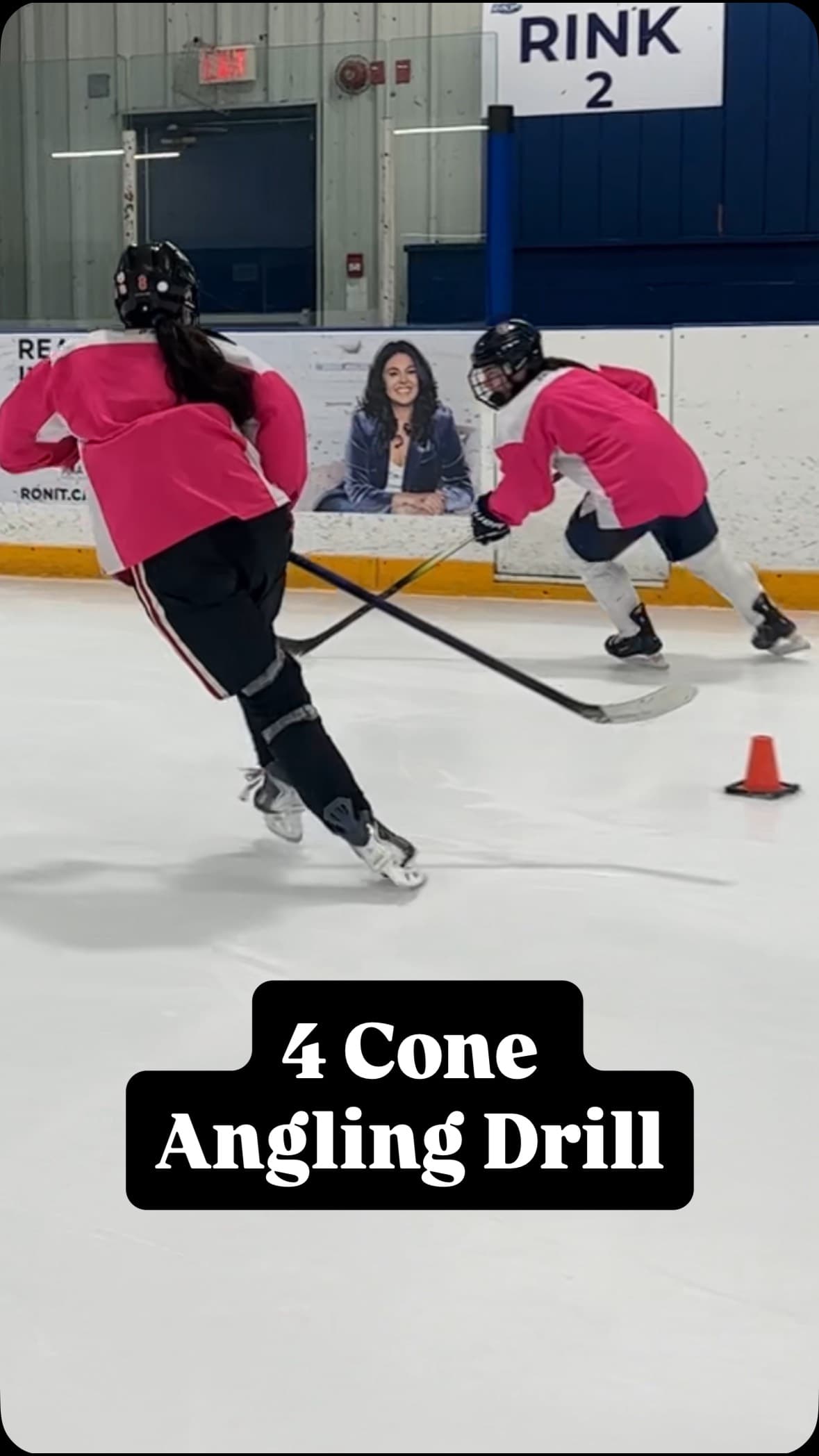
An old drill but a good one: four cones, angling opponents to the outside with a good stick and body position, using skating to stay in a good defensive spot.
The Angle Shooter drill from Jim Midgley focuses on developing angling habits and defensive pressure immediately after a player takes a shot. Players attack across the ice to take a shot on net, then quickly transition into a defensive role where they angle the next puck carrier to the outside. This drill reinforces strong skating habits, smart stick positioning, and controlling the opponent’s lane to reduce quality scoring chances. Setup - Divide players into two groups (two colors) on each side of the ice. - Run the drill simultaneously on both sides of the rink. - Use the offside dots as a skating guideline when players attack across the ice. - The drill is whistle-controlled by the coach. How It Works - On the whistle, the first player (#1 ) carries the puck across the ice using the offside dots as a guide and takes a shot on net. - After the shot, the coach blows the whistle again. - The shooter immediately stops, turns, and becomes the angler. - At the same time, a player from the opposite line (# 2) carries a puck across the ice toward the net to take a shot. - The original shooter angles the puck carrier, forcing them to the outside and disrupting the shot. Key Concepts - Angling fundamentals - Offense to defense transition - Stick positioning and puck pressure - Forcing attackers to low-percentage areas - Defensive skating habits
Develop a defenseman's skating, gap control, and confidence by reinforcing efficient footwork and maintaining a tight gap in open-ice situations. Description - This 1 on 1 drill provides defensemen with opportunities to develop confidence in their skating and gap control. Defensemen work on quickly transitioning from a backward skate to forward skating, maintaining a tight gap, and using efficient footwork to eliminate time and space as the attacker advances. Setup & Execution - The forward begins with the puck and attacks straight down the ice. - The defenseman starts by backpedaling to the red line. - Once the defenseman reaches the red line, they pivot, match the attacker's speed, and close the gap. - The play continues as a live 1 on 1 to the net. - As a progression, the defenseman can quickly recover into a second rush to reinforce repeated gap control and skating habits. Coach's Note - Doug emphasizes that this drill is designed to build confidence in a defenseman's skating. The more comfortable a defenseman is with their footwork, the more confident they'll be maintaining tight gaps and holding the blue line in game situations.
This drill is a quick offensive drill for forwards to work on their stick lifts, timing, and attack. - SETUP: Setup - This is a neutral zone drill, there should be one net on the red line with its back towards the wall. One player on each side of the bottom of the circle ready to receive a pass. - Two lines of players in line with the posts with a pile of pucks nearby. There is only one player ready with a puck per rep. - HOW THE DRILL WORKS: Setup - To start the drill that player going first will make a pass vertically to the player across from them. They will then attack, stick lift, and take the puck and make a pass back to their own line. - After passing back to their own line, the player who received the pass will pass it laterally to the first player in the other line. While this is happening the player doing the drill swings and turns towards the middle to catch the puck from the player who has the puck. - After receiving the puck, the player then attacks the player vertically across from the line they started in and pulls the puck to the outside, making sure they are protecting it with their back and hips and then once they get around the player, they take the puck in and shoot. - COACHING POINTS: Setup - In this drill it is important that the players focus on showing good targets for all of their passes including some communication. They should also make sure that they are being strong and quick in their stick lifts.
Puck Protection & Wall Play
131 v 1 Use the Net from Jason Lammers is a great drill for all age levels that encourages offensive awareness and puck protection while the defenders work on angling and proper stick detail. The offensive team is trying to skate the puck through the gate while the defender is looking to strip the puck and score on net. Setup - Setup a net and a gate as the goals. These can be placed in center ice like the video displays, or in other areas of the ice. - A defensemen starts with the puck behind the net. - A forechecking forward starts in the middle of the playing area and tries to angle the defender to one area of the ice. - The defender keeps their head up, uses the net to protect the puck and tries to skate through the gates. - If the forward strips the puck, they try to score a goal on net. - After the rep the forward rotates to defense, the defender rotates out, and a player from the line sets up behind the net. - Keep score! 1 point for a goal through the gates and 2 points for a goal. Variations - Can set this up in different areas of the ice. - Can use tires, cones or gloves to create the gate. - Can make the gate larger (makes the game easier for the breakout team) or smaller (makes the game harder) - Can progress this to 2 v 2, so that the defensive team has to work together to break the puck out and the forechecking team can work together to stop the breakout. - Can progress this to the in zone net and these two options: 1 v 1 Puck Retrieval to 2 v 1 from Jason Lammers 2 v 1 Use the Net drill from Topher Scott - 1 v 1 Puck Retrieval to 2 v 1 from Jason Lammers - 2 v 1 Use the Net drill from Topher Scott
Small area 3 v 2 game built around holding onto pucks under pressure with a numerical advantage.
This is a great drill for working on cutbacks behind the net, it is useful for both forwards and defensemen because this is a great skill to use whether in the offensive or defensive zone. - SETUP: Setup - To set up this drill, there should be a line at the top of one of the circles with a pile of pucks. The player starting the drill can start on the top of the other circle but after that it is continuous. - There should be a goalie in net in its respective position. - HOW THE DRILL WORKS: Setup - To start the drill, player 1 will skate around the net and show their forehand to player 2 who is first in line. Player 2 will pass the puck to player 1, get it back, and then as player one turns towards the wall showing either their forehand (lefty) or backhand (righty), they will give the puck back to 1. - Player 1 will then skate back around the net while player 2 is mirroring them. Player 2 will then provide pressure just off of the left post and player 1 will perform a cut-back to escape the pressure and turn back the other way. - After Player 1 makes it back around the post, they will find player 2 in the slot for a quick pass and shot. - Because this is continuous, after Player 2 shoots, they will skate around the net and get ready for a give and go with the next player in line. - COACHING POINTS: Setup - The most important thing about this drill is performing the cut back and utilizing the space behind the net to create separation between you and the defender.
The Corner Houda from Dave Smith focuses on puck retrievals, wall play, quick transitions, and structured zone play. It offers flexibility for various d-zone and special teams scenarios by changing it up from 3v3 to 5v3 to 5v4. Setup - Two coaches positioned on opposite sides of the blue line to initiate a rimmed puck. - Players are split into offensive and defensive groups—typically starting 3v3 (but can expand to 5v3 and 5v4). - Puck is rimmed around the boards to initiate a battle. Execution - First three players from one side retrieve the puck and start on offense; three from the other side defend. - Offensive group gains possession and attempts to create a scoring opportunity. - Drill is repeatable with different number combinations: 3v3, 5v3, 5v4 (PP/PK), etc. - Defensive group must pass or skate the puck over the red line to transition out. - Can include a net and goalie at the red line for breakout scoring opportunities after defensive transition. Progression - Start with 3v3 for basic wall play and transition work. - Advance to 3v5 to work on defensive zone returns and structure (slot, net front, strong side wall). - Incorporate special teams scenarios: Power play (PP) starts with puck possession. Penalty kill (PK) may retrieve puck and clear or attempt to shut down the PP setup. - Power play (PP) starts with puck possession. - Penalty kill (PK) may retrieve puck and clear or attempt to shut down the PP setup. Variations - Use variations (3v3, 5v3, 5v4) to target different systems and teaching points. - Can have the defensive group must pass or skate the puck over the red line to transition out or you can include a net and goalie at the red line to give the defense a chance to shoot on net.
The Fran Gow 3 on 2 and 3 on 3 small area game focuses on controlling pucks off the wall, creating time and space, and attacking the net with purpose. Players learn to manage pressure, roll off defenders, protect the puck, and make quick decisions in tight areas while defenders work on stick on puck and box outs. Drill Setup - Place a net just above the hashmarks or along the ringette line if available. Establish a goal line across the ice with the net facing the end boards. - Start with three offensive players and two defensive players. You can add a third defender to make it three on three for additional compete. - Each offensive group receives three pucks. The first and third pucks are rimmed in by the coach on their side. The second puck is rimmed by the coach on the opposite side. - On each whistle a coach rims a puck around the boards. Offense must retrieve it, control it off the wall, and attack the net. Any time a puck crosses the line, enters the net, or is covered by the goalie, the next whistle starts the next puck. Coaching Points - Offense: Coaching Points - Defense: Coaching Points - General Concepts: Variations - Can place net on goal line, on the hashmarks (as shown in diagram) or on top of circles - Can play 3 v 2 or 3 v 3
Receiving passes, protecting pucks and creating offense from one of the hardest areas on the ice.
College and AAA forwards working on playing with the puck away from their bodies, controlling it while shifting weight rather than keeping the hands in tight. The stickhandling is deliberately stripped out so the focus is weight transfer.
Puck protection with interchanges: heads up, brains on, leading with the puck and creating space.
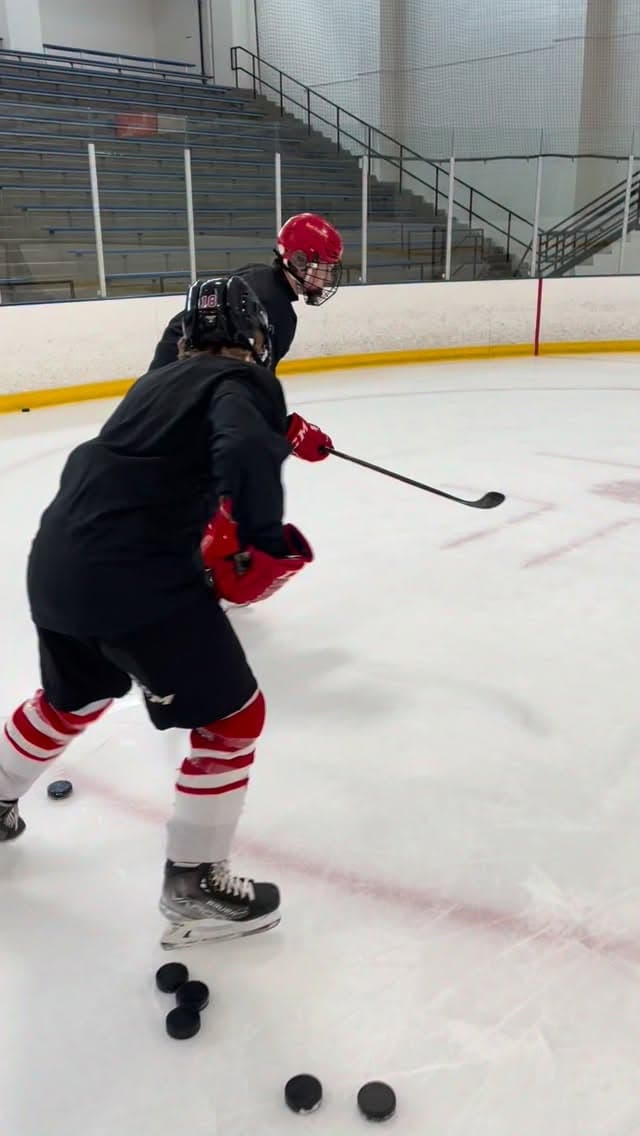
New York Sirens forward Elle Hartje teaches players that winning a puck race isn't about being first to the puck—it's about winning the puck line. This competitive puck battle game develops body positioning on puck races, puck protection under pressure, and the ability to quickly transition into offense or defense on the second whistle. Setup - Coach places a puck inside one of the faceoff circles. - Two players begin outside the circle. - On the first whistle ("Go!"), both players race to gain possession. - The player who wins the puck must protect it while staying inside the circle. - The defender applies pressure and attempts to steal possession. - If the puck leaves the circle, it is dead and the coach immediately spots a new puck in the circle. - On the second whistle ("Go!"), play becomes live. The player with possession attacks the net to score, while the defender tries to regain possession and return the puck to the coach. Coaching Points - This drill was filmed at the Girls Pro Edge Experience at Rochester Ice Center.
Retrieve the puck under pressure and immediately play a give-and-go to get out of the zone with speed.
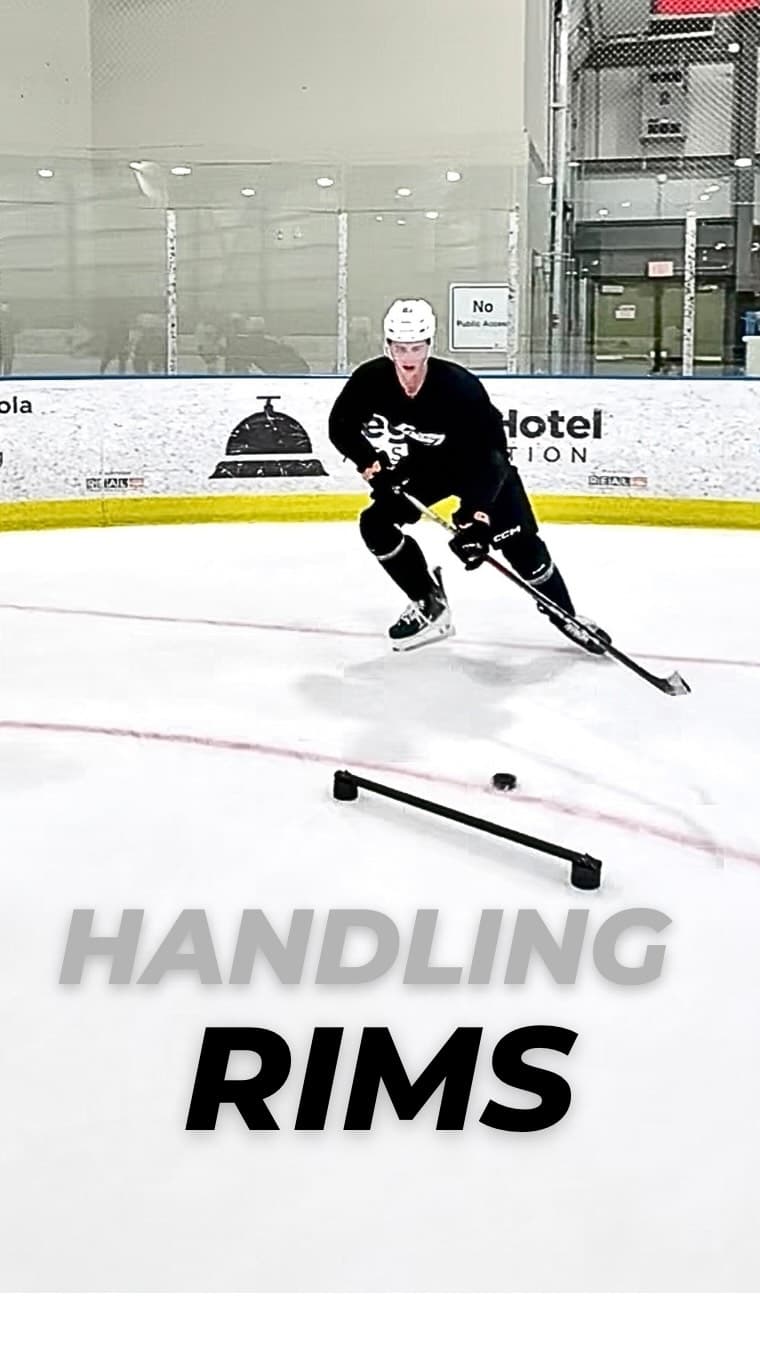
Rims happen every game; what you do after the retrieval creates the offense. This drill develops collecting a rimmed puck, attacking with speed, beating the pressure and getting to the net for a quality scoring chance.
The Soft Catch Behind the Net to Attack from the Academy of Hockey is a drill from the Soft Catch Skills Practice to help practice wall play, passing, routes and timing. Coaches can add light pressure to the drill so players need to keep their head up and pass around the coach. The drill highlights the "soft catch skill" where players catch the puck across their body in stride. - The primary benefit of a soft catch across your body is that it allows you to maintain your skating momentum and instantly load your weight to seamlessly transition into a shot, pass, or deke without missing a stride. The soft catch also allows you to protect the puck while along the boards. Setup - One net - Two lines along each side of the boards. - On the whistle, one side rims the puck (yellow player 1) along the boards while the player from the other side soft catches the puck (blue player 1), curls and finds the player who rimmed the puck in the slot for a quick shot. - The drill is continuous and after a rep is completed, the next player in the other line rims the puck (blue player 2). Variations - Coaches can add light pressure to the drill so the players must keep their head up and pass around. - Can add a live defender so the drill becomes a live 2 v 1. - Can set this up in different areas of the ice so the rim and puck collection happen at a different spot other than behind the net.
Warm-up drill focused on wall work, from Minnesota Wild skating and skills coach Andy Ness. A skill that gets too little attention at the younger age groups.
Battle Drills
71 v 1 Use the Net from Jason Lammers is a great drill for all age levels that encourages offensive awareness and puck protection while the defenders work on angling and proper stick detail. The offensive team is trying to skate the puck through the gate while the defender is looking to strip the puck and score on net. Setup - Setup a net and a gate as the goals. These can be placed in center ice like the video displays, or in other areas of the ice. - A defensemen starts with the puck behind the net. - A forechecking forward starts in the middle of the playing area and tries to angle the defender to one area of the ice. - The defender keeps their head up, uses the net to protect the puck and tries to skate through the gates. - If the forward strips the puck, they try to score a goal on net. - After the rep the forward rotates to defense, the defender rotates out, and a player from the line sets up behind the net. - Keep score! 1 point for a goal through the gates and 2 points for a goal. Variations - Can set this up in different areas of the ice. - Can use tires, cones or gloves to create the gate. - Can make the gate larger (makes the game easier for the breakout team) or smaller (makes the game harder) - Can progress this to 2 v 2, so that the defensive team has to work together to break the puck out and the forechecking team can work together to stop the breakout. - Can progress this to the in zone net and these two options: 1 v 1 Puck Retrieval to 2 v 1 from Jason Lammers 2 v 1 Use the Net drill from Topher Scott - 1 v 1 Puck Retrieval to 2 v 1 from Jason Lammers - 2 v 1 Use the Net drill from Topher Scott
2 v 2 Net Front Corner Battles with Support is a competitive 2 v 2 small area game from the 2025 Buffalo Sabres Development Camp that practices corner and net front battles. The design of this drill encourages players to win the puck battle and pass it to the point for support and a shot, tip or redirect on net. Setup - Nets are in the corner as shown in the diagram. - Each team has 2 players at the point, 2 players in zone, and 1 goalie. - The drill begins with a coach flipping the puck into the zone. - Each team is working to retrieve the puck and score on the opposing teams net, while the defending team is working to get the puck back so they can score on the other net. - Coaches can require the defense to have to pass the puck to the point before they can transition to offense, or they can allow the defense to immediately attack the other teams goal. Variations - Coaches can require the defense to have to pass the puck to the point before they can transition to offense, or they can allow the defense to immediately attack the other teams goal. - Coaches can require the defense to only look for passes and redirects and no shots. - Coaches can require the defense to one touch or two touch everything so the puck is not sitting at the point. - Coaches can only allow the defense to go d to d once or twice (if they allow them to go back and fourth unlimited times it can slow the game down) - This drill is a variation of Defend Net Front Progression With 2 Point Players, which sets up the two goals on the goal line and gives the players more space but works on similar concepts and would be better for younger age levels.
This one on one drill focuses on an area of the ice where a lot of turnovers occur. Being able to transition quickly will help generate scoring chances. This drill sets players up in a situation where the sole purpose is to have them keep moving their feet as they enter the zone, fighting through the check if they have to. Setup - This can be set up as a full ice (as shown in the video), or half ice on both sides, or as a station drill. - The drill is set up with the pucks and coaches in the middle of the ice at about the edge of the center face-off circle with pucks. The extra players are inside the center circle out of the way. The forward starts on the blue line along the wall and the defense start on the blue line just inside the dots. - On the whistle, both players skate up to the red line and stop. The forward calls to receive a pass from the coach (or another player) and the defense transitions backwards... then the danger zone starts! - Variation: If the defense is getting beat too often, you can have them stop or pivot backwards in between the blue line & center line, which will give them a bit of a head start on the forwards. Forward Options - Outside Option: The first is to use their speed and gain the zone to the outside. If the defense is able to play them at the blue line then they can give themselves a soft chip inside the zone and keep their feet moving through the check. - Middle of Ice Option: If the defense does not do a good job at the blue line and allows the forward to enter the zone with space then the forward can cut to the middle of the ice. It is important that the forwards get the puck down deep into the zone in this situation. - Get Creative! Anything goes! Change up your skating speed and tempo, use deceptive moves with your body and puck control to get the defenceman off balance, etc. Have fun and work to survive the danger zone! Defense Coaching Points - This 1 on 1 drill is for a very specific part of the ice. More 1 on 1 situational drills can be viewed on our 1 on 1 hockey drills page.
Picket Fences is a great small area hockey game that can be setup as a 2 vs. 2 or 3 vs. 3 game. The offensive team gets 2 points for scoring a goal and the defensive team gets 1 point by skating the puck between the tires. Game: Objective: Play a Game up to a certain Number (1 point for the Defensive Team skating the puck between the tires & 2 points for the Offensive Team when they score) - When the whistle blows, three players in White (Offensive) get a puck from coach while three players in Red (Defensive) being to defend - The team in White attempts to score while the Team in Red attempts to steal the puck & skate it between the tires - The coach allows the players to compete for 20-30 seconds - There is NO change of possession (White is offense the entire shift) - When the next whistle blows, three new players enter from the White and Red team - Now, Red is on Offense and White is on Defense - Coach can give a new puck to the Offensive Team if: - If the goalie covers the puck - If the puck goes out of play - A goal is scored - The defensive team skates the puck between the tires Principles: The brilliance of this game is both teams are attempting to ‘score’ while one attacks the goalie & one aims for possession to skate the puck between the tires. The game incorporates: - Defending 3v3 (in a condensed space) - Once the Defenders gain possession of the puck, they must thinking ‘offensively’ to skate/get open to score a Goal (skate puck between tires) - Communication with other teammates is essential so each defender can operate in a ‘man on man’ scenario - Attacking 3v3 (in a condensed space) - The offensive players are can either challenge a defender 1v1 with the puck or try to isolate and create a 2v1 on a defender - Player without the puck must work to get open, drive net or create space for teammates - Must find a way to create space & opportunities to get off a quality shot with pressure - ‘Play after the Play’ – anticipate loose puck/rebounds and regain possession for more offensive zone time with the puck - Players must constantly talk & perceive the ever changing environment to solve problems as they happen (both offensively & defensively) Related Game / Variation The picket fences 3 vs 3 uses the full zone and incorporates 2 gates. This way the defenders can use deception or are forced to use another option in order to carry the puck through the gates.
New York Sirens forward Elle Hartje teaches players that winning a puck race isn't about being first to the puck—it's about winning the puck line. This competitive puck battle game develops body positioning on puck races, puck protection under pressure, and the ability to quickly transition into offense or defense on the second whistle. Setup - Coach places a puck inside one of the faceoff circles. - Two players begin outside the circle. - On the first whistle ("Go!"), both players race to gain possession. - The player who wins the puck must protect it while staying inside the circle. - The defender applies pressure and attempts to steal possession. - If the puck leaves the circle, it is dead and the coach immediately spots a new puck in the circle. - On the second whistle ("Go!"), play becomes live. The player with possession attacks the net to score, while the defender tries to regain possession and return the puck to the coach. Coaching Points - This drill was filmed at the Girls Pro Edge Experience at Rochester Ice Center.
Shoot, strip the next puck, shoot again. Keep the feet moving the whole way through.
The Tomas Holmstrom Small Area Game from Spiros Anastas is a competitive net front battle drill designed to teach offensive players how to get inside for screens, tips, and rebounds while defenders work on box outs, containment, and blocking shots. A shooter fires from the top of the circles as players fight for positioning inside a defined box. Drill Setup - Draw a box from just inside the dots and hashmarks up to the top of the circles and back down to the goal line. Drill Setup - Players: Drill Setup - 3 offensive players inside the game - 2 defensive players with the option to add a third to increase difficulty or emphasize shot blocking - 1 shooter positioned outside the box at the top of the circles Drill Setup - Place 5 pucks outside the box for five consecutive reps. Drill Setup - On each whistle all offensive players must tag up outside any boundary of the box which can include the goal line, the sides, or the high line. Defenders do not tag up but must track where attackers enter. The shooter can only shoot after the whistle but may delay to wait for a screen or tip. Shots only with no direct passes. After five reps switch offense and defense and keep score. Coaching Points - Offense: Coaching Points - Defense: Coaching Points - Shooter: Coaching Points - Goalie: Variations - Can make it 3 v 2 or 3 v 3 - Can require the defenseman to shoot further away - Can allow the defenseman to pass for redirects or one timers Variations - View more drills and content from Spiros Anastas
Transition
8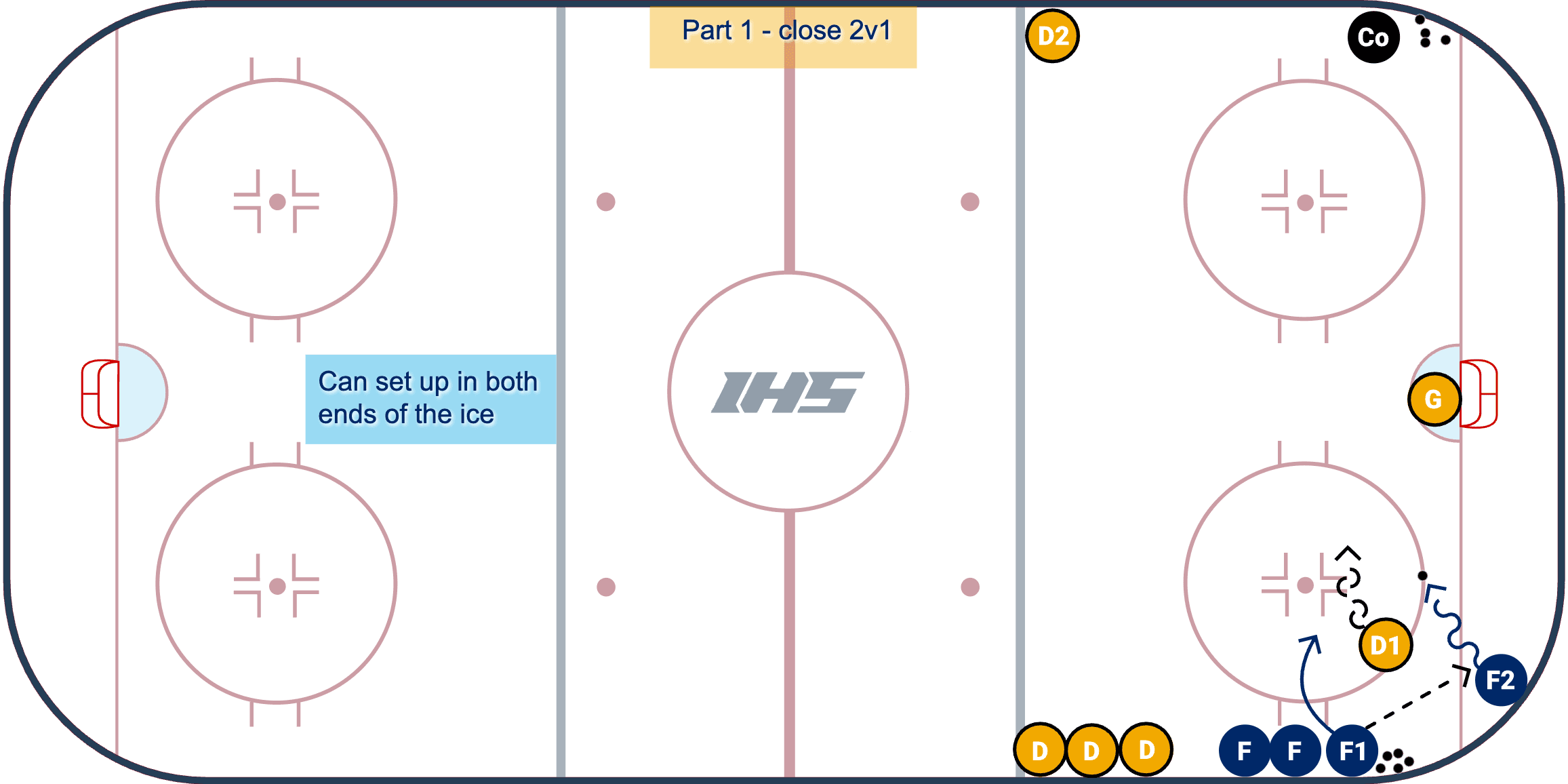
The 2 v 1 Preds drill from Jim Midgley focuses on quick offensive plays around the net, tracking habits, and transition offense. The drill begins with a tight 2-on-1 play down low where forwards try to create a quick scoring chance. Immediately after the play, one forward tracks back to pressure the coach and regain possession, leading into a regroup and a long 2-on-1 rush back up the ice. Setup - The drill can be run out of both ends of the rink. - Two forwards begin low in the zone with one defenseman defending. - A coach is positioned higher in the zone to initiate the tracking portion of the drill. - The drill is whistle controlled by the coach. How It Works - On the whistle, the two forwards attack the defenseman in a tight 2 v 1 down low. - The forwards can use a quick exchange, scissor play, or short pass to create a scoring chance. - The goal is to make a quick play to the net and get a shot. - After the play, one forward immediately tracks back to pressure the coach and attempt to steal the puck. - The other forward works to get back inside the ice and support the play. - If the forwards regain the puck, they pass to the defenseman who quickly regroups the puck back to the forwards. - The forwards then attack up the ice in a long 2 v 1 rush against the original defenseman. Key Concepts - Quick offensive plays around the net - Tracking and puck pressure - Transition play - Regroup habits - 2-on-1 rush decision making
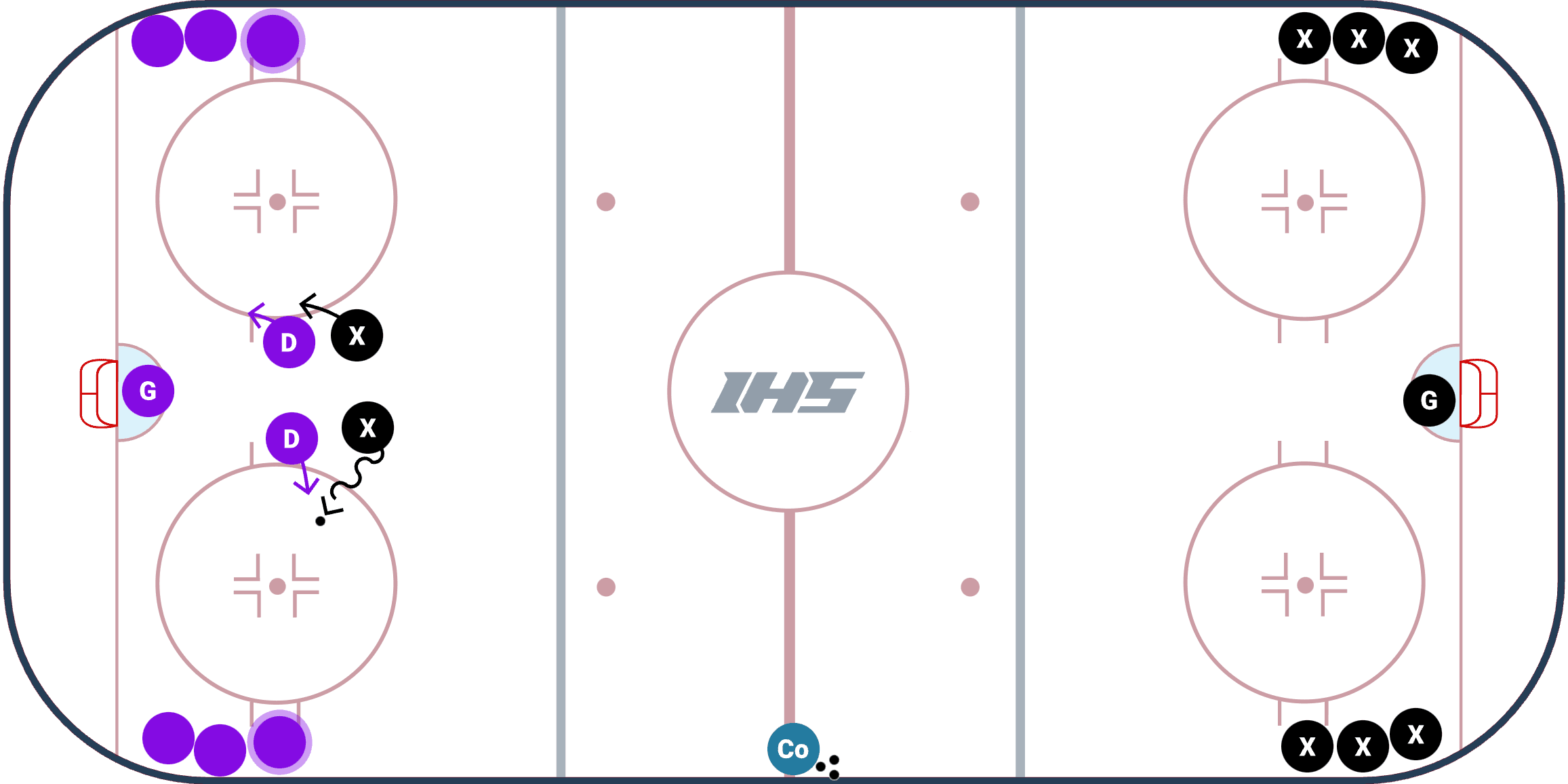
The 2 on 2 Long Transition drill from Jason Lammers focuses on pushing players out of their comfort zones to improve speed, decision-making, and transition play. The 2 on 2 Long Transition emphasizes breakout passes, backchecking, and offensive and defensive transitions. Setup - Players: Divide into two teams (e.g., White and Black). - Starting Positions: Two White players and two Black players start on the ice for a 2 on 2 scenario. The remaining players from each team line up below the hash marks on their respective sides of the ice. - Two White players and two Black players start on the ice for a 2 on 2 scenario. - The remaining players from each team line up below the hash marks on their respective sides of the ice. Execution - Initial Play: The drill begins as a 2 on 2. The offensive team attempts to create plays and score, while the defensive team works to get the puck and pass to their teammates along the boards. - Transition: When the breakout pass is made from the defensive team to their teammates along the boards, one teammate stretches out as a passing option, and the other two players that were on offense, now backcheck. - Rotation: The new pair from attacks, while the original forwards now backcheck. The drill is continuous and the players that backcheck and are on defense work to pass to their teammates in line. Variations - Adjust the number of players to create 3 on 3 or 4 on 4 scenarios. - Can make this drill cross ice (as shown here).
This one on one drill focuses on an area of the ice where a lot of turnovers occur. Being able to transition quickly will help generate scoring chances. This drill sets players up in a situation where the sole purpose is to have them keep moving their feet as they enter the zone, fighting through the check if they have to. Setup - This can be set up as a full ice (as shown in the video), or half ice on both sides, or as a station drill. - The drill is set up with the pucks and coaches in the middle of the ice at about the edge of the center face-off circle with pucks. The extra players are inside the center circle out of the way. The forward starts on the blue line along the wall and the defense start on the blue line just inside the dots. - On the whistle, both players skate up to the red line and stop. The forward calls to receive a pass from the coach (or another player) and the defense transitions backwards... then the danger zone starts! - Variation: If the defense is getting beat too often, you can have them stop or pivot backwards in between the blue line & center line, which will give them a bit of a head start on the forwards. Forward Options - Outside Option: The first is to use their speed and gain the zone to the outside. If the defense is able to play them at the blue line then they can give themselves a soft chip inside the zone and keep their feet moving through the check. - Middle of Ice Option: If the defense does not do a good job at the blue line and allows the forward to enter the zone with space then the forward can cut to the middle of the ice. It is important that the forwards get the puck down deep into the zone in this situation. - Get Creative! Anything goes! Change up your skating speed and tempo, use deceptive moves with your body and puck control to get the defenceman off balance, etc. Have fun and work to survive the danger zone! Defense Coaching Points - This 1 on 1 drill is for a very specific part of the ice. More 1 on 1 situational drills can be viewed on our 1 on 1 hockey drills page.
Retrieve the puck under pressure and immediately play a give-and-go to get out of the zone with speed.
Rims happen every game; what you do after the retrieval creates the offense. This drill develops collecting a rimmed puck, attacking with speed, beating the pressure and getting to the net for a quality scoring chance.
This drill is a quick offensive drill for forwards to work on their stick lifts, timing, and attack. - SETUP: Setup - This is a neutral zone drill, there should be one net on the red line with its back towards the wall. One player on each side of the bottom of the circle ready to receive a pass. - Two lines of players in line with the posts with a pile of pucks nearby. There is only one player ready with a puck per rep. - HOW THE DRILL WORKS: Setup - To start the drill that player going first will make a pass vertically to the player across from them. They will then attack, stick lift, and take the puck and make a pass back to their own line. - After passing back to their own line, the player who received the pass will pass it laterally to the first player in the other line. While this is happening the player doing the drill swings and turns towards the middle to catch the puck from the player who has the puck. - After receiving the puck, the player then attacks the player vertically across from the line they started in and pulls the puck to the outside, making sure they are protecting it with their back and hips and then once they get around the player, they take the puck in and shoot. - COACHING POINTS: Setup - In this drill it is important that the players focus on showing good targets for all of their passes including some communication. They should also make sure that they are being strong and quick in their stick lifts.
The Box Game from Brad Flynn is a small area game that works on quick decision making, transitions, give & goes and net front play. Setup - Teams line up at the blue line. - Coach dumps a puck in the corner, which starts an in zone 2 on 2. - The 3rd person in each line jumps into the zone at the point and they are the "slide player" at the blue line. They are allowed to go to the boards, to the coach. The slide player can pass or shoot. - Anytime there is a change of possession, the team that got the puck must pass to their slide player and work to get open, or get to the front of the net. - Part 2 progression option: Coaches can move the slide players up to the tops of the circle, so there is a smaller amount of space, which will require quicker decision making and give the slide players more opportunities for quick shots to the net. Variations - Can reduce the playing area as shown in the video - Can make this a 2 v 2 or 3 v 3 game.
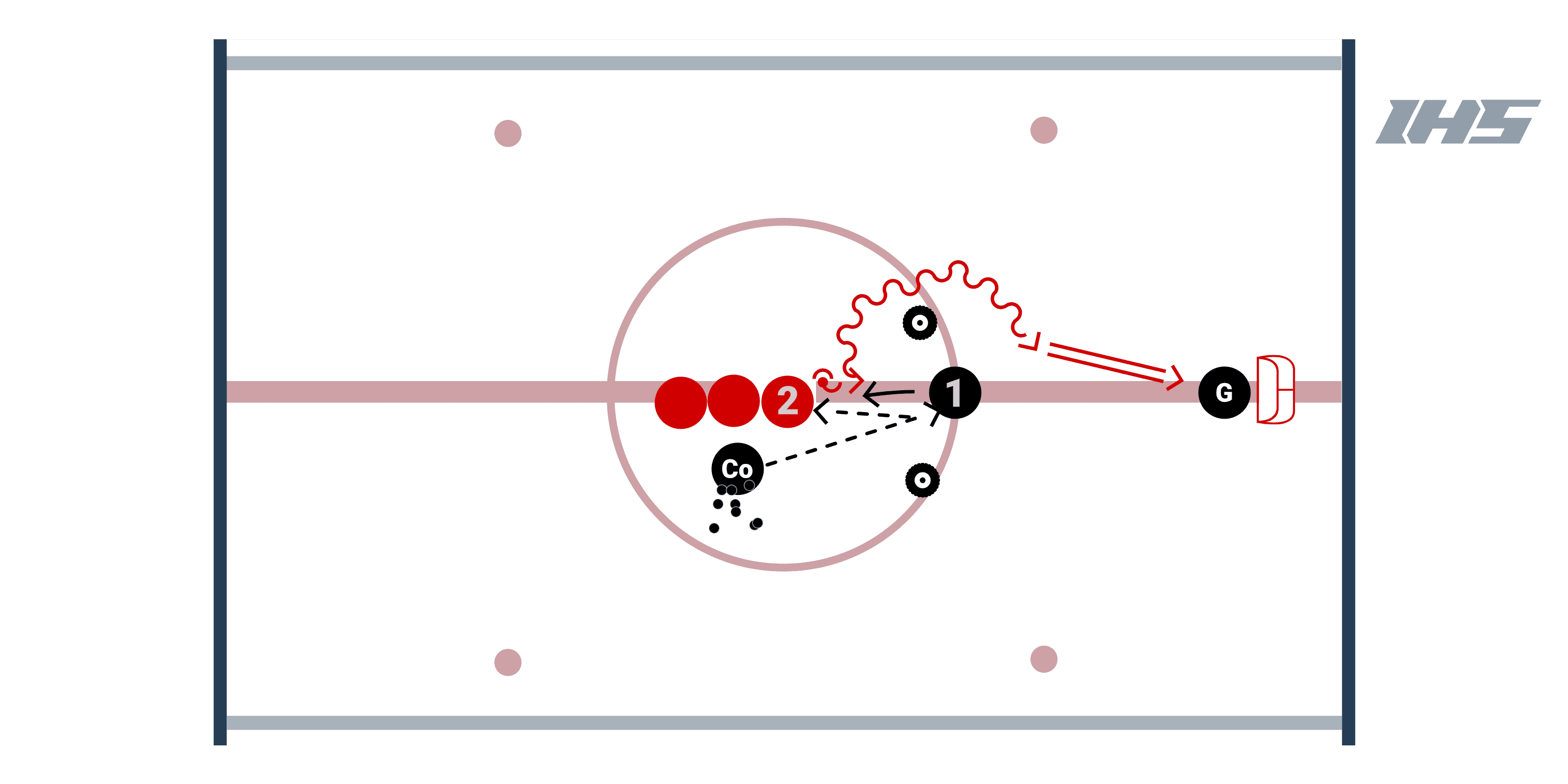
This is a neutral zone drill that is great for players to work on reading the pressure and quickly escaping to create offensive opportunities. - SETUP: Setup - To set up this drill, there should be a net on the red line with its back towards the wall. A coach off to the side of the circle with a pile of pucks and a line of players starting at the middle dot. - There should be two tires just off of each post and the first defensive player should be just in between those tires. - HOW THIS DRILL WORKS: Setup - To start the drill, the coach will pass a puck to Player 1 whom is in between the two tires and they will pass it to the first player in line (Player 2). - Player 2 will turn their back to Player 1 who is then picking a side and applying pressure to Player 2. Player 2 will read which side the pressure is coming from and then escape out and around the tire to take a shot. - Player 1 then becomes Player 2 and Player 2 goes back into line. - COACHING POINTS: Setup - The main piece of this drill is that the players are reading which side the pressure is coming from and then as quickly as they can escape around the tire to create a quick offensive scoring chance.
Rush & Odd-Man
3The 2 v 1 Preds drill from Jim Midgley focuses on quick offensive plays around the net, tracking habits, and transition offense. The drill begins with a tight 2-on-1 play down low where forwards try to create a quick scoring chance. Immediately after the play, one forward tracks back to pressure the coach and regain possession, leading into a regroup and a long 2-on-1 rush back up the ice. Setup - The drill can be run out of both ends of the rink. - Two forwards begin low in the zone with one defenseman defending. - A coach is positioned higher in the zone to initiate the tracking portion of the drill. - The drill is whistle controlled by the coach. How It Works - On the whistle, the two forwards attack the defenseman in a tight 2 v 1 down low. - The forwards can use a quick exchange, scissor play, or short pass to create a scoring chance. - The goal is to make a quick play to the net and get a shot. - After the play, one forward immediately tracks back to pressure the coach and attempt to steal the puck. - The other forward works to get back inside the ice and support the play. - If the forwards regain the puck, they pass to the defenseman who quickly regroups the puck back to the forwards. - The forwards then attack up the ice in a long 2 v 1 rush against the original defenseman. Key Concepts - Quick offensive plays around the net - Tracking and puck pressure - Transition play - Regroup habits - 2-on-1 rush decision making
The 2 on 2 Long Transition drill from Jason Lammers focuses on pushing players out of their comfort zones to improve speed, decision-making, and transition play. The 2 on 2 Long Transition emphasizes breakout passes, backchecking, and offensive and defensive transitions. Setup - Players: Divide into two teams (e.g., White and Black). - Starting Positions: Two White players and two Black players start on the ice for a 2 on 2 scenario. The remaining players from each team line up below the hash marks on their respective sides of the ice. - Two White players and two Black players start on the ice for a 2 on 2 scenario. - The remaining players from each team line up below the hash marks on their respective sides of the ice. Execution - Initial Play: The drill begins as a 2 on 2. The offensive team attempts to create plays and score, while the defensive team works to get the puck and pass to their teammates along the boards. - Transition: When the breakout pass is made from the defensive team to their teammates along the boards, one teammate stretches out as a passing option, and the other two players that were on offense, now backcheck. - Rotation: The new pair from attacks, while the original forwards now backcheck. The drill is continuous and the players that backcheck and are on defense work to pass to their teammates in line. Variations - Adjust the number of players to create 3 on 3 or 4 on 4 scenarios. - Can make this drill cross ice (as shown here).
The Fran Gow 3 on 2 and 3 on 3 small area game focuses on controlling pucks off the wall, creating time and space, and attacking the net with purpose. Players learn to manage pressure, roll off defenders, protect the puck, and make quick decisions in tight areas while defenders work on stick on puck and box outs. Drill Setup - Place a net just above the hashmarks or along the ringette line if available. Establish a goal line across the ice with the net facing the end boards. - Start with three offensive players and two defensive players. You can add a third defender to make it three on three for additional compete. - Each offensive group receives three pucks. The first and third pucks are rimmed in by the coach on their side. The second puck is rimmed by the coach on the opposite side. - On each whistle a coach rims a puck around the boards. Offense must retrieve it, control it off the wall, and attack the net. Any time a puck crosses the line, enters the net, or is covered by the goalie, the next whistle starts the next puck. Coaching Points - Offense: Coaching Points - Defense: Coaching Points - General Concepts: Variations - Can place net on goal line, on the hashmarks (as shown in diagram) or on top of circles - Can play 3 v 2 or 3 v 3
Net Front
82 v 2 Net Front Corner Battles with Support is a competitive 2 v 2 small area game from the 2025 Buffalo Sabres Development Camp that practices corner and net front battles. The design of this drill encourages players to win the puck battle and pass it to the point for support and a shot, tip or redirect on net. Setup - Nets are in the corner as shown in the diagram. - Each team has 2 players at the point, 2 players in zone, and 1 goalie. - The drill begins with a coach flipping the puck into the zone. - Each team is working to retrieve the puck and score on the opposing teams net, while the defending team is working to get the puck back so they can score on the other net. - Coaches can require the defense to have to pass the puck to the point before they can transition to offense, or they can allow the defense to immediately attack the other teams goal. Variations - Coaches can require the defense to have to pass the puck to the point before they can transition to offense, or they can allow the defense to immediately attack the other teams goal. - Coaches can require the defense to only look for passes and redirects and no shots. - Coaches can require the defense to one touch or two touch everything so the puck is not sitting at the point. - Coaches can only allow the defense to go d to d once or twice (if they allow them to go back and fourth unlimited times it can slow the game down) - This drill is a variation of Defend Net Front Progression With 2 Point Players, which sets up the two goals on the goal line and gives the players more space but works on similar concepts and would be better for younger age levels.
Generating scoring chances by popping off the goal line and receiving a pass as the shoulders and hips rotate, for a quick release shot, or drawing the puck across the body to change angles if the defender steps up.
This small area game is played from the top of the circles and below. The coach has the pucks in the middle of the ice and the players are split into two teams and lines up at the top of the circles to define the boudary. How the game is played - The coach will dump a puck in and designate one team to have 3 players join the game while the other team will have two. The team that has three players must always have one player below the goal line. They can rotate players behind the net but they must always have 1 behind the net.
Receiving passes, protecting pucks and creating offense from one of the hardest areas on the ice.
In-tight shooting work around the net, focused on getting control of loose pucks and finishing before the goalie can reset.
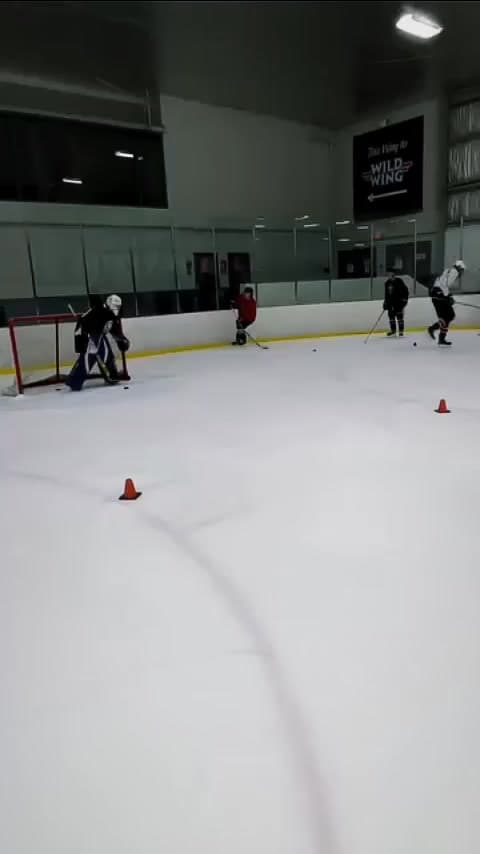
Reading the play from behind the net: movement, awareness and being ready to strike when the puck comes out front.
The Box Game from Brad Flynn is a small area game that works on quick decision making, transitions, give & goes and net front play. Setup - Teams line up at the blue line. - Coach dumps a puck in the corner, which starts an in zone 2 on 2. - The 3rd person in each line jumps into the zone at the point and they are the "slide player" at the blue line. They are allowed to go to the boards, to the coach. The slide player can pass or shoot. - Anytime there is a change of possession, the team that got the puck must pass to their slide player and work to get open, or get to the front of the net. - Part 2 progression option: Coaches can move the slide players up to the tops of the circle, so there is a smaller amount of space, which will require quicker decision making and give the slide players more opportunities for quick shots to the net. Variations - Can reduce the playing area as shown in the video - Can make this a 2 v 2 or 3 v 3 game.
The Tomas Holmstrom Small Area Game from Spiros Anastas is a competitive net front battle drill designed to teach offensive players how to get inside for screens, tips, and rebounds while defenders work on box outs, containment, and blocking shots. A shooter fires from the top of the circles as players fight for positioning inside a defined box. Drill Setup - Draw a box from just inside the dots and hashmarks up to the top of the circles and back down to the goal line. Drill Setup - Players: Drill Setup - 3 offensive players inside the game - 2 defensive players with the option to add a third to increase difficulty or emphasize shot blocking - 1 shooter positioned outside the box at the top of the circles Drill Setup - Place 5 pucks outside the box for five consecutive reps. Drill Setup - On each whistle all offensive players must tag up outside any boundary of the box which can include the goal line, the sides, or the high line. Defenders do not tag up but must track where attackers enter. The shooter can only shoot after the whistle but may delay to wait for a screen or tip. Shots only with no direct passes. After five reps switch offense and defense and keep score. Coaching Points - Offense: Coaching Points - Defense: Coaching Points - Shooter: Coaching Points - Goalie: Variations - Can make it 3 v 2 or 3 v 3 - Can require the defenseman to shoot further away - Can allow the defenseman to pass for redirects or one timers Variations - View more drills and content from Spiros Anastas
Neutral Zone
3A fun race that works on edges, tight turns and body positioning. Rewards the winner with a shot. Variations - Left Turn - Right Turn - Forward to Backwards - Backwards to Forwards - Side Jumps
Danny Heath, founder and head coach of Project Hockey, shares habits for passing into space, following his on-ice presentation at TCS Live Minnesota.
This is a neutral zone drill that is great for players to work on reading the pressure and quickly escaping to create offensive opportunities. - SETUP: Setup - To set up this drill, there should be a net on the red line with its back towards the wall. A coach off to the side of the circle with a pile of pucks and a line of players starting at the middle dot. - There should be two tires just off of each post and the first defensive player should be just in between those tires. - HOW THIS DRILL WORKS: Setup - To start the drill, the coach will pass a puck to Player 1 whom is in between the two tires and they will pass it to the first player in line (Player 2). - Player 2 will turn their back to Player 1 who is then picking a side and applying pressure to Player 2. Player 2 will read which side the pressure is coming from and then escape out and around the tire to take a shot. - Player 1 then becomes Player 2 and Player 2 goes back into line. - COACHING POINTS: Setup - The main piece of this drill is that the players are reading which side the pressure is coming from and then as quickly as they can escape around the tire to create a quick offensive scoring chance.
Power Play
2The Designated Shooters Umbrella Power Play Game engages a lot of players at once, and encourages puck movement, and battles in front of the net. The game can be played 2 v 2 or 3 v 3, and you can modify the game to have 2 or 3 point players. Setup - Place nets back to back inside the zone. - Set up 3 "Umbrella" point players at the point on each sides of the ice. - Set up a 2 v 2 or 3 v 3 game inside the zone. - On the whistle, coach chips the puck into the zone and the players battle out 2 v 2 or 3 v 3. - Players are encouraged to use their point players for give and gos, one timers, and tips in front of the net. Variations - Can set the game up to only have 2 point players instead of 3. - Can play 2 v 2 or 3 v 3 inside the zone. - Can award 2 points for a goal off of a one timer.
Defenseman Brad Hunt working the low-high look: skate from near the boards up to the middle of the offensive zone after receiving the puck, and get the shot away before the lane closes. Forwards drive the net front to screen and hunt the rebound.
Small Area Games defensive zone
1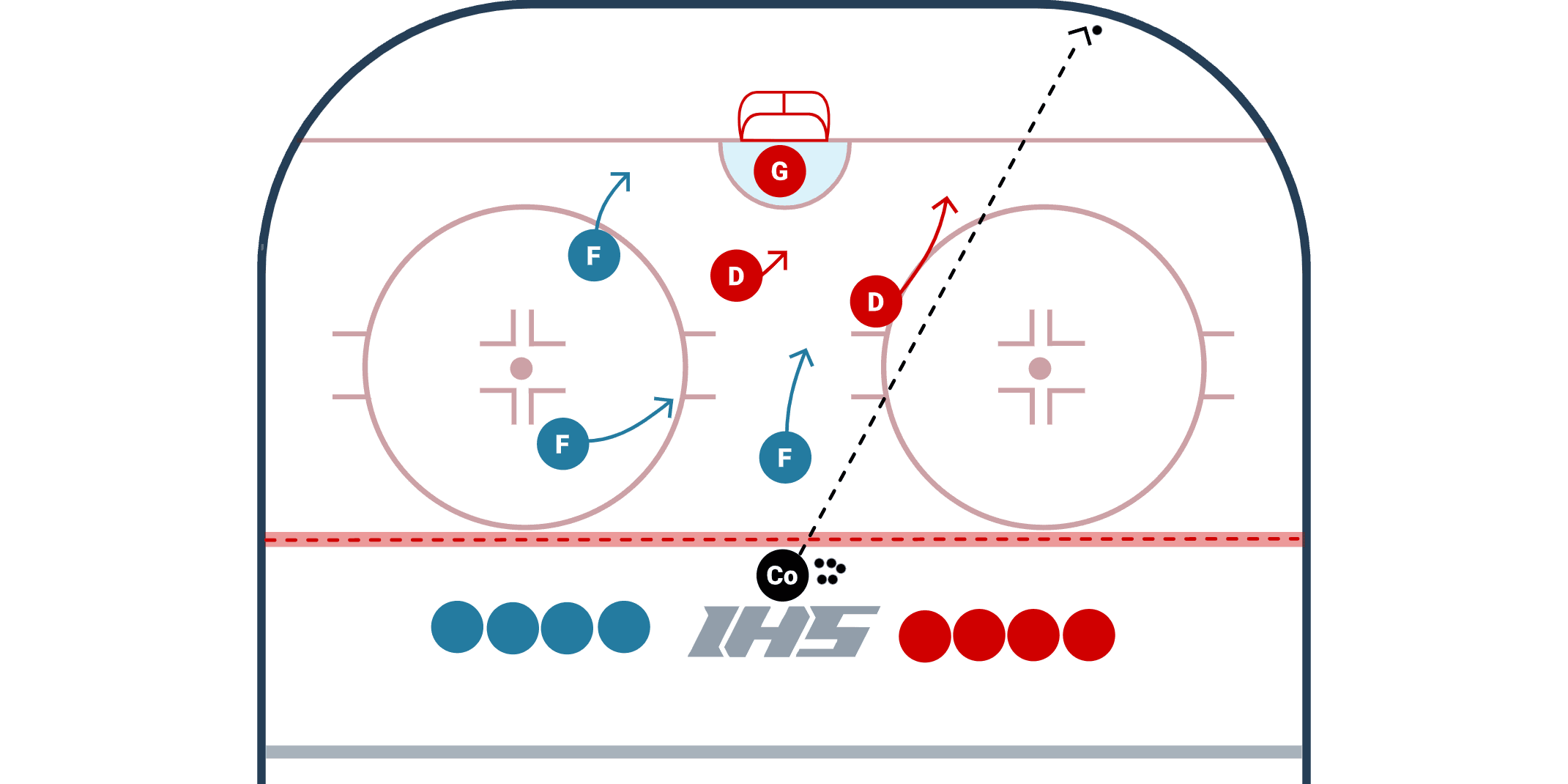
Small Area Game
8
Shooting from the boards is a low percentage play if you're trying to score on the first shot. It happens! I witnessed it against my team just the other night in fact. But what it's really good for is creating chaos in front of the net. That said, if we can shoot from the low slot, that's a higher percentage play, right? The problem is that we have to get the puck there first, and the other team also knows it's a higher percentage play. So let's combine the two. I wanted a simple small sided game that focuses on wall play under pressure. Let's get it off the wall and into the middle of the ice for a higher percentage chance. And if that's not available? Let's keep the defenders honest.
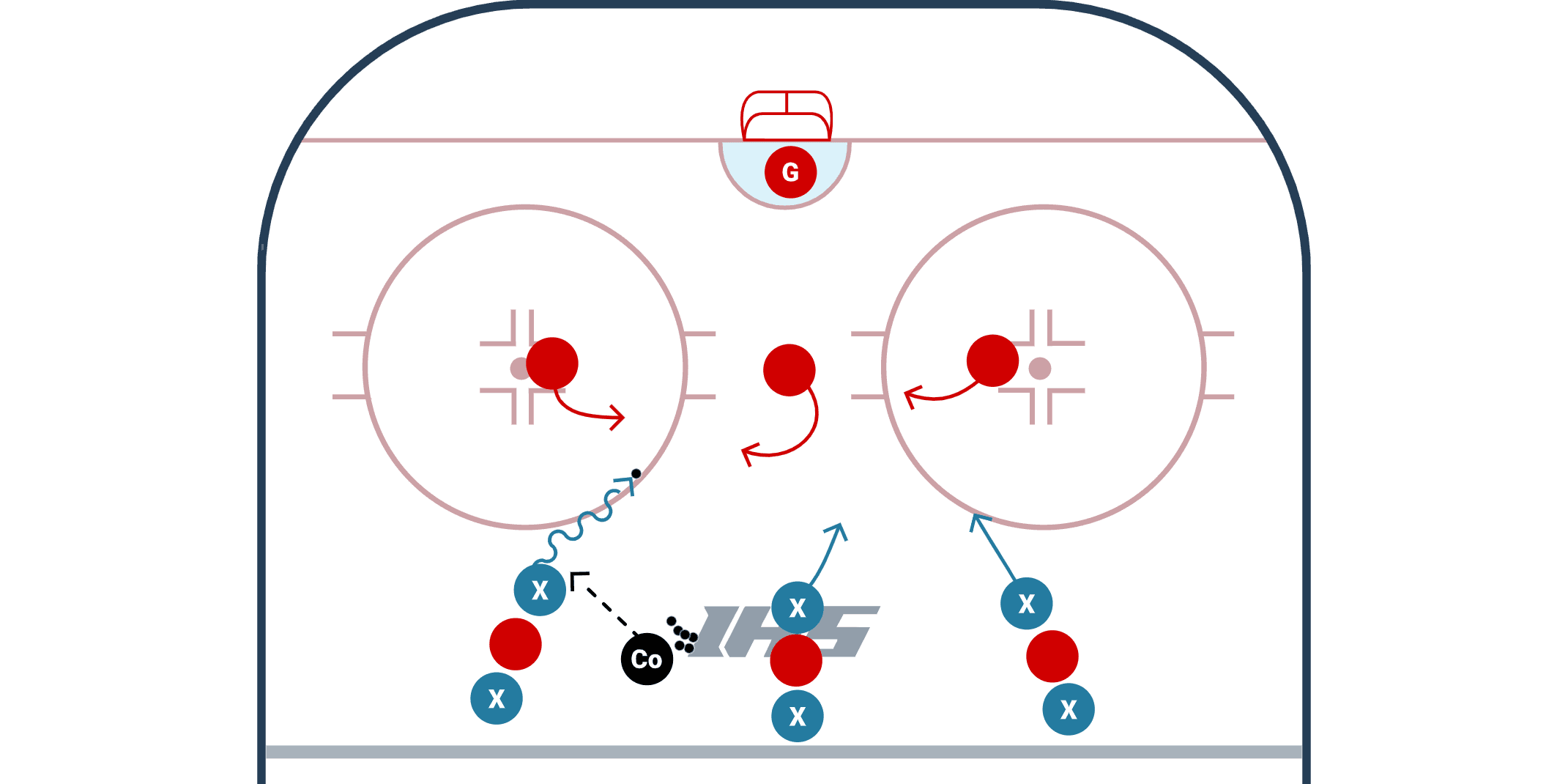
The 3 on 3 Transition Game from Cail MacLean is a high tempo 3 on 3 small area game that encourages quick offense. Variations - Can play 3 on 3 in zone (as shown), or 2 on 2 half ice, or 2 on 2 quarter ice, or 1 on 1 quarter ice. - Can have players line up in different areas of the ice (tops of circles, blue line, center ice, etc).

4v3+1 with the dot lanes marked with the industrial strength sharpie
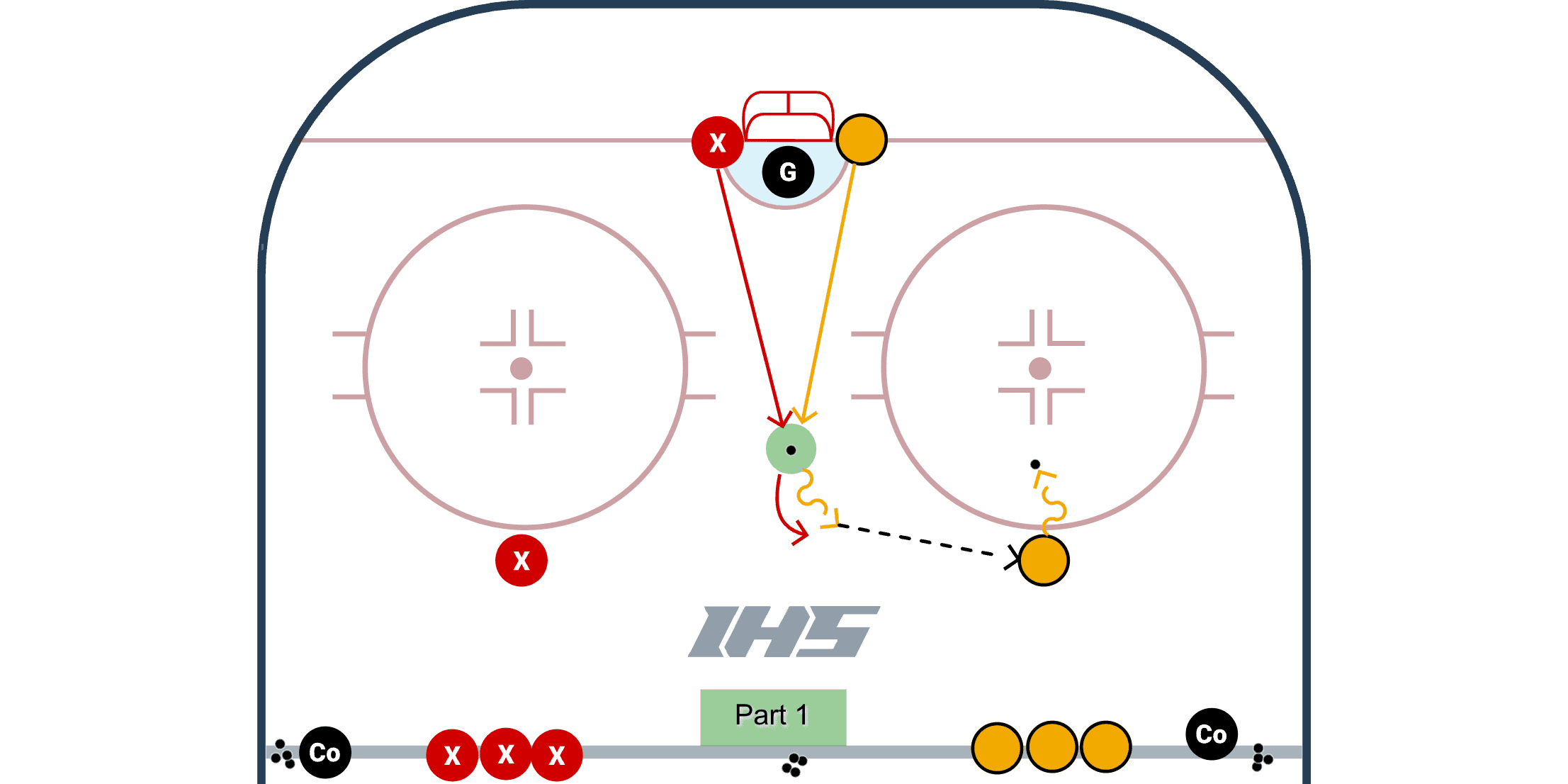
Objective The Brooksy Utah Mammoth from John Dean helps players develop competitive habits for winning loose pucks, cutting through an opponent’s hands, and making the next play immediately. The drill progresses from a puck race into a quick 2 vs. 1, followed by a rim retrieval under pressure and a 2 vs. 2. Variations - You can have the last players in line on both sides of the ice be the person who rims the puck instead of the coach. - Coaches can place the puck race in different areas of the ice. - Coaches can place the support players in different areas of the ice.
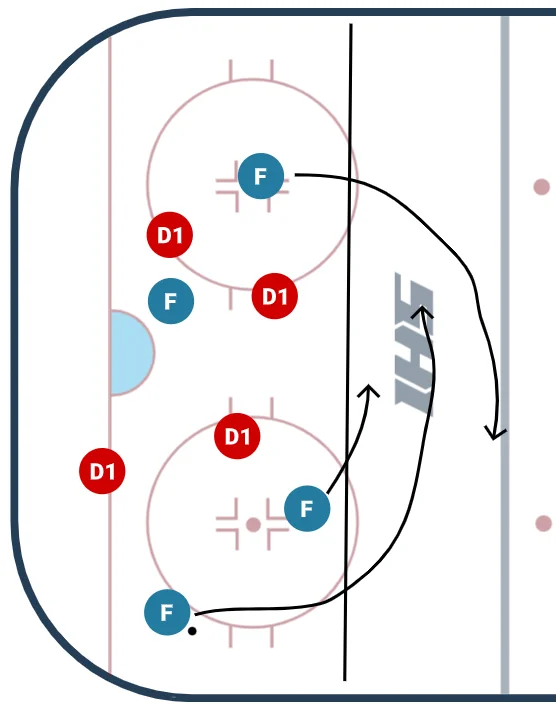
4v4 3 in High Ice SSG 1 net, 1 endzone game On change of possession, at least 3 of 4 players must get above the line before attacking downhill Highlights high ice possession and elements of creating confusion through high ice actions
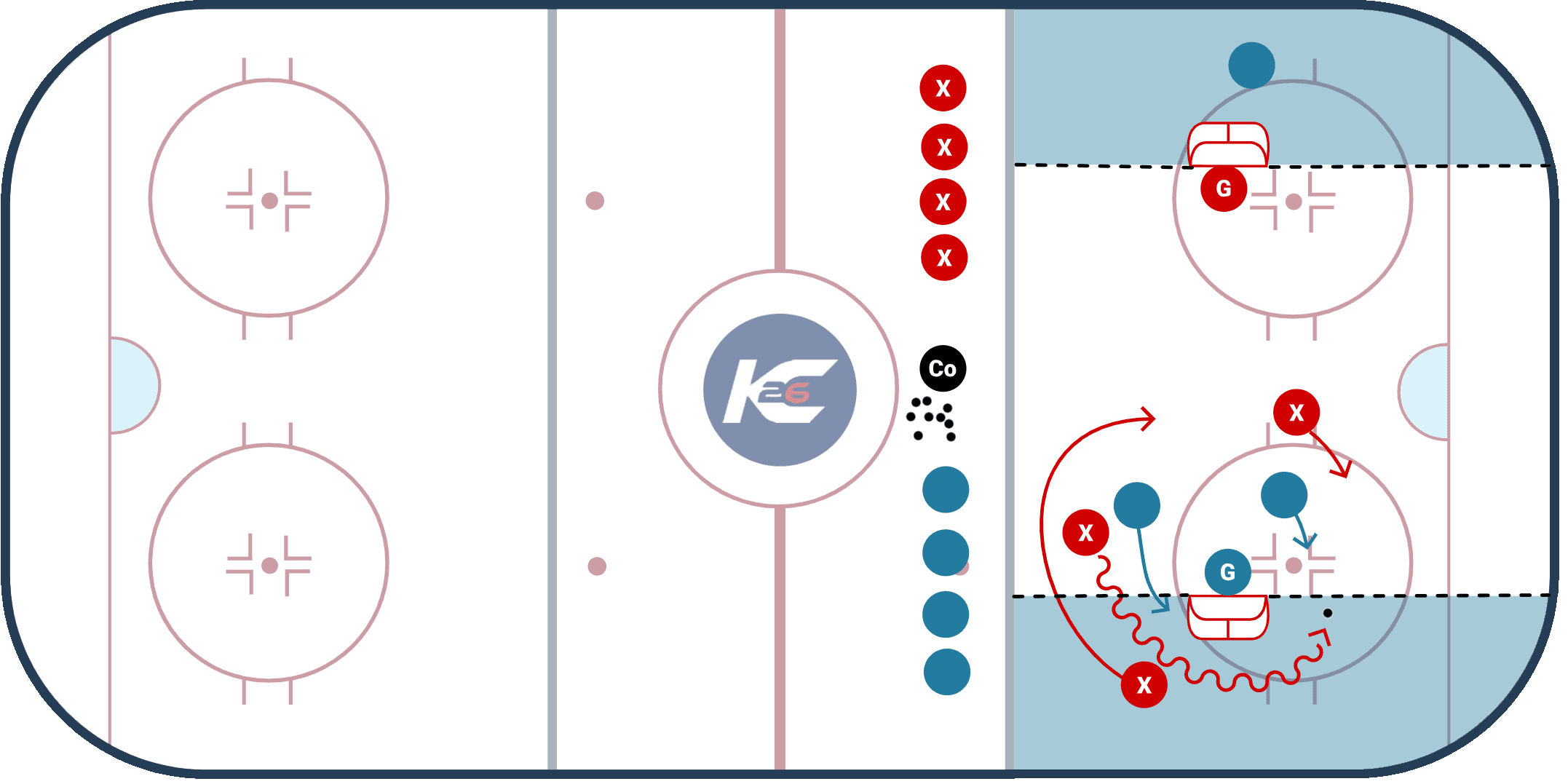
The Gretzky 2 vs. 2 Switch game from Kendall Coyne Schofield is a great small area game that has a modification to the normal Gretzky 2 v 2 Game: the "Gretzky" behind the net can switch with active players at any point, so long as at least one player is behind the goal line. This modification allows more options for player to create offense and encourages exchanges and switches. - In a half ice setup, place two nets facing each other in opposite face off circles. - Have a 2 vs. 2 in the middle of the ice. - Each team has 1 player behind the net in their offensive zone. They can not go in front of the net unless one of their 2 teammates activates a switch - To start, coach can pass a puck, take a shot on net, or chip it in the middle of the ice for a battle. - Keep score! - Offensive players: - Players in the middle of the ice: work on give and go's and exchanges with your teammates and your "Gretzky" - Players behind the net: know where you want to pass to before you get the puck. Use the net as protection and get creative. Communicate with your teammates on opportunities you can create through switches - Defensive players: - Head on a swivel and know where all of the players are. - Keep stick on ice to block passing lanes. Variations - Can be 2v2 or 3v3 in the middle of the ice - Can allow 2 "Gretzky's" - Can require players to only hold the puck for 1 or 2 seconds or a whistle is blown
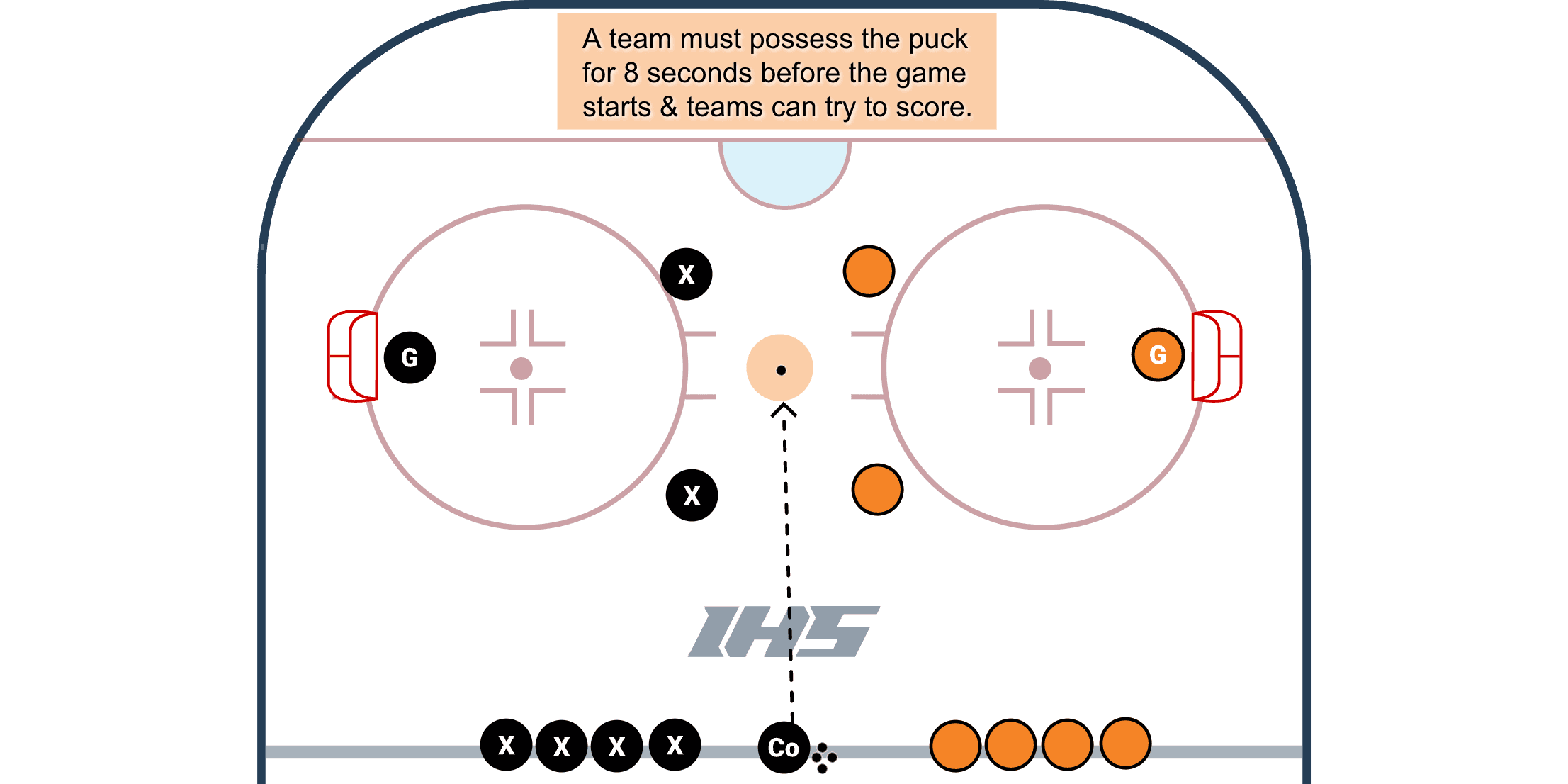
Objective Ride The Bull is a small area game from Matt Thomas that works on developing puck protection and possession skills under pressure. Teams must protect the puck, use their teammates, and keep possession for 8 seconds. If they are able to accomplish this, they are awarded a 3rd teammate and each teams begin game play to try to score on the opposing teams net. Variations - Can play 1v1, 2v2, or 3v3 - and the winning team is awarded an extra player. - Can change up the amount of time required to hold the puck on to.
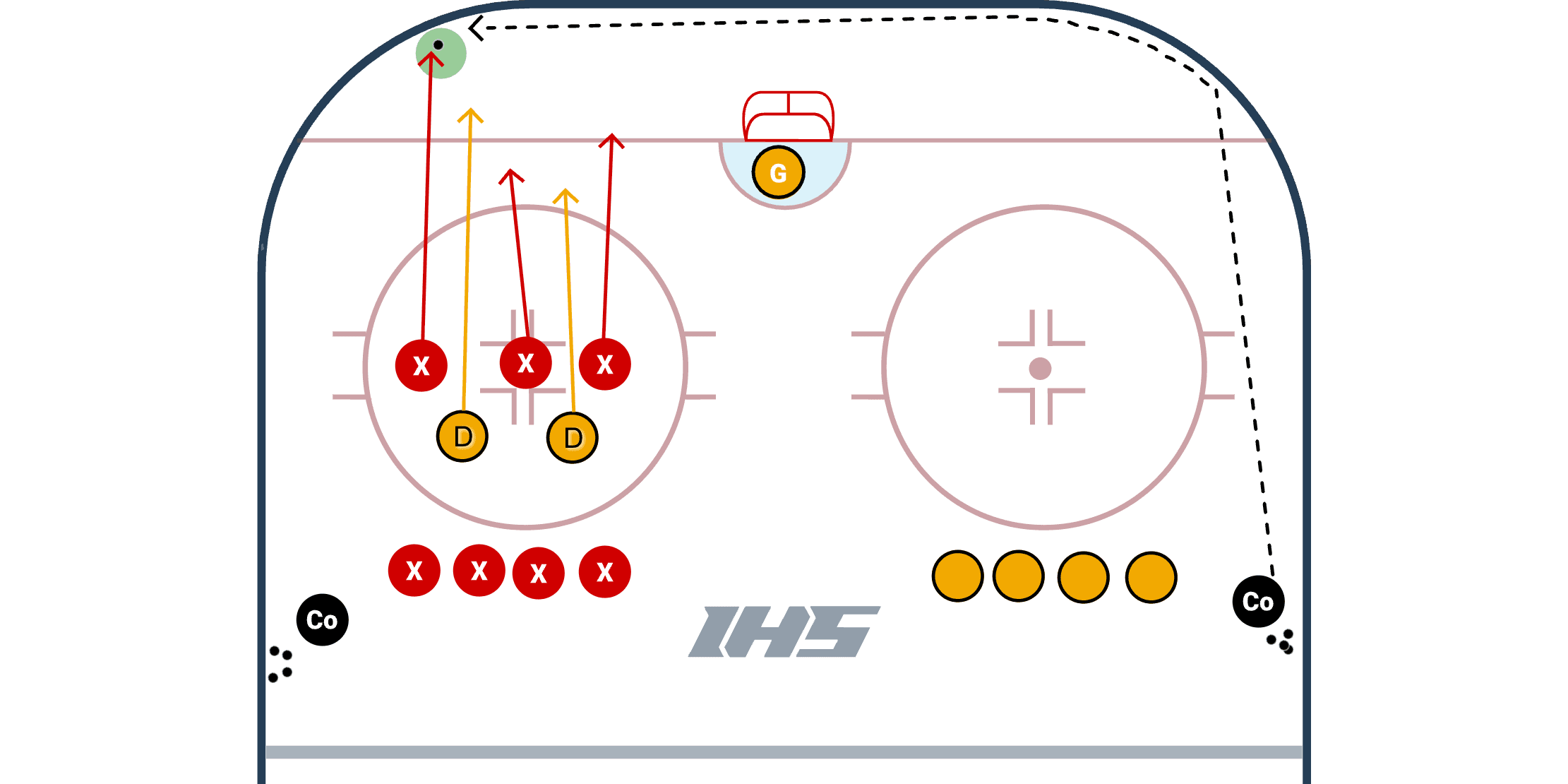
Objective The Yellow Runner Rally from John Dean teaches players to retrieve a contested rim, establish immediate support, and transition from a contested puck battle into offensive-zone possession. Once possession is earned, the three attackers form a possession triangle and use their numerical advantage to keep the offensive zone alive.
Puck Protection & Wall Play
1Forecheck
2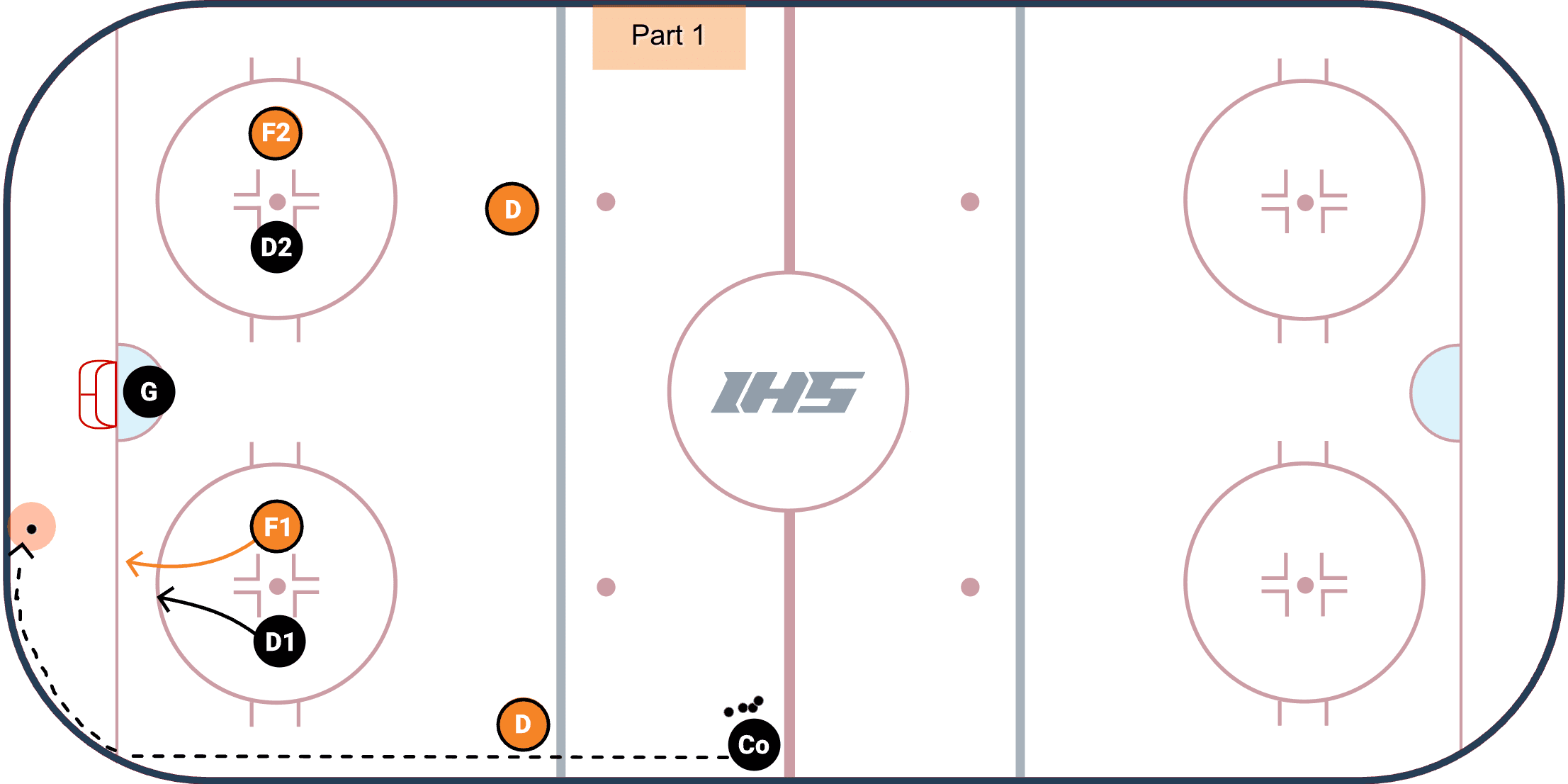
Objective Battle Creek 2 on 2 from Matt Thomas helps players develop puck protection and strong-side escapes from below the goal line, along with transitions and regroups to rush attacks. The drill also teaches defensemen to regain their gap through the middle, and defend while staying connected. Variations - Can make this 3/4 ice or 1/2 ice.
Objective The Yellow Runner Rally from John Dean teaches players to retrieve a contested rim, establish immediate support, and transition from a contested puck battle into offensive-zone possession. Once possession is earned, the three attackers form a possession triangle and use their numerical advantage to keep the offensive zone alive.