
All global drills
1 v 1 Use The Net
1-on-1s
Puck Protection & Wall Play
Battle Drills
Ice Hockey Systems
Global
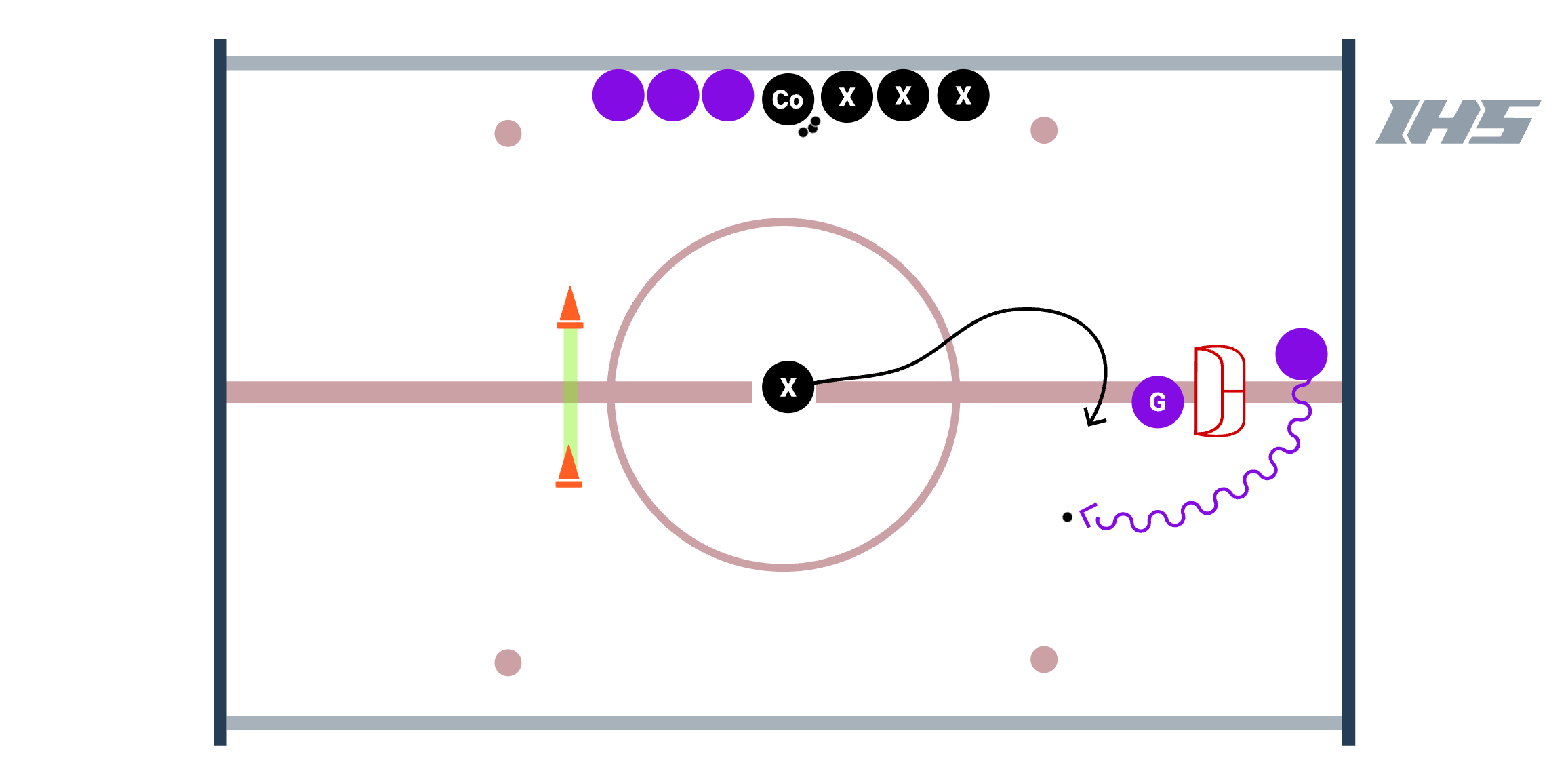
1 v 1 Use the Net from Jason Lammers is a great drill for all age levels that encourages offensive awareness and puck protection while the defenders work on angling and proper stick detail. The offensive team is trying to skate the puck through the gate while the defender is looking to strip the puck and score on net.
Setup
- Setup a net and a gate as the goals. These can be placed in center ice like the video displays, or in other areas of the ice.
- A defensemen starts with the puck behind the net.
- A forechecking forward starts in the middle of the playing area and tries to angle the defender to one area of the ice.
- The defender keeps their head up, uses the net to protect the puck and tries to skate through the gates.
- If the forward strips the puck, they try to score a goal on net.
- After the rep the forward rotates to defense, the defender rotates out, and a player from the line sets up behind the net.
- Keep score! 1 point for a goal through the gates and 2 points for a goal.
Variations
- Can set this up in different areas of the ice.
- Can use tires, cones or gloves to create the gate.
- Can make the gate larger (makes the game easier for the breakout team) or smaller (makes the game harder)
- Can progress this to 2 v 2, so that the defensive team has to work together to break the puck out and the forechecking team can work together to stop the breakout.
- Can progress this to the in zone net and these two options: 1 v 1 Puck Retrieval to 2 v 1 from Jason Lammers 2 v 1 Use the Net drill from Topher Scott
- 1 v 1 Puck Retrieval to 2 v 1 from Jason Lammers
- 2 v 1 Use the Net drill from Topher Scott
Coaching points
- Make sure both players keep their heads up to read the play.
- The forward that is forechecking should create an angle to try to force the defender up one area of the ice.
- The defender should use deception to fake out the angling forward and create time and space.
- The defender should wait until the forechcker gets close to the net to make sure they do not give away what side of the net they plan to go too early.