
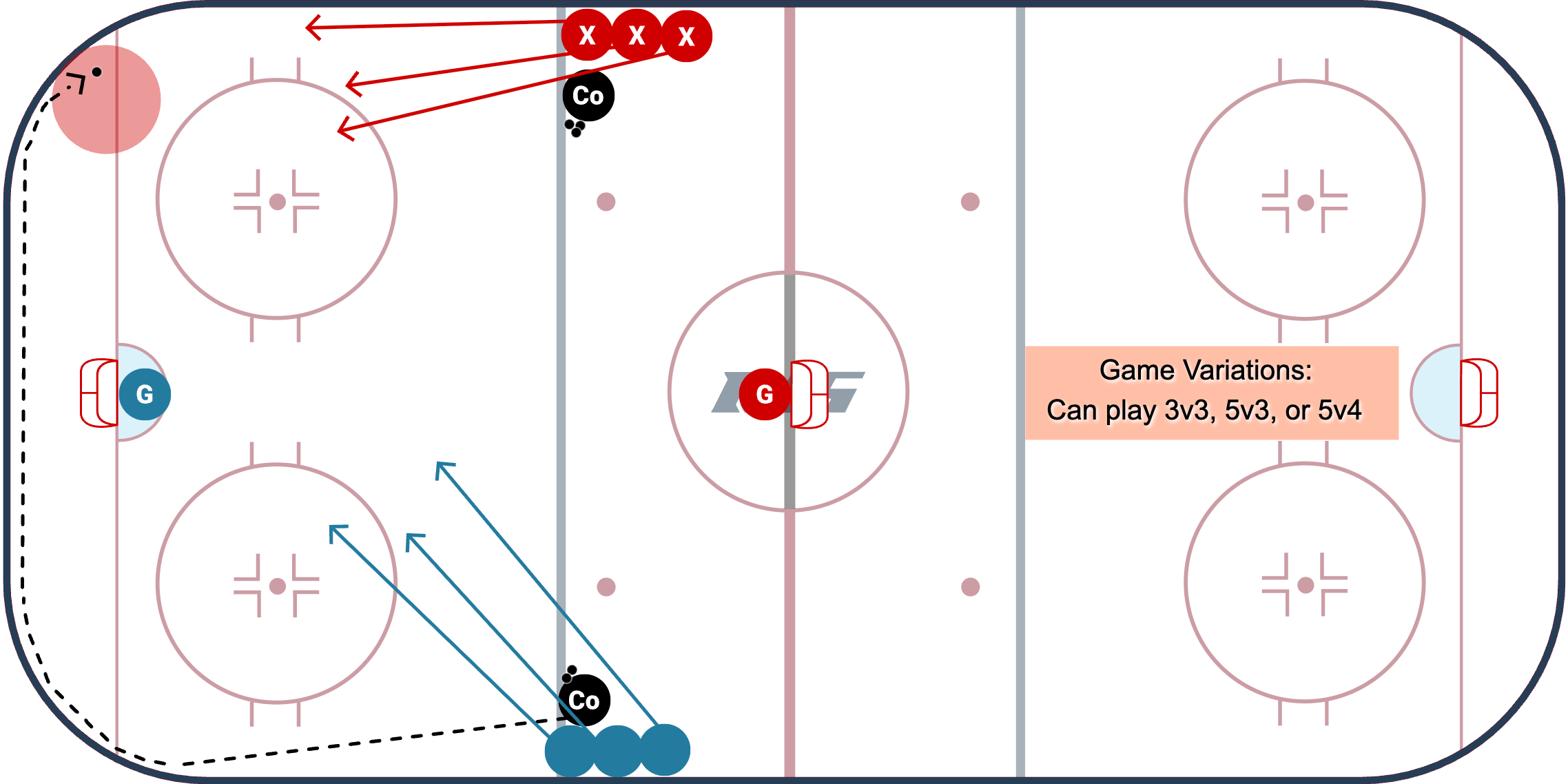
The Corner Houda from Dave Smith focuses on puck retrievals, wall play, quick transitions, and structured zone play. It offers flexibility for various d-zone and special teams scenarios by changing it up from 3v3 to 5v3 to 5v4.
Setup
- Two coaches positioned on opposite sides of the blue line to initiate a rimmed puck.
- Players are split into offensive and defensive groups—typically starting 3v3 (but can expand to 5v3 and 5v4).
- Puck is rimmed around the boards to initiate a battle.
Execution
- First three players from one side retrieve the puck and start on offense; three from the other side defend.
- Offensive group gains possession and attempts to create a scoring opportunity.
- Drill is repeatable with different number combinations: 3v3, 5v3, 5v4 (PP/PK), etc.
- Defensive group must pass or skate the puck over the red line to transition out.
- Can include a net and goalie at the red line for breakout scoring opportunities after defensive transition.
Progression
- Start with 3v3 for basic wall play and transition work.
- Advance to 3v5 to work on defensive zone returns and structure (slot, net front, strong side wall).
- Incorporate special teams scenarios: Power play (PP) starts with puck possession. Penalty kill (PK) may retrieve puck and clear or attempt to shut down the PP setup.
- Power play (PP) starts with puck possession.
- Penalty kill (PK) may retrieve puck and clear or attempt to shut down the PP setup.
Variations
- Use variations (3v3, 5v3, 5v4) to target different systems and teaching points.
- Can have the defensive group must pass or skate the puck over the red line to transition out or you can include a net and goalie at the red line to give the defense a chance to shoot on net.
Coaching points
- Emphasize strong wall play and puck retrieval skills.
- Work on defensive structure under pressure—good layers, net front presence, and slot coverage.
- Reinforce good defensive habits - keeping sticks on the ice to block passing lanes and angle the forwards to the outside of the ice.
- Encourage communication and awareness for both forwards and defense.