
Global tactics library
Rush
6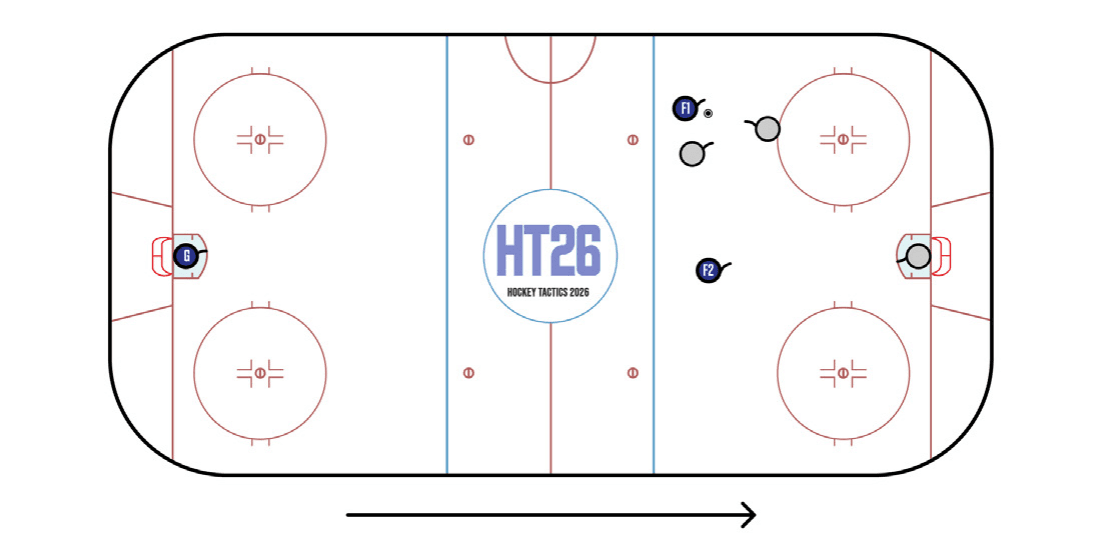
2v1 rushes are few and far between, but a savvy offensive player can manufacture 1v2s multiple times per shift. By baiting a double-team, F1 effectively creates an odd-man situation elsewhere on the ice. Over time, players who consistently excel in 1v2 situations force opposing players to defend more passively, which creates more time and space to extend the possession.
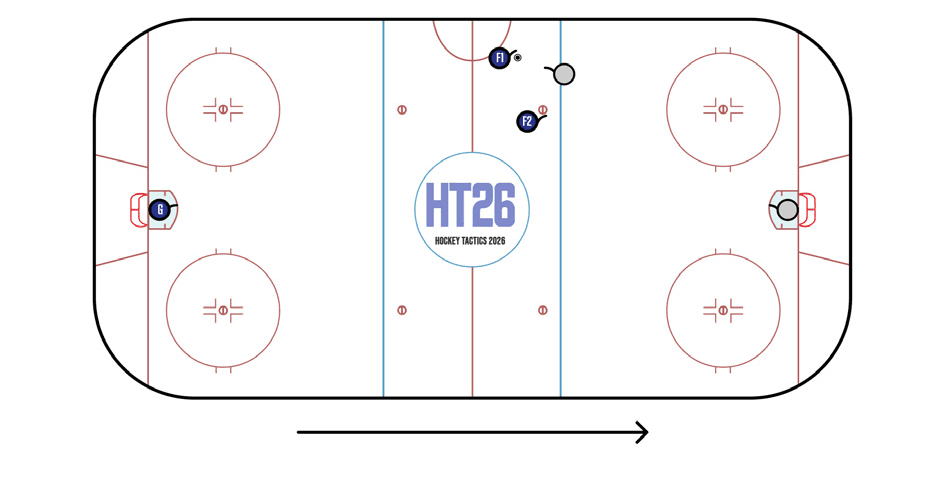
A 2v1 rush is one of the highest-value offensive plays in hockey and also one of the trickiest to execute under game pressure. It’s a good idea for F1 to make an early pass to F2, as a lateral play forces the lone defender and the goaltender to adjust their angles ahead of the critical moment. About two-thirds of 2v1s do not result in a goal. Acting decisively and promptly will ensure the best possible outcome.
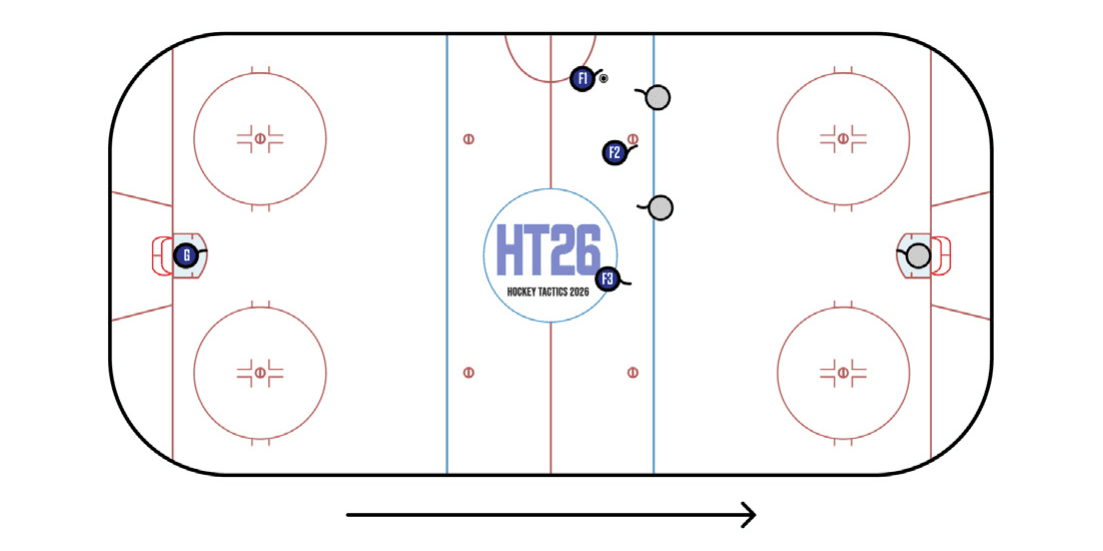
There are two likely scenarios on a 3v2 rush, both calling for F1 to stay wide and bait the strong-side defenseman outside the dot lane. 1) Strong-Side 2v1: As F1 drifts toward the boards, F2 stays in close support to create a 2v1 while F3 sprints to the back post as a tap-in option 2) Middle Drive: F2 accelerates and drives the net between both defensemen while F3 cuts into the high slot for a catch-and-shoot opportunity
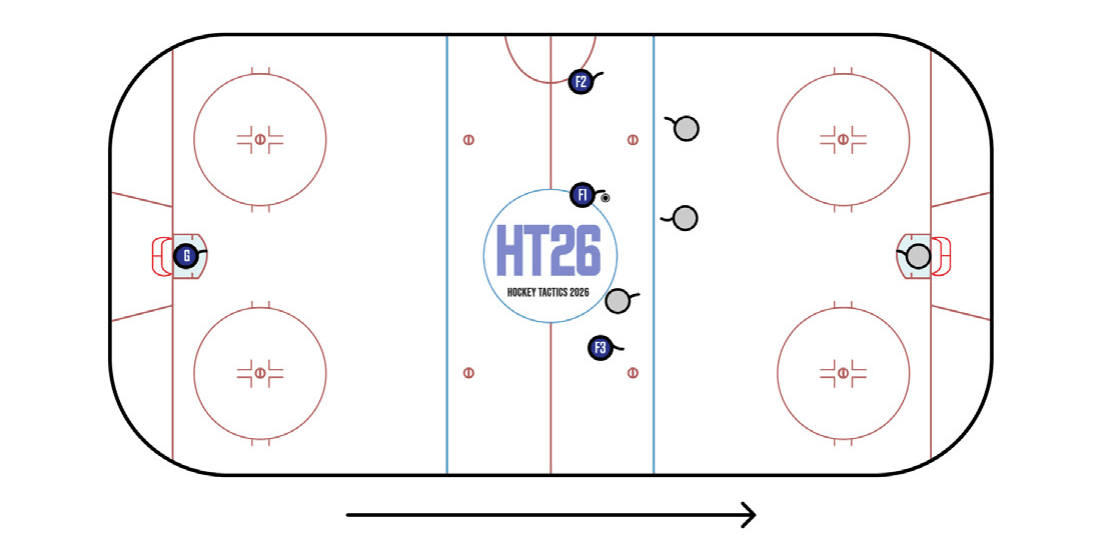
All else being equal, carrying the puck through the middle drastically improves the attacking team’s ability to threaten the net immediately after crossing the blue line. By entering the OZ between the dots, F1 forces both Ds to collapse to the middle and invites the first backchecking forward to overcommit. Meanwhile, F2 is an easy target for a kick-out pass while F3 has an opportunity to win a foot race to the back post.
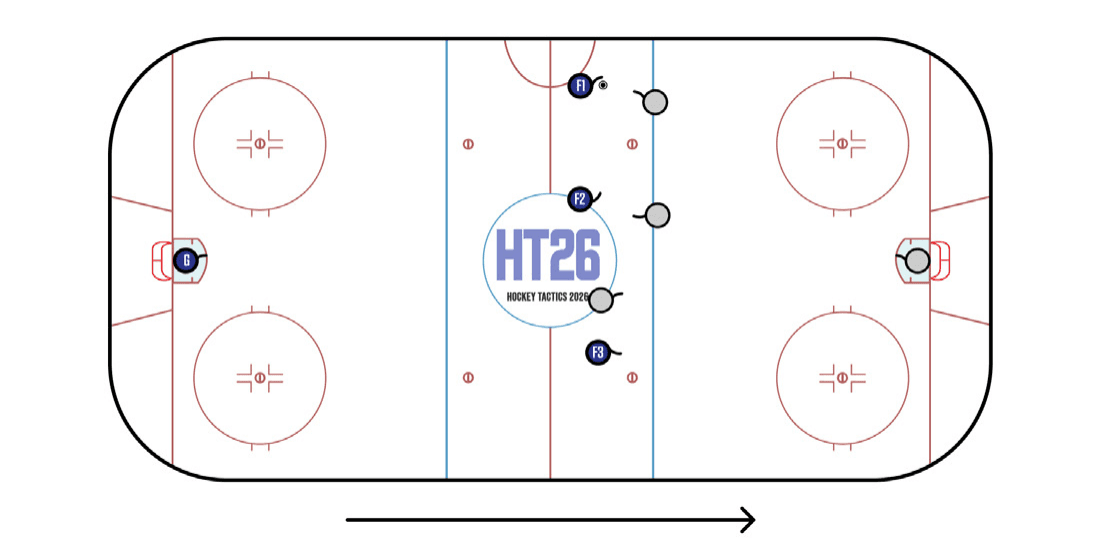
It is difficult to create a rush chance without a numerical advantage. The odds are especially against a puck carrier attempting to enter the offensive zone from outside the dot lanes, the two invisible lines running end-to-end that separate the perimeter and the middle of the rink. If defenders maintain man-on-man coverage, the attackers will likely have to dump the puck in, else risk a costly turnover.
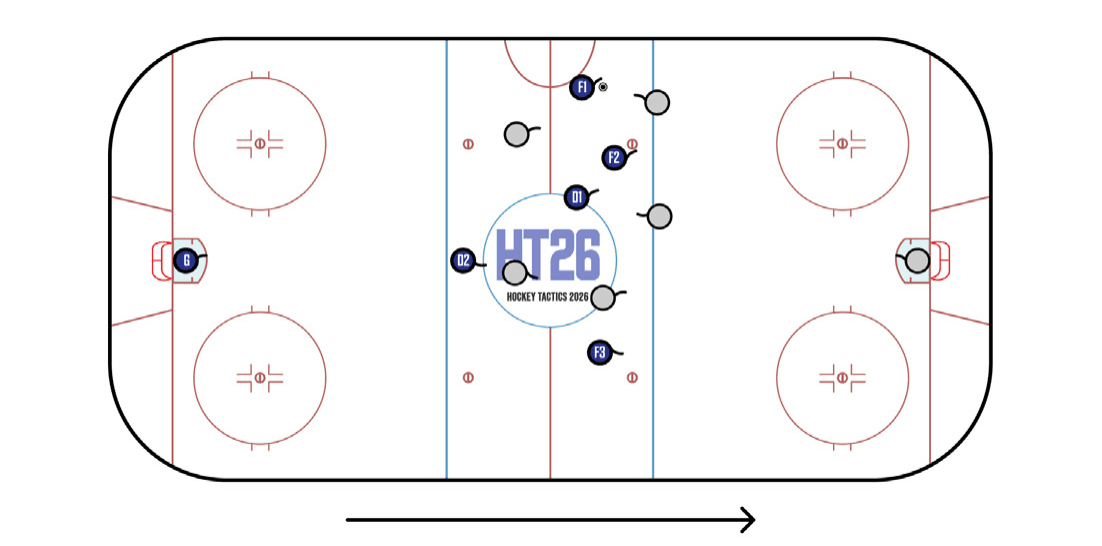
As NHL defensemen become more mobile and offense-minded, teams are giving them permission to join the rush and turn a typical 3v3 line rush into a 4v3. D1’s presence in the middle allows F1 and F2 to overwhelm the strong-side defenseman and create a mismatch on entry. Note that D2, the last man back, may have to defend a 2v1 against if the attacking team turns the puck over at the blue line.