
Global tactics library
Offensive Zone Forecheck
10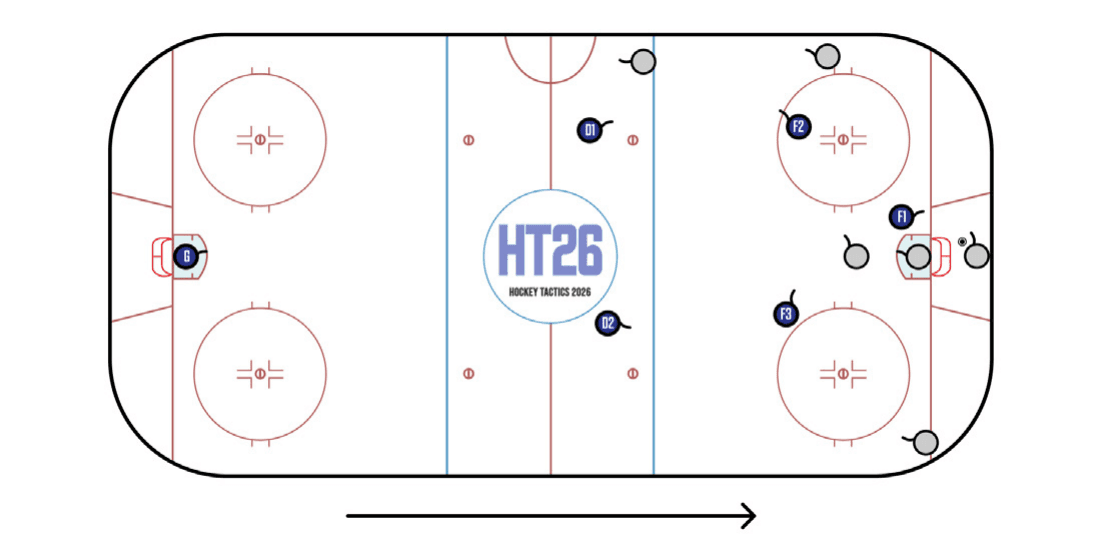
A Set Forecheck is used against a Set Breakout, where the opposing puck carrier stops behind the net and their teammates run predetermined routes up-ice. The defending team has two major decisions to make: 1) Does F1 chase behind the net? 2) Do the other four players attach to individuals in man-on-man coverage or fall back as a unit in zone coverage?
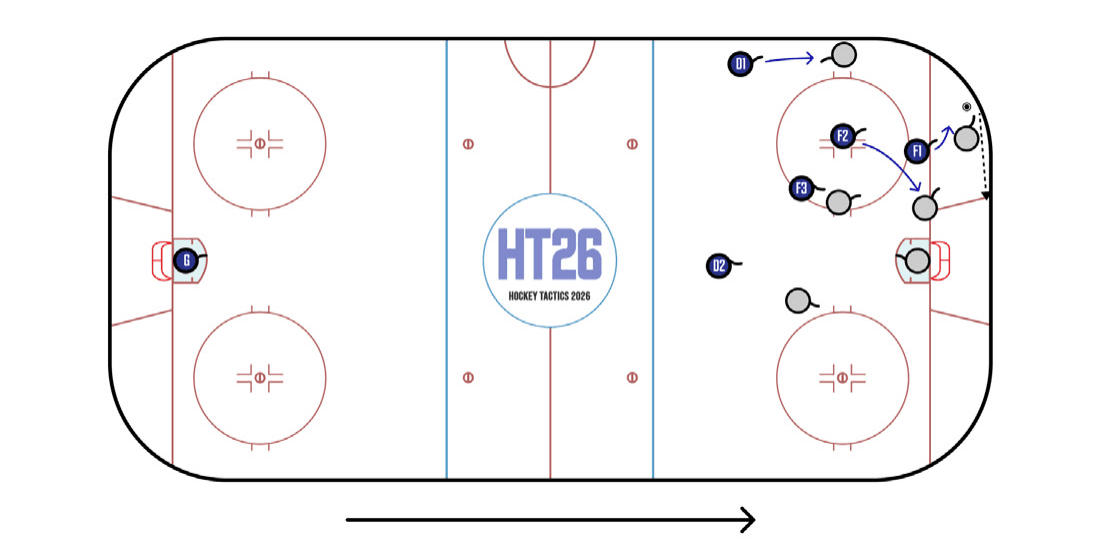
As attackers become more skilled and tactically fluent, forecheckers adjust by dialing up their aggression. The now-popular Skinny variant of the 1-2-2 calls for forwards to attack the puck carrier in a narrow column. If F1 is beaten by a D reverse, F2 jumps on the pass recipient. F3 stays above and acts as backup. Ds are responsible for wide exit attempts, and pinch against rim plays.
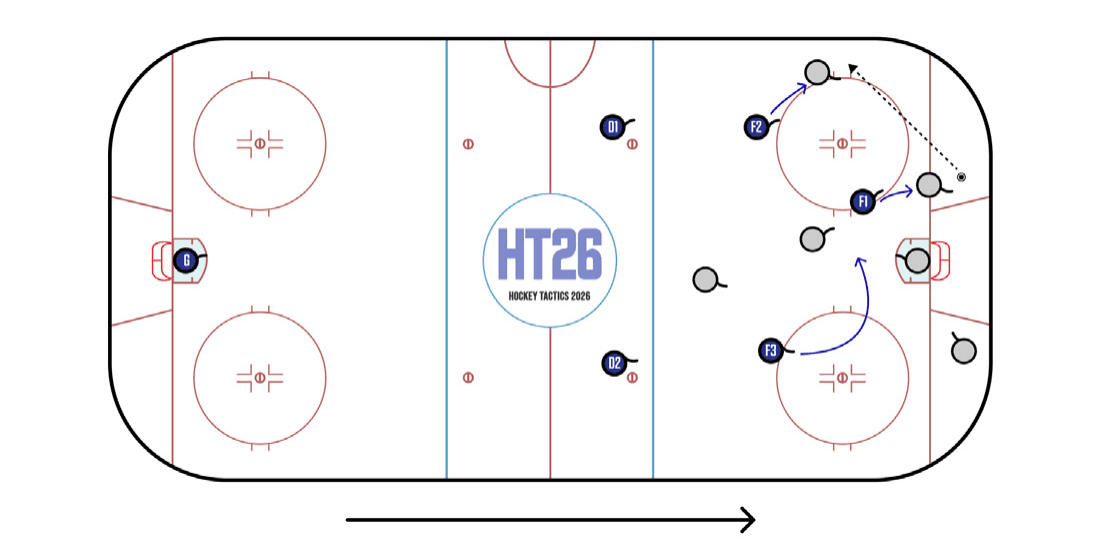
The 1-2-2 is the first forechecking formation minor hockey players learn as well as the most popular one in the NHL. The main difference is F1’s behavior. At lower levels the first forechecker approaches the opposing defenseman cautiously and angles them toward the strong-side boards. In the NHL, F1 is a heat-seeking missile that locks onto the puck retriever and attacks them in a straight line. The difference in execution is due to the professional player’s superior conditioning and skating ability. When F1 is beaten by a pass to the half wall, F2 and F3 are already on their way to kill the next play.
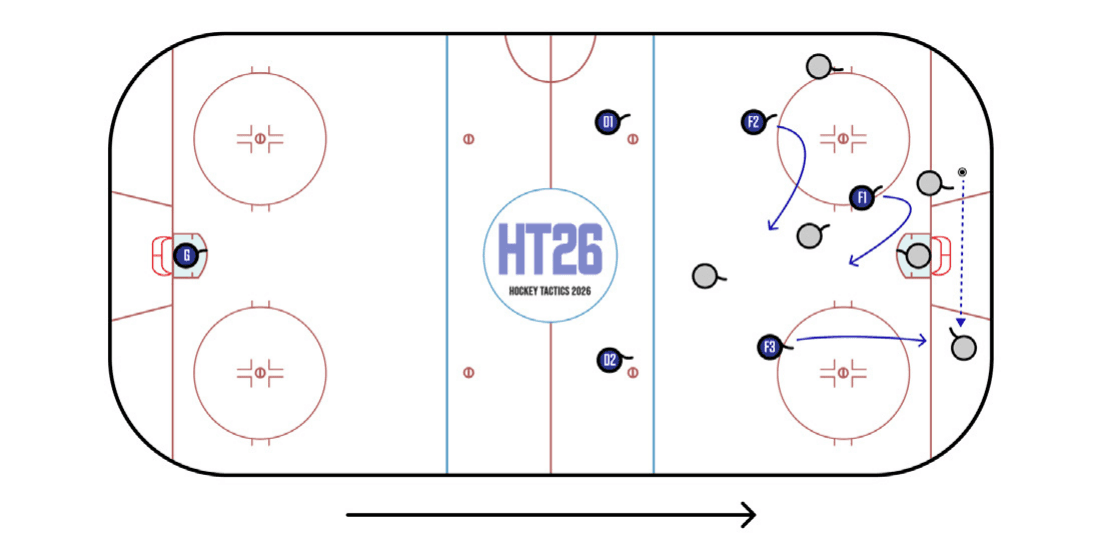
High level forecheckers are quick to exchange roles as the situation develops. As the opposing team goes D-to-D behind its net, F1 and F2 reload through the middle while F3 attacks the pass recipient, becoming the new F1.
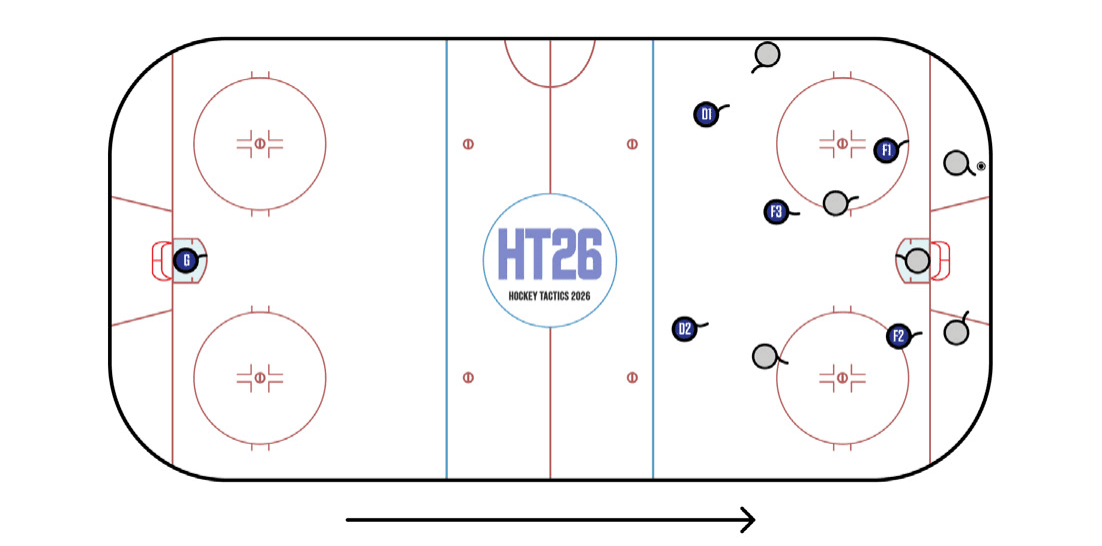
A 2-1-2 forecheck is man-on-man defense. Wingers (or F1 & F2) lock onto opposing Ds. The center (or F3) stays with his counterpart. Ds gap up to opposing wingers. This aggressive formation demands concentration, as dangerous gaps open whenever individuals are late to their checks. The 2-1-2 is most often seen following a faceoff loss, when forecheckers have an easier time attaching to their marks.
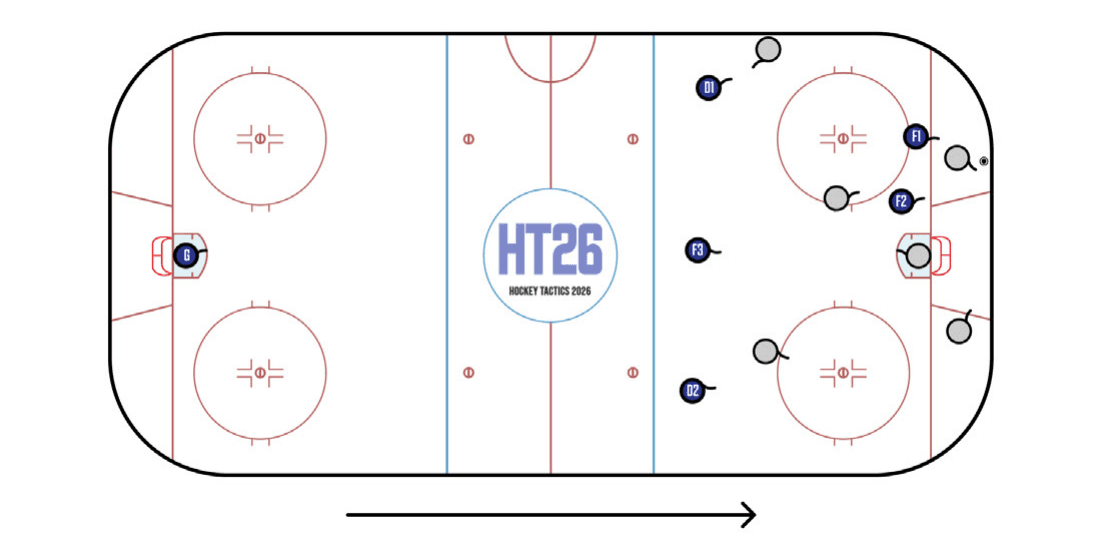
The 2-3 is versatile formation that can be deployed with aggressive or passive intent. F1 and F2 have the green light to hound the opposing Ds, even double-teaming a difficult retrieval if the opportunity presents itself. F3 stays high, along the Ds, to prevent odd-man rushes. The Achilles heel of this formation is the gap between F1/F2 and D1/F3/D2.

Early Tracking (or Reloading) is a habit that allows teams to forecheck in waves. The earlier and harder F1 and F2 sprint toward the neutral zone against a change of side, the more aggressively weak side players can hound the puck.
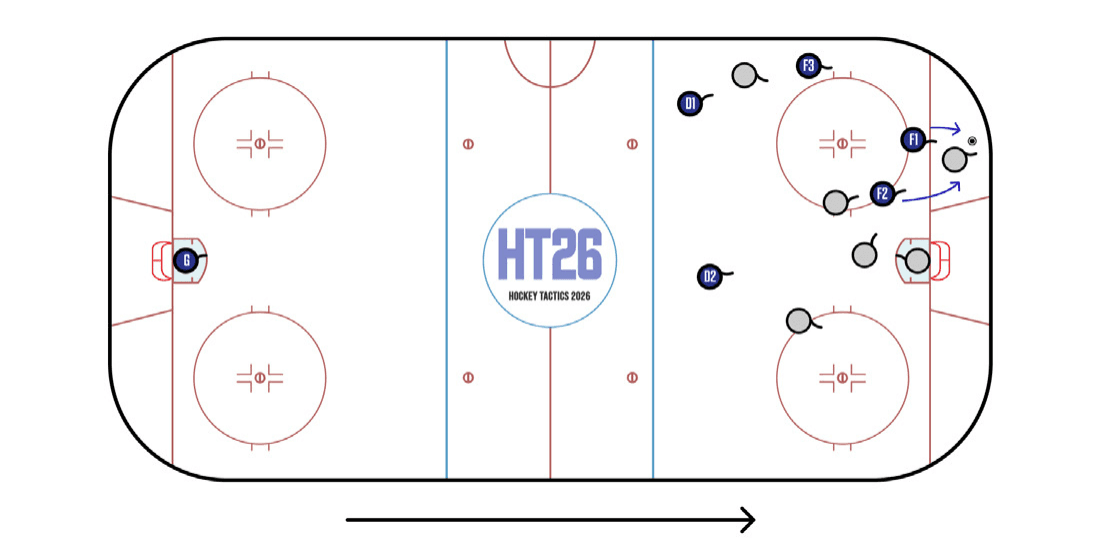
The One-and-a-Half is a development of the 1-2-2. As usual, F1 straight-lines to attack the puck carrier. F2, in the middle, reads the play and either stays above the low forward or double-teams the puck battle. F3 covers the strong-side wall. D2 is ready to pinch. This deceptive forecheck is difficult to counter, especially for teams with a below-average D corps.
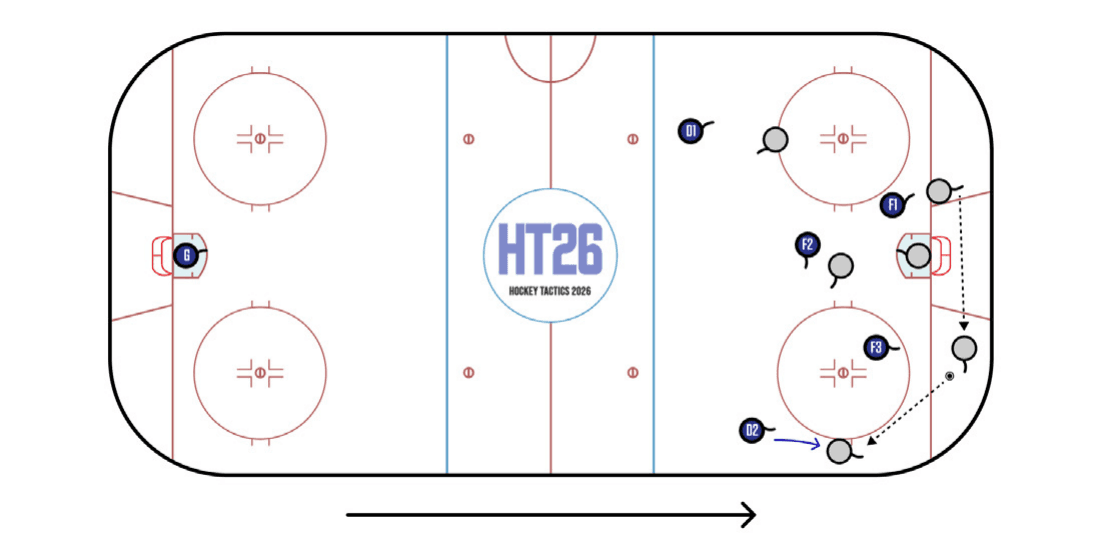
A generation ago pinching was considered a risky play by the majority of coaches. Today it is essentially a non-negotiable. Statistical analysis has confirmed the importance of shot suppression in driving team results. Shots tend to be preceded by entries and exits. The best way for a forechecking team to prevent an exit is to use its Ds to neutralize opposing wingers along the boards, before a breakout has a chance to materialize.
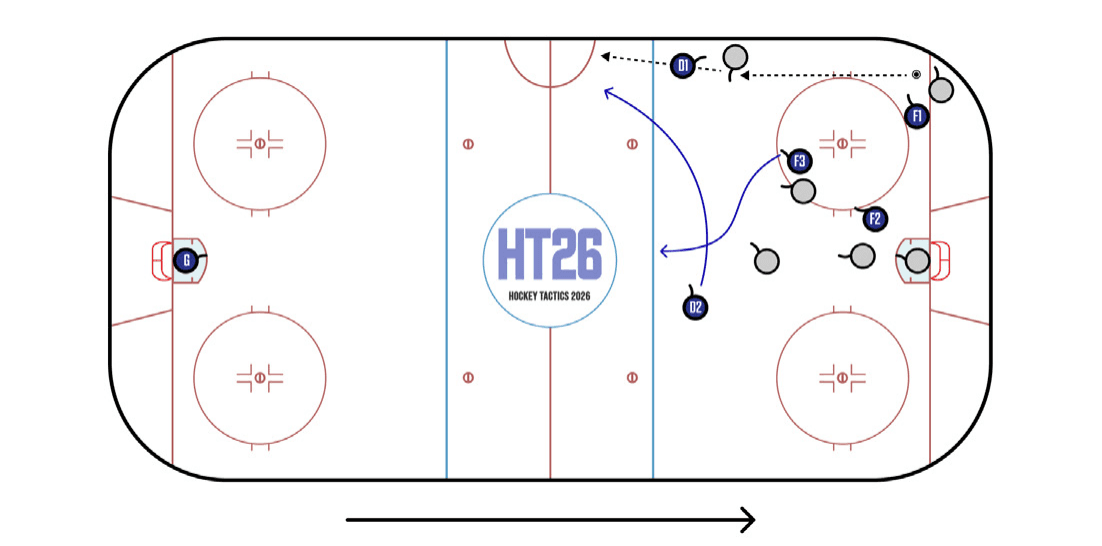
An indirect exit (high flip, glass-and-out, bump-by) can be a great equalizer against an aggressive forecheck. If D1 commits to a pinch and is beaten by an indirect play, D2 intercepts the puck on his partner’s side (a poach, in doubles tennis) while F3 takes over in the middle.